
Excluded Territory: Russia – Donbas Is Not Being Integrated
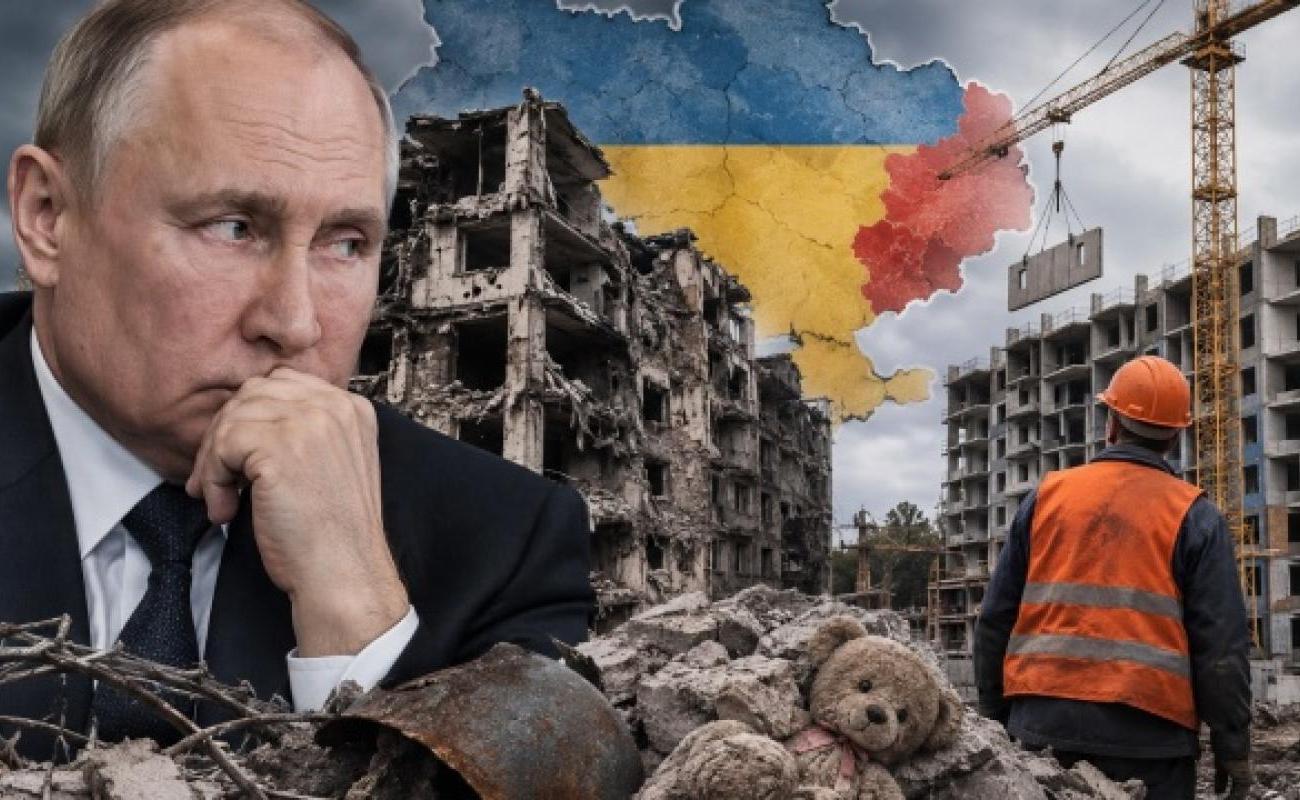
Why the Kremlin has once again had to postpone the "integration of the new regions"
Back in March of this year, during a meeting with Denis Pushilin—the head of the occupation administration in the Donetsk region—Putin highlighted the "good pace of reconstruction and development" in the area. Yet, by late October, one of Russia’s most ardent propagandists, Rostislav Ishchenko, effectively admitted that Russia no longer has any need for the Donbas’s industry and that no one intends to revive it. Another prominent "Z-blogger," Maxim Shevchenko, went even further, stating that the Kremlin had conquered the Donbas only to abandon it. So, what was the fighting for?
In reality, it has long been clear that the Kremlin’s occupation timeline has failed. Initially, Moscow had set a transition period for the so-called "new regions" lasting until January 1, 2026. By that date, the occupied Ukrainian territories were supposed to be fully integrated into Russia’s economic, financial, credit, and legal systems, as well as into the structure of the Russian Federation’s state authorities.
However, on October 30, the State Duma approved two laws extending the temporary regulations for the occupied Ukrainian territories—along with specific provisions regarding the application of Russian law—for another four years, until January 1, 2030.
In Putin’s master plan for Russia’s future, these "new regions" increasingly resemble a territory of permanent exception. After all, the fact that—four years after being declared "Russian"—they still require special rules indicates that they have not become (and will not become) ordinary constituent parts of the Russian Federation—not even by its own twisted legal standards.
Naturally, no law of the Russian Federation can alter the international legal status of the occupied territories. The seized portions of the Donetsk, Luhansk, Zaporizhzhia, and Kherson regions, as well as Crimea, remain an integral part of Ukraine. Their occupation lacks international recognition and provides no legal basis for the extension of Russian sovereignty over these territories.
At the same time, the Kremlin’s military ambitions are increasingly out of sync with the actual capabilities of the Russian army. In June, Ukrainian President Volodymyr Zelenskyy stated that Russia had already postponed its deadline for capturing the Donbas 15 times. In September, the ISW estimated that, at the current rate of advance, Russian troops would not be able to capture the remainder of the Donetsk region until October 2, 2032.
Both the Russian figure of "2030" and the ISW’s estimate of "2032" illustrate Putin’s failure. Even if offensive potential were to be maintained (though it is currently being depleted)—and setting aside the impact of Ukrainian defensive operations—the stated goal remains years away. Prospects for any significant reconstruction of the occupied territories are equally distant. This is most clearly evidenced by the examples of occupied Mariupol, Bakhmut, and Avdiivka.
Mariupol: New Facades Where Other People’s Lives Once Were
A study by Human Rights Watch, SITU Research, and the Ukrainian organization Truth Hounds has documented the scale of destruction in Mariupol. In the central part of the city—an area covering approximately 14 square kilometers—443 out of 477 multi-story residential buildings were damaged or destroyed; that is 93 percent. While this figure does not represent the entire city, it illustrates the magnitude of the catastrophe within the central district alone.
Meanwhile, an investigation by Bellingcat—utilizing satellite imagery, developer data, and real estate listings—has identified 23 new residential complexes, comprising over 50 buildings and at least 6,000 apartments. However, these figures do not mean that 6,000 families from Mariupol have had their homes returned to them. A significant portion of these new units is being marketed to citizens from within Russia, with offers of subsidized mortgages. At the same time, Ukrainian owners of destroyed or dismantled residential buildings often do not have the opportunity to buy an apartment in a new building for the compensation received.
Another mechanism works in parallel - confiscation of real estate. In April 2025, BBC Verify reported that at least 5,700 apartments in Mariupol were added to lists of properties that could be declared "ownerless" by the occupation authorities.
In such a system, the construction crane becomes not only a symbol of pompous restoration, but also a tool for property redistribution. A new residential area is being formed on the site of a destroyed Ukrainian city, in which its former residents are no longer needed.
The economic basis of pre-war Mariupol is also being destroyed. In the Russian general "development" plans, the territory of the destroyed "Azovstal" is intended for a technopark, embankments, museums and public spaces. Perhaps this is the planning of a new urban space. But calling it the restoration of Mariupol is cynical. The industry that formed the strong economic base of the city is not returning along with the promenades.
Bahmut and Avdijivka: Plans are built faster than cities
Bahmut is another illustrative example of the gap between propaganda and reality. The independent media Vot Tak conducted a study on the city's stock of high-rise residential buildings. Journalists manually classified 344 residential buildings with a height of three floors or more. According to their estimates, 97.4 percent of the inspected buildings showed signs of destruction, and 6.7 percent were critical ruins unsuitable for restoration.
At the same time, there is no convincing evidence of the systematic renewal of city infrastructure, residential areas and industries. So far, Bahmut is being renewed mostly with verbs in the future tense.
The situation in Avdijivka is no less indicative. Back in September 2022, long before the most destructive phase of the fighting, satellite monitoring by UNOSAT recorded 634 damaged buildings in the city. In February 2024, the Donetsk Regional Military Administration estimated the total level of destruction in Avdijivka at 95 to 98 percent.
The local coking plant stopped working. Before the war, it was one of the largest employers in the city, employing thousands of people and playing an important role in the local economy. Its destruction means the loss of the foundation around which urban life has been shaped for decades. Its former director, Musa Magomedov, estimated the renovation of the plant as effectively a new construction project worth three to four billion dollars.
What Is the Donbas Worth After Russia?
The primary current benchmark for assessing damage and reconstruction needs is the fifth Rapid Damage and Needs Assessment (RDNA5), prepared by the Government of Ukraine, the World Bank, the European Commission, and the UN.
The document covers the period from the start of the full-scale invasion through December 31, 2025. By this date, total direct damage to Ukraine is estimated at $195.1 billion, socio-economic losses at $666.7 billion, and recovery and reconstruction needs over the next ten years at $587.7 billion.
According to the regional breakdowns in the RDNA5, the Donetsk region requires over $109 billion for recovery—more than 20 percent of the national total. The Luhansk region accounts for an additional 6.4 percent of total needs, or approximately $37.6 billion. In total, this amounts to nearly $147 billion.
These figures represent recovery needs, not direct losses. They are particularly significant when one considers that the assessment of occupied territories is constrained by limited access to facilities and the reliance on remote data collection.
To understand the scale of the changes, it is worth recalling that the first joint assessment of recovery and peacebuilding needs in the Donbas (published back in 2015) projected only about $1.52 billion for an initial two-year period. This figure cannot be directly compared with the RDNA5 report; the territorial scope, methodology, time horizons, and the very nature of the assessment differ. Yet, the extent of the destruction accumulated since the start of the full-scale invasion is undeniable.
Even the nearly $147 billion figure does not represent the final cost of restoring the Donbas to a fully functioning state. This amount cannot fully account for all future expenses related to addressing the consequences of flooded mines, water purification, combating soil pollution, dismantling hazardous industrial facilities, demining, and rebuilding human capital.
By 2030, Moscow could adopt dozens more amendments, unveil ostentatious housing developments, renovate a few schools, and draft as many new master plans as it pleases. But none of this changes the fundamental reality: Russia does not actually want the Donbas—the very region for which Putin launched a full-scale war. And, all things considered, it makes little effort to hide this. Consequently, the only remaining option is to once again postpone the plan for its "integration"—first to 2026, now to 2030, and so on, indefinitely. But the end will come eventually. And when it does, the price of reality will have to be paid.