
EU picks E5 team for Ukraine peace talks, sidelining Kallas
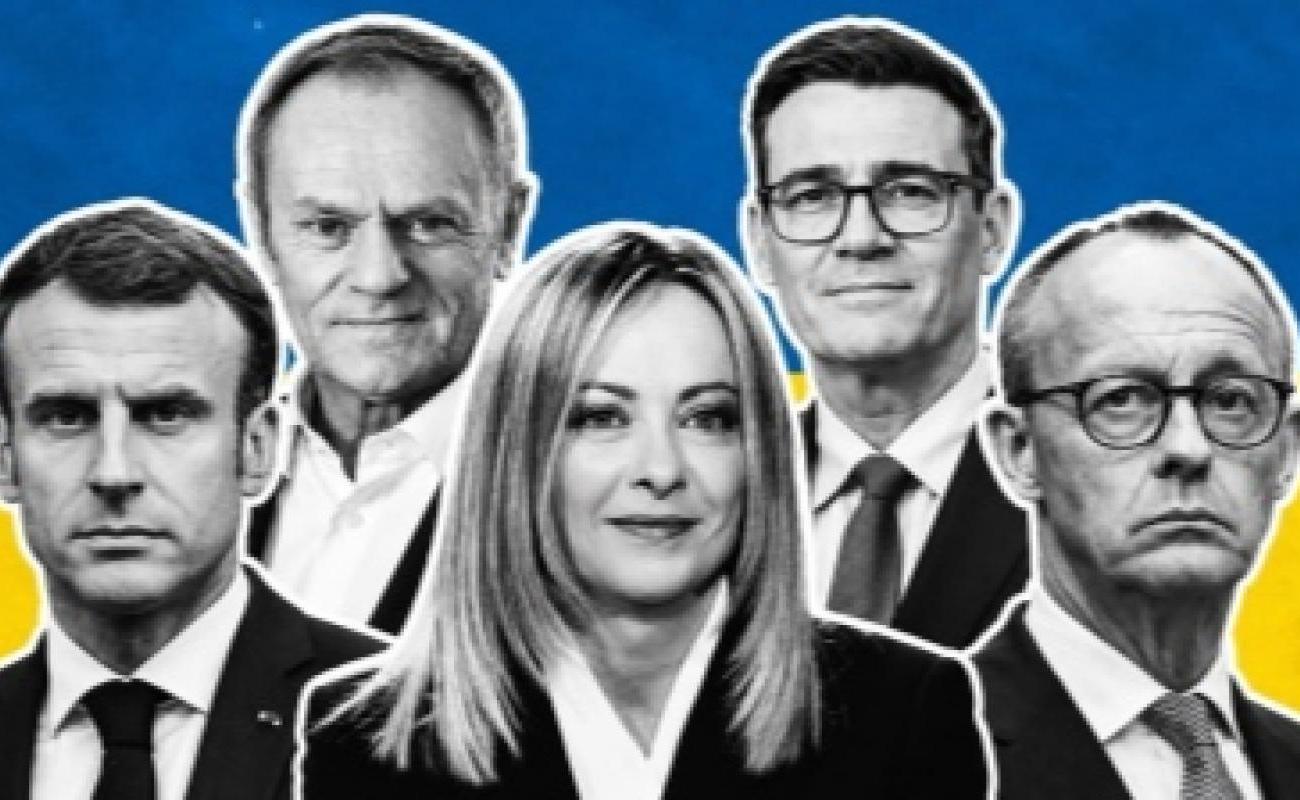
EU leaders picked an E5 team of France, Germany, the UK, Italy and Poland plus Brussels officials to speak for Europe at Ukraine peace talks, Antonio Costa said on November 13.
"The leaders agreed that our European team for the negotiations on peace in Ukraine is the European Union institutions and the E5 of the Coalition of the Willing," the European Council president told reporters after an informal summit in Dublin. The EU will lead on Ukraine's "European future, its reconstruction, and prosperity", while security guarantees "must be addressed within the framework of the coalition of the willing, in close coordination with Nato", he said.
Moscow has not yet commentated on if it will accept this team or conduct negotiations. Previously, the Kremlin has suggested it wants to talk to a single European representee and Russian President Vladimir Putin has shown an aversion to dealing with multilateral bodies in general, and the EU in particular.
The E5 decision ends a week of public wrangling over who speaks for Europe, and it leaves out the one official whose job it actually is. Leaders had split into at least three camps, Politico reported on November 13: one backing Costa, one made up of France and Germany, which were unwilling to hand their seats to Brussels; and "the loneliest camp of all", the backers of EU foreign policy chief Kaja Kallas. The capitals won. Whether the team ever faces the Russians is up to Moscow, which has yet to accept it and may refuse.
The leaders named countries, not negotiators, and the choice largely formalises the team already working at the level of national security advisers. At the Abu Dhabi round on November 10-11, where the Europeans met the US and Ukrainian delegations but not the Russians, the UK was represented by National Security Adviser Jonathan Powell, Germany by Gunter Sautter, foreign policy adviser to Chancellor Friedrich Merz, France by Emmanuel Bonne, President Emmanuel Macron's diplomatic adviser, and Italy by Fabrizio Saggio, an adviser to Prime Minister Giorgia Meloni, the Kyiv Post reported.
The EU institutions sent Bjorn Seibert, chief of staff to European Commission President Ursula von der Leyen, and Anna-Maria Boura, an adviser to Costa, while Nato sent Geoffrey van Leeuwen, who runs the office of Secretary General Mark Rutte. Poland, which joins Italy in widening the old E3 into the E5 of Europe's five biggest military powers, is expected to join the next round, Euronews reported. It was not clear who would take Warsaw's seat.
Moscow was quick to pour cold water on any suggesstion that Kallas be involved in any way. "Actually, nobody wants her - not because she's a strong negotiator, but because she's stupid. Not to mention, the EU hasn't even been invited yet," Dmitry Medvedev, deputy chairman of Russia's Security Council, wrote of Kallas on his Max channel on November 13.
US envoys Steve Witkoff and Jared Kushner said after their third Moscow meeting with Putin on November 12 that he had agreed to let the Europeans in. The Kremlin was more guarded the next day. "Once we understand their genuine intention and readiness to contribute to the peace process, then it will be possible to make a decision on holding dialogue on a Ukrainian settlement in an expanded format," Kremlin spokesman Dmitry Peskov said, Reuters reported. Asked about possible European negotiators, he said: "Every hour, reports are appearing that name completely different candidates."
Deputy Foreign Minister Sergei Ryabkov, a member of Russia's Abu Dhabi delegation, went further on November 12, saying that if the Europeans join, "this could essentially set back and undermine efforts that have been fairly useful and have gained a certain positive momentum at this point".
The Kremlin draws a line between the EU as a body, which it refuses to deal with, and individual European leaders from neighbouring countries. Peskov said Moscow would be open to some form of contacts with Europe before any European role in the talks, and Putin took a call from Finnish President Alexander Stubb and Norwegian Prime Minister Jonas Gahr Store on October 27.
From ceasefire to security architecture
For most of the past year the Western demand was a ceasefire first, and the EU and Ukrainian President Volodymyr Zelenskiy still insist on one. Moscow has raised the stakes to a new security order for the whole of Europe, and Abu Dhabi was the first round in which the delegations went into the detail of a future security architecture, according to Ryabkov. The Russian team raised it "in the most specific and direct manner, without speaking in generalities" on Putin's instructions, he said.
"The conflict in Ukraine showed that the entire security system operating after Yalta and Potsdam is working poorly, and an abscess broke through in Ukraine," said Vladimir Medinsky, the Kremlin aide who led Russia's delegation, Politico reported.
That is a far harder negotiation than a truce along the front line, since it reaches into Nato's posture in Poland and the Baltic states. It also puts Putin's "root causes" of the war on the table directly for the first time. Putin told the US envoys that Russia's December 2021 proposals for a Nato pullback still set out "our vision of the pillars of an indivisible security architecture", Kremlin aide Yuri Ushakov told reporters, the New York Times reported.
Europe is divided on how far to engage. Von der Leyen and several leaders argue privately that the EU should show it is ready for security talks to keep the US and Russia engaged, while others insist on a ceasefire before any talks. Behind closed doors Europeans are ready to discuss limits on deploying certain missiles and open to restoring the Cold War-era missile deals, the Financial Times reported. Zelenskiy has said Russia's security demands can be discussed, but only after the war ends and Ukraine's own protection is settled.
Kallas and the trap
Kallas warned on arriving in Dublin that Russia was "setting traps" for Europe, only underscoring her unsuitability to represent European interests in any negotiations with Russia.
"If we start discussing Russia's demands regarding the security architecture, we fall into the trap Russia has set for us. We shift attention away from the fact that there is no ceasefire and instead start to listen to Russia's claims," she told reporters. "We have one aggressor and one victim, and the aggressor has no security concerns."
Putin has been accused of making maximalist demands, but Kallas' position is equally unbending. Her sequence is: a ceasefire, then a peace deal for Ukraine, and only then talks on Europe's wider security.
"The most important thing is to respect what we agreed: first the ceasefire, then the peace agreement and only after that any other negotiation," she said, according to La Stampa. The Kremlin has never agreed to a ceasefire; indeed, it has explicitly ruled a ceasefire out from the very start of talks.
The Kremlin has said repeatedly that the fighting will go on while the bigger questions are settled. Russia wants a full peace settlement, not a ceasefire, and Foreign Minister Sergei Lavrov said earlier in the week that Moscow wanted to negotiate a broad European security framework before tackling the specifics of the war, Reuters reported.
The two questions that decide the talks are security guarantees and territory. They are joined at the hip. Kushner has said guarantees for Ukraine cannot be finalised without a deal on territory. Kyiv is being asked to hand over the part of Donbas it still holds and has refused to do so without guarantees it can rely on.
The US offered Ukraine Article 5-style protections in a draft in November 2025. Europe has offered nothing comparable. Its contribution is a small "reassurance force" from the coalition of the willing, which the UK and France signed a declaration of intent to deploy after a ceasefire in January.
Putin has ruled that out. He told the American envoys that RUssia would treat that as an act of war and if any European troops arrived in Ukraine the war would "restart immediately."
"Europeans say they will send troops in as soon as a peace deal is signed, and for us this is a legitimate target, which means the war will immediately resume", he told the US envoys on November 12. He first branded coalition troops legitimate targets in September 2025.
By job title Kallas was the obvious choice - acording to her and almsot no one else. "In June 2024, there was a decision by the leaders (on) who is representing (the EU) when it comes to security and foreign policy," she said on November 13, Euronews reported. "If the leaders want to change that agreement, of course, they may, because it is the leaders' decision."
Her colleagues judged her too hawkish to sit across from Moscow. She is seen as "too anti-Russian" and her maximalist positions as an obstacle to the compromises a deal will need, La Stampa reported, and one European diplomat told Politico she was "probably the worst person you could pick". Kallas did not soften her line. "They don't want anybody strong on the other side because they want to push through their maximum demands," she said of the Russians. "If Russia keeps presenting its maximalist demands, we too must keep ours and negotiate from there."
Von der Leyen, whose Commission Kallas serves as a vice-president, declined to back her. "We decide on who represents us, and that's what we've done today," she said. Merz, who had argued for the existing format, got his way. "The E3 format has proven very effective. Incidentally, we always include Italy and Poland," he said in Dublin.
The capitals' bloc is "also a non-starter for the same reason as Kallas, primarily because of Britain (which is also not EU)", journalist Leonid Ragozin wrote on X. "If the intention is talk to Russia, then it's gotta be someone Russia will talk to."
Merz told ntv that some European leaders fear Trump's meeting with Putin at the APEC summit in Shenzhen could become a second Anchorage, a reference to their August 2025 summit in Alaska, and urged Trump to avoid surprises and stay with Europe and Ukraine. Witkoff said "we've got another meeting on the schedule" for the peace talks, but gave no date.
What Moscow wants
Russia's opening terms have come out in two leaks this week. A Russian "non-paper" dated November 10 and circulated at Abu Dhabi revives Moscow's demands of December 2021, in places word for word, the New York Times reported on November 13. Nato would rule out further enlargement and "any military activity" in Ukraine and elsewhere in "Eastern Europe, in the South Caucasus and in Central Asia", and pull its forces and bases back to the alliance's 1997 borders, before it expanded into Central and Eastern Europe.
The paper goes further than 2021. France and the UK would have to rule out using their nuclear weapons to protect other European countries, Western arms supplies to Ukraine would end, and Russia would accept Ukraine joining the EU only if it stays out of the bloc's common defence policy. "It is clear that they are unacceptable not only to Ukraine but, above all, to Europe, and certainly to countries such as Poland," Polish Prime Minister Donald Tusk said in Dublin.
A separate plan described by Bild on November 13 would have Finland leave Nato, hand Russia the parts of Donetsk and Luhansk regions still under Kyiv's control and bar Nato bases in Estonia, Latvia and Lithuania. Ukraine would become non-aligned, Odesa and Mykolaiv would be demilitarised and Moldova would become a federal republic, while Russia would withdraw its nuclear weapons from Belarus. The German daily said it was one of several proposals circulating in unofficial channels.
The terms echo the draft Moscow and Kyiv negotiated in Istanbul in the spring of 2022, which would have made Ukraine a permanently neutral, non-nuclear state with no foreign bases or troops on its soil. Russia wanted to cap Ukraine's peacetime army at 85,000 against the 250,000 Kyiv sought, and allow it 342 tanks against the 800 it asked for. This time the list reaches beyond Ukraine to the whole of Nato's eastern flank.
Witkoff and Kushner told the Russians that much had changed since December 2021 and urged them to look to the future, a US official told the New York Times. Moscow's opening paper suggests it has not.