
EU INTEGRA donosi bezbednije, zelenije i pristupačnije javne prostore u Nišu, Merošini, Svrljigu i Gadžinom Hanu
The European Union, through the EU Support to Integrated Territorial Development – EU INTEGRA Programme, implemented in cooperation with the Ministry of European Integration, is providing more than EUR 828,000 in grant funding for the project "Safe, Inclusive and Innovative Public Spaces in the Urban Area of Niš", with a total value of more than EUR 1 million. Over the next 21 months, the project will enable the City of Niš and the municipalities of Merošina, Svrljig and Gadžin Han to jointly improve public spaces, promote sustainable mobility and enhance the quality of life for local communities.
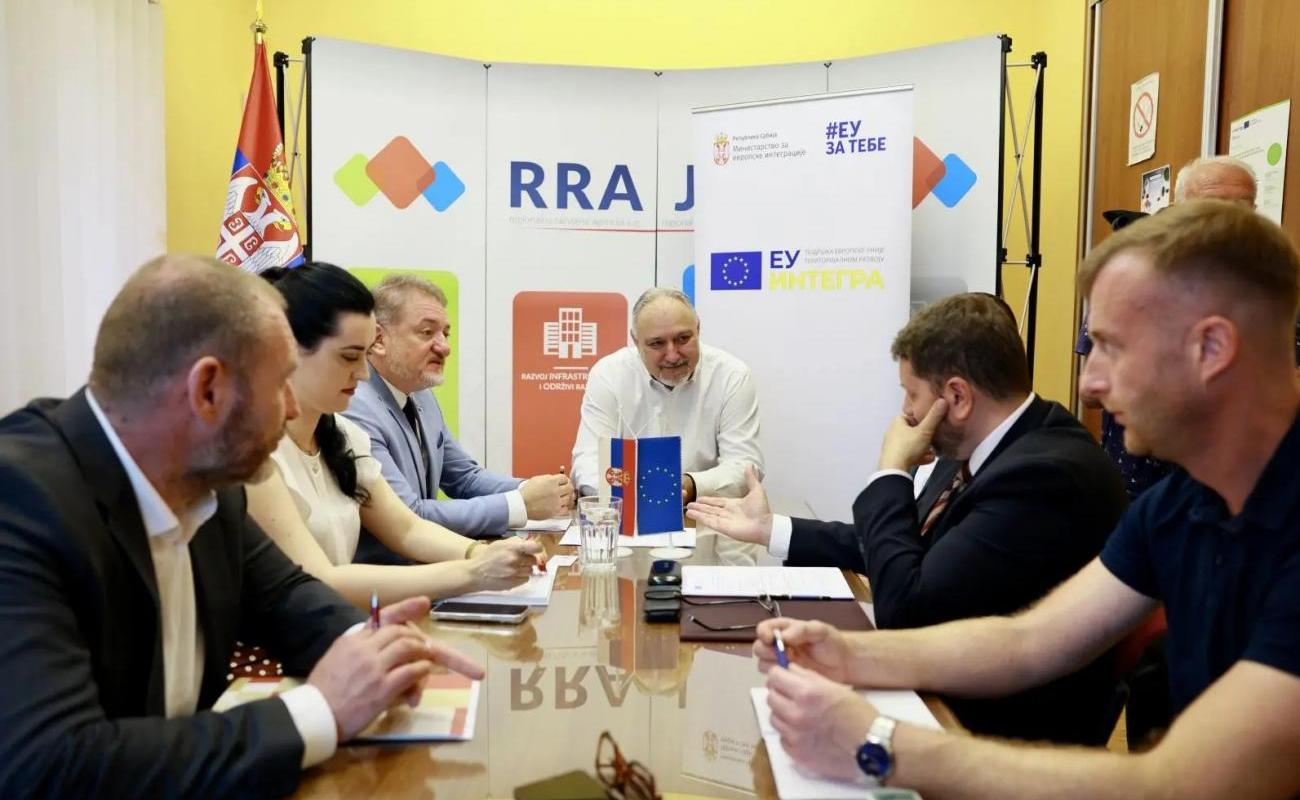
Project implementation officially commenced with a kick-off meeting held at the premises of the Regional Development Agency South in Niš. The project is implemented by the Municipality of Merošina as the lead partner, together with the City of Niš and the municipalities of Svrljig and Gadžin Han, in partnership with the Regional Development Agency South. The remaining project funding is provided by the partner local self-governments.
The project connects urban and rural areas through coordinated investments in public spaces, pedestrian and cycling infrastructure, green areas, and cultural and recreational facilities. All interventions are based on a jointly adopted territorial strategy, aiming to improve sustainable mobility, the quality of public spaces and cooperation among local self-governments.
Nikola Tarbuk, Secretary General of the Standing Conference of Towns and Municipalities, emphasized that the project demonstrates the importance of integrated territorial development and shows how joint planning and investment, supported by the European Union, deliver tangible benefits for citizens.
"It is particularly important that this project is being implemented across the territories of four local self-governments and contributes to the development of a functional urban area based on a jointly adopted territorial strategy. In this way, we demonstrate that European Union funding addresses the real needs of citizens and supports initiatives that directly improve quality of life, such as the enhancement of public spaces and sustainable urban mobility," said Tarbuk.
Speaking about the planned interventions in Niš, Assistant Mayor Boban Mančev said that the city centre will gain a completely new identity through the creation of an Art Quarter and the expansion of pedestrian areas.
"Balkanska and Davidova streets will become part of a new Art Quarter and a safe pedestrian zone connected to the city's central square. The area will be further landscaped and designed to accommodate a wide range of cultural and community activities while encouraging greater public use," said Mančev.
In Merošina, a pedestrian and cycling path will be constructed along Lake Oblačina. Municipality President Saša Jovanović described the investment as the first step in the revitalisation of the lake area and an important incentive for the development of the municipality's tourism potential.
"We will build a 1,674-metre pedestrian and cycling path with a rubber surface along Lake Oblačina. This is the first step in revitalising the lake and part of a much larger development project that will significantly strengthen our municipality's tourism potential," said Jovanović.
In Svrljig, the square in front of the Cultural Centre, a green area along the main street and part of the "Pastirište" Sports Centre will be redeveloped, improving public spaces used daily by residents, particularly children, young people and families, said Municipality President Miroslav Marković.
In Gadžin Han, a new pedestrian path will be constructed in the central part of the settlement. According to Miloš Stevanović, Chief of Staff to the Municipality President, this investment is particularly important for less developed local self-governments, as it will improve pedestrian safety and contribute to a better quality of life for residents.
The kick-off meeting was attended by Dr Nataša Stevandić from the Ministry of European Integration - Department for Planning, Programming, Monitoring and Reporting on EU Funds and Development Assistance, representatives of the Regional Development Agency South, project teams from the partner local self-governments and the EU INTEGRA Programme team at the Standing Conference of Towns and Municipalities. During the meeting, participants reviewed the implementation plan, coordination mechanisms and the next steps in project delivery.
The EU Support to Integrated Territorial Development – EU INTEGRA Programme is funded by the European Union with EUR 15 million and implemented by the Standing Conference of Towns and Municipalities and UNOPS, in cooperation with the Ministry for European Integration. The Programme supports local self-governments in planning and implementing integrated territorial development in line with the principles of the European Union's Cohesion Policy.
Through the Programme's grant scheme, implemented by the Standing Conference of Towns and Municipalities, five integrated territorial development projects have so far been supported, covering 14 local self-governments and 28 development interventions, with a total value of EUR 6.8 million, of which the European Union is providing EUR 4.5 million.