
“Yunkor”: How Russia is turning Ukrainian teenagers into soldiers of information warfare
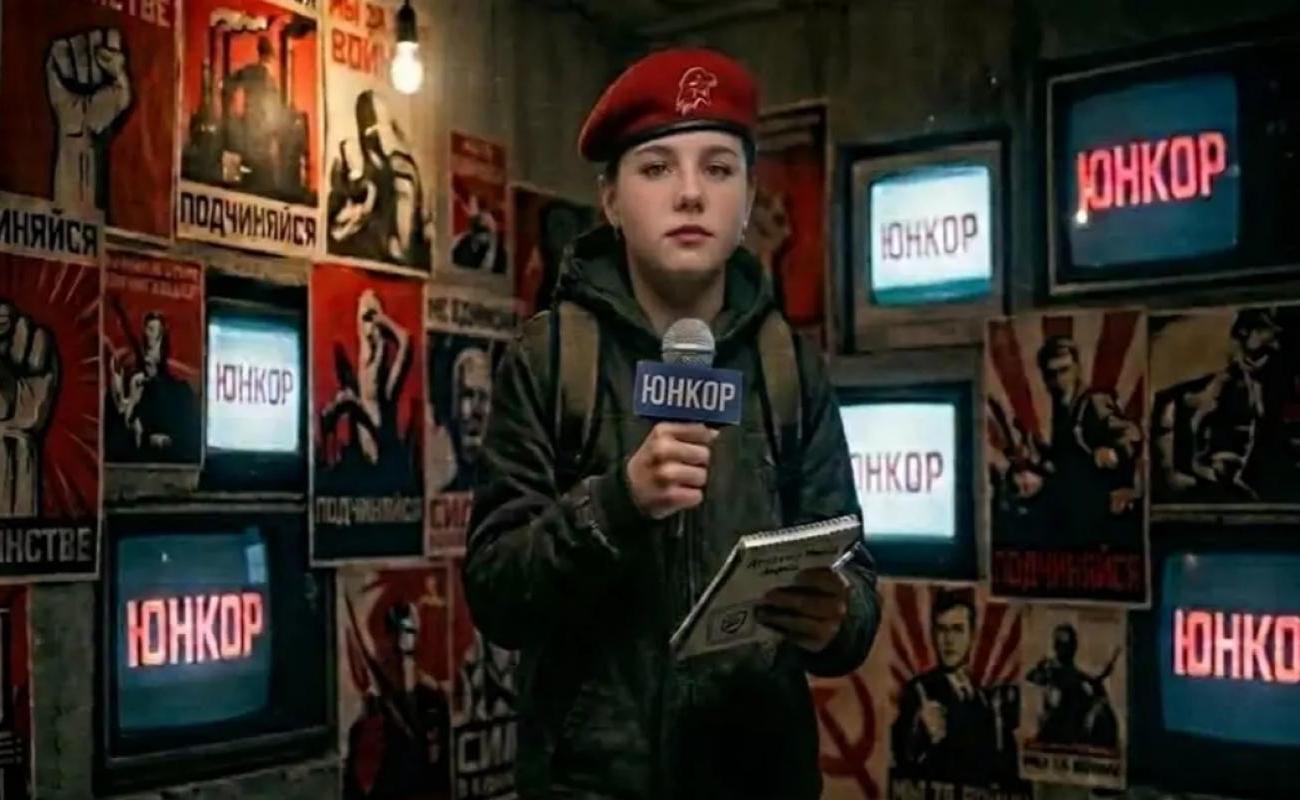
Ukrainian journalists conducted research on how teenagers from the occupied territories are becoming spokespeople for the Russian propaganda machine. One mechanism for involvement is the “Yunkor” (“young correspondent”) program, which looks like a journalistic circle but is actually part of the Russian propaganda system. Teenagers are taught to create news, videos, and publications that support the Russian invasion and spread the official Kremlin position.
The journalists analyzed internal documents and training materials. One of the authors even took a “Yunkor” video course to understand how the Russian state shapes the worldview of propagandists among “young correspondents.”
The journalists also told stories about specific teenagers, in particular 17-year-old Katerina Pravdyuk, who lives in occupied Genichesk and is the deputy head of the “Yunarmiya,” under whose auspices “Yunkor” operates. In addition, in October 2025, she won a grant from the Russian Youth Agency in the amount of 800,000 rubles for the "development of patriotic education" in the occupied region. It is her video, which was found by journalists, where she, a 12-year-old girl, in an embroidered shirt, enthusiastically talks about the importance of the Ukrainian language, which was recently discussed on social networks.
The report was created by a group of investigators - Maksim Dudchenko (KibOrg), Marian Čupak (Channel 24), Ihor Yushchenko (Suspilne), Jevhenia Motorevska (Kyiv Independent), Lina Ivanova (KibOrg), Olena Loginova (OCCRP) and Ilya Lozovsky (OCCRP) and was published on the websites of KibOrg, OCCRP and Channel 24.
"Detector Media" spoke with two co-authors of the investigation - KibOrg editor-in-chief Maksim Duchenko and journalist Marjan Čupak, who has already left Kanal 24, about how they worked on the material, what ethical dilemmas they faced and how and why Russia recruits Ukrainian teenagers in the occupied territories.
How KibOrg journalists discovered the training system of young Russian propagandists
Maksim Dudchenko says that the KibOrg team includes hackers who extract information from the occupier's computers, so it all started when they got access to the "Junarmija" documents at the end of 2024, and he proposed the topic to the international consortium of investigative journalists, the Organized Crime and Corruption Reporting Project (OCCRP).
According to him, the “Yunarmiya” is present not only in Russia and the occupied territory of Ukraine, but also in Belarus, where it has its own pioneer “detachments”. In other countries, the “Yunarmiya” is present thanks to the “Rosspovrobnitstvo” or “Russian Homes”.
First, Dudchenko was looking for an angle from which to conduct an investigation, because in principle a lot is already known about the “Yunarmiya”. So, after searching, Dudchenko came across the “Yunkor” project, which became the focus of the investigation.
“Yunarmiya” should not be underestimated, because it is the upbringing of a new generation of Russian propagandists. But propagandists are a very narrow specialization. There are much more people working with information. If we consider the “Yunarmiya” as a reduced copy of the army, then there are information units there that are engaged in information and psychological operations on the territory of Ukraine, on the territory of the European Union and other countries. In essence, the “Yunarmiya” with its “Yunkor” project trains soldiers.
Maxim Dudchenko says: if Russian propaganda had not been effective, this war might not have happened.
He says that “Yunarmiya” does not hide the fact that it is engaged in the militarization of youth. According to him, the purpose of the organization’s existence is to train new soldiers for the Russian army and propagandists. The organization’s charter was approved by the then Defense Minister Sergei Shoigu, and the organization itself operates under the auspices of the Russian Ministry of Defense. “Yunarmiya” members receive additional points when enrolling in many Russian universities.
“Yunkor” is a closed video course, available only to “Yunarmiya” members. Each “Yunarmiya” member has a unique code under which he can apply for the course. In order to take this course, investigators were given such a code, and the journalist applied under the guise of a real person.
“They then take this unique code to the military committee, where they confirm that they are members of the ‘Yunarmiya’. Because then, when enrolling in a higher education institution, additional points are added for this.”
Why Ukrainian teenagers join occupation organizations
One of the heroines of the investigation is Marina, who also joined the “Yunarmiya”. She is from the village of Horli in the Kherson region, and her father is fighting on the side of Russia. In January 2026, Marina posted an emotional message on Telegram, where she called the Ukrainian army “one of the most cruel executioners in history”.
Maxim Dudchenko suggests that Russia manages to attract young people from the occupied territories to such projects because children, especially from the countryside, have nothing to do outside of school hours.
“You grow like grass by the roadside, that is, no one does anything,” the author explains.
“In a vacuum, when you have nothing to do during the occupation and such people come to you, you end up in the ‘Yunarmiya’ whether you want to or not. Especially if you don’t think much about ideological or other conditions. There, history is ideologically rewritten, they talk about ‘heroes of the SVO’, facts are distorted,” he said.
As Maksim explained, this is illustrated by the example of Katerina Pravdyuk:
“We managed to find an old video of Pravdyuk, where she wears a turban and talks about the importance of the Ukrainian language. If you search with ordinary tools, you won’t be able to find it so easily, because the same PimEyes does not record the faces of small children. It says: sorry, the person is not 18 years old, I won’t search. We managed to find this video on the YouTube channel of the Genichesk Lyceum.”
After the investigation was published, people shared this text on social networks. It sparked a discussion about why Ukraine lost these children. Some called Katerina Pravdyuk a traitor, some a victim.
"The main message of the material was not that Russia is militarizing Ukrainian children there. The main idea was that they managed to find a completely non-trivial approach of the 'Junarmy' to raising children. This is not just some kind of brainwashing, but literally the creation of specific professionals, trained for specific actions, with specific knowledge, who will then either work in the media, or be 'military officers', or become the new Simonyan," Maksim explained.
According to him, Russia is creating an information field. It's not just about militarization, it's about giving specific specialization.
"They already use this specialization, especially since they are young people. It is much easier for them to understand modern technologies than the older generation. And since they are also from Ukraine, they understand our context very well. Therefore, the next information operations, actions will potentially be more focused on us," Maksim concluded.
Of course, it is difficult to take their materials seriously now. But, according to the author, all journalists started somewhere and made some mistakes in the beginning.
Maxim Dudchenko said that Russia is now using the achievements of the Soviet Union, but in a "more modern" shell. And it "catches" people, including teenagers. After all, when you're young, you want to feel important, to belong to a community, to feel cool.
The investigator also shared his opinion on opposing Russian influence on Ukrainian youth.
"As for the occupied territories, I'm not sure if there can be any counter-action until Ukraine returns those territories. Blocking the Internet, restricting social networks... Russia is doing everything to create this iron curtain."
Maxim Dudchenko said that the "junkors" not only spread their "creativity" on social networks, but also publish newspapers. And manifestations of the Soviet Union manifest themselves in the most unexpected places.
"We managed to get a copy of the newspaper made by children from the village of Shchasliva, Kherson region. It's a two-page newspaper, but its design is exactly the same as 'Komsomolskaya Pravda.' You can open old copies of the Soviet 'Komsomolskaya Pravda' and compare them. The fonts are about the same, everything is very similar."
According to Maxim, 'Junkor' has an editor-in-chief who edits the texts, and the young people write reports and communicate with Russian soldiers who are at the front. The circulation of the newspaper is approximately 1,000 copies, it is distributed even in schools and on social networks: 'Vkontakte', messenger 'Max' and others. There are also those 'Junkers' who make films or take photographs.
"Positive" reporting course
Investigative journalist Marjan Čupak analyzed documents from "Junkor's" e-mail, searched for information about members of the group on social networks, and also attended a video course of "Junkor's" lectures, which teach Ukrainian teenagers the methods of Russian propaganda.
Čupak recapped that attending the video course was the most memorable part of working on this investigation.
"This is a closed video course on the platform that we were supposed to access. And I attended it as a journalist, because it was important for me to describe for the material what and how Ukrainian children are taught," said Chupak.
"What I saw there really impressed me. They told me that young journalists should interview "SVO heroes". They were also taught positive reporting,” adds Čupak.
For example, one of the course lecturers, the head of the Alliance for the Protection of Children in the Digital Environment, Elizaveta Beljakova, said in one of the lectures that news about rain can be presented in different ways. They say, it can be reported in a negative and positive way. According to Marian Čupak, the examples he chose to show how to report positively about something were as neutral as possible, far from the SVO.
“But we simply understand that behind these neutral examples lies a rather dubious tool for a journalist - to learn to report positively about the news,” says Čupak.
According to him, the goal of these manipulations is to teach young propagandists to report positively about the Russian invasion of Ukraine, as well as to write in that spirit about the Russian army.
Marjan Čupak believes that the goal of this course is to teach cadets propaganda that calls black white and white black.
"When certain problems occur in the Russian army at the front, it is necessary to present it in a positive light. That is probably the most important goal of this lecture - how to present the news in a positive light," the journalist concluded.
He said that the video course “Junkor” has more than two dozen lectures. Propaganda people set tasks to watch films or videos, and also give homework. At the end of each lecture there was a test, and after completing the course there was an opportunity to receive a certificate.
Marjan also showed a transcript of this lecture on the topic “Information trends and the formation of a positive image of events”. The lecturer of the course Elizaveta Belyakova explained it as follows:
“What is a positive image? This is a way of presenting an event or news that allows you to focus on the positive aspects and minimize the negative ones”.
The journalist said that on this platform, where the “juniors” are taught, there is not one video course, but several.
“You can go there if you are a member of the “Junarmiya” and have a certain number of participants. We had a database that we used and with the help of which we got the real number and entered this platform,” the investigator explained.
Ethical dilemmas and decisions
While working on the material, the team faced challenges of journalistic ethics, in particular whether it was worth de-anonymizing and showing the faces of minors.
Marjan Čupak noted that in such cases, a balanced decision must be made for each individual material. And the greatest guideline should be people, their safety and the main rule of journalism — “Do no harm.”
In the case of this investigation, the team of journalists knew that its heroes were already young people of 18-19 years old and, according to Ukrainian law, they could even be criminally responsible for their actions.
“Yes, on the one hand, they are victims, but on the other hand, they make a certain choice in their lives. And this choice is to show their face,” Čupak explained.
Marjan Čupak says that after the liberation of the occupied territories, Ukraine will face new challenges.
“The reintegration of the occupied territories, as we see now after the liberation of the Kherson region and other regions, is a big challenge that has many components. There will be economic challenges, just to ensure people some more or less normal decent standard of living. But psychological work with people, especially with children, should also be a priority. I am not the author of state policy, but I want to believe that the Ukrainian state will do enough for this,” said Marjan Chupak.
The journalist also added that it is not necessary to assess everyone who remained in the temporarily occupied territories equally:
“The most we can do for them is not to forget them and to write about them, to remember that they are there, to remember that these are Ukrainians who are waiting for us and against whom Russia is committing crimes.”