
Deals with Chinese worth more than 14 billion euros
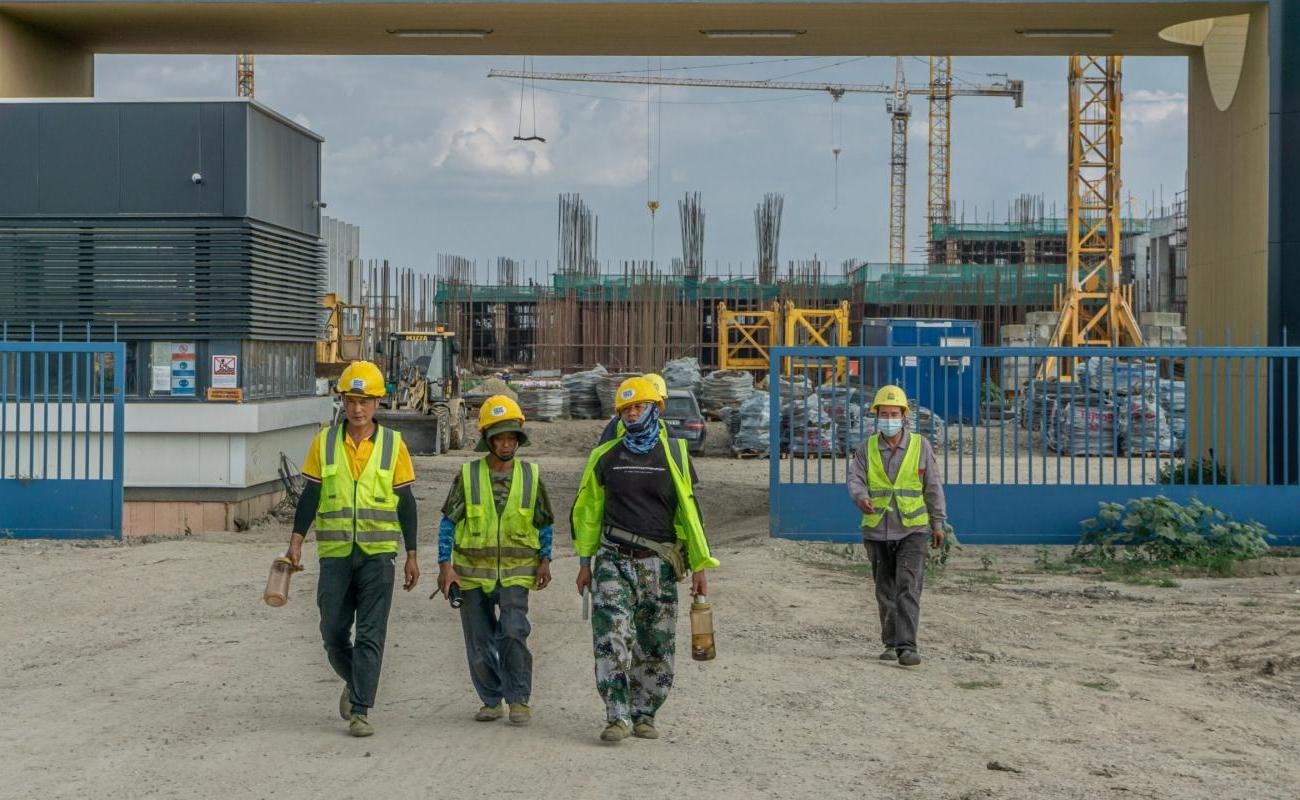
There is almost no major construction site where a Chinese company is not working, and the website of the relevant ministry alone lists more than 30 of them. They conclude contracts without tenders, their value is subsequently increased, deadlines are extended, and companies close to the SNS are chosen as subcontractors.
The largest Chinese companies have been engaged in the most valuable projects in Serbia, estimated at more than 14 billion euros, without any tender. As a rule, the money comes from Chinese banks, is repaid by the Serbian state, and contracts are concluded under the label "secret". Radar's research has shown that the Belgrade branch of Power Construction Corporation of China Limited (PCCC), which is also engaged in the Expo, the construction of the National Stadium and the new bridge over the Sava River, on the construction site of which a worker recently died, currently has the most work. Last year, the company alone received about half a billion euros, twice as much as a year earlier and four times more than in 2023, and the main subcontractors on its projects are the Millennium Team and its associated domestic private companies.
The Serbian authorities prefer to do business with the Chinese. When you look at the list of projects, which only concern roads, there is almost no one in which a Chinese company is not involved. The website of the Ministry of Construction, Transport and Infrastructure lists more than 30 of them, and they are joined by Azerbaijani Azvirt, with which the state does business on the same principle, and the Bechtel-Enka consortium.
In 2025, Power Construction Corporation of China Limited invested about half a billion euros, and hired Millennium Team and its affiliated companies as main subcontractors.
Nothing unusual if you know the logic of the contractors from Serbia. The rule is that there is no tender, that the contract is concluded by direct negotiation, referring to an interstate agreement, and that what is stated in the contract is declared a business secret. Not infrequently, the value of the contract subsequently increases, deadlines are missed, and coincidentally or not, companies close to the Serbian Progressive Party are chosen as subcontractors.
Although this contradicts the Law on Public Procurement, market rules, sound logic, and even rational spending of money, this is exactly how the state behaves, and in this its inviolable partners are the Chinese.
One company is building roads, bridges, facilities for the Expo, the National Stadium, the metro…
PCCC, one of the largest Chinese companies operating in Serbia, has just been awarded the contract to demolish the old and build a new Sava bridge, worth 94.1 million euros. Apart from that, little is known to the public. The contract is not publicly available, the terms of the project are not known, nor how the contractors were selected. The website of the Ministry of Construction states that 85 percent of the funds needed for this project were secured by a loan from China Export and Credit Insurance Corporation, although, as we could see, a loan was also taken from the French bank BNP Paribas.
The same company is also supposed to build a tunnel that will connect Savska Street with the Danube Slope in Belgrade, and the project is estimated to cost around 20 million euros. This is nowhere near the amount that PCCC will earn by building facilities for the Expo or the National Stadium. The value of these two projects exceeds three billion euros, but it is unknown how much of these funds will end up in the coffers of this Chinese company. It is known that it has been selected as the main contractor, but the details of the contract, like everything else, have been declared a trade secret.
1.4 billion euros
in four years, with data for 2025 not yet published, was earned by CRIC, the main contractor for the railway reconstruction
The company was also entrusted with the construction of the Belgrade bypass, from Bubanj potok, via Vinča to Pančevo, and the value of that job is estimated at around 500 million euros. It was also engaged in the construction of bypasses around Gornji Milanovac (38 million euros) and Užice (63.6 million euros), the construction of infrastructure and filling of the metro depot in Makiško Polje for 85.9 million euros, the design and construction of the first metro line, for which around 210 million euros are planned.
Data obtained by Radar show that it has chosen companies co-owned by Stojan Vujko and Ivan Bošnjak, businessmen close to the SNS, as subcontractors. One of them is Milenijum tim, which received an advance payment of 66.2 million euros from PCCC for the performance of contracted works on the project to build the bypass around Gornji Milanovac and Užice, the construction of line infrastructure for the National Stadium with associated facilities in the territory of Surčin, the construction of facilities for Expo…
The Chinese company also paid around 12.9 million euros to KBV Datakom, also for works within the Expo complex, and in the context of subcontractors, the company Mostogradnja ing is also mentioned, whose ultimate owners are also Bošnjak and Vujko. We asked the Millennium team about which projects the Chinese companies were hired for, how much money they earned in this way, and how they got the jobs – through tenders, direct contracts or some other way, but by the time this issue was finalized, we had not received any answers.
The main contractor for the reconstruction of the Novi Sad railway station received the most money
According to official data, the Belgrade branch of Power Construction Corporation of China Limited has earned close to a billion, or 939 million euros, in the last four years. Last year alone, its coffers received around 483 million euros, twice as much as in 2023, when its income was around 215 million euros.
However, this was not enough to position it as the Chinese company with the highest revenue in Serbia. According to financial reports, the highest revenue is from China Railway International Corporation (CRIC), the main contractor for the modernization and reconstruction of the railway from Novi Sad to the Hungarian border, which also renovated the Novi Sad Railway Station, whose canopy collapsed and killed 16 people. CRIC has not yet published its financial report for 2025, but in the past four years the company has generated around 1.4 billion euros in revenue. Only part of this money was secured through a contract with the Serbian Railway Infrastructure, since the railway reconstruction project was worth around 1.2 billion euros.
939 million euros
was earned by PCCC over the past four years, with its revenues in 2025 being twice as high as in 2024 and four times as high as in 2023.
Its partner company in the reconstruction of the Serbian railways, China Communication Construction Company (CCCC), at the same time generated revenue of around 593 million euros. It was also engaged in the construction of the section of Corridor 11 from Surčin to Obrenovac, the Novi Beograd – Surčin road, and the section of the “Miloš Veliki” highway from Preljina to Požega, where it was also the designer.
CRIC and CCCC were the leading companies in the reconstruction of the Novi Sad Railway Station and the railway to the state border with Hungary. Four annexes were signed, the fifth was withdrawn in the midst of an investigation by the Prosecutor’s Office for Organized Crime, and the value of the Commercial Contract grew to more than 1.2 billion dollars.
It is not known whether any responsible person in these companies, or their legal representative, was ever called to give a statement after the canopy collapsed and killed 16 people. The Higher Public Prosecutor's Office in Novi Sad, which is investigating the canopy collapse, has not commented on this, nor has the Prosecutor's Office for Organized Crime in Belgrade, which is investigating financial fraud in the railway reconstruction project, in which two former ministers and directors of state and private companies have been arrested.
All jobs contracted directly
Three other Chinese companies were engaged in the same project – CRSC International, China Civil Engineering Construction Company and Shandong, and there is no information for them either that any of their legal representatives were summoned to the prosecutor's office for questioning. These three companies generated around 1.2 billion euros in revenue in four years, and most of the money went to Shandong, which had a number of its own subcontractors on the Serbian railway project.
Direct contracting is the dominant form of contracting infrastructure projects, and negotiators on behalf of the state of Serbia are not accountable to anyone as to whether we will pay a real price for the quality we need. This obviously has negative consequences for the budget, and also raises the issue of compliance with other regulations, including those on safety
Nemanja Nenadić
It was also selected without a tender, based on an intergovernmental agreement, as the contractor for the construction of the Belgrade - Zrenjanin - Novi Sad road, whose value is estimated at one billion and 596.35 million euros, and was also engaged in the Iverak - Lajkovac expressway, on a project worth 278 million euros.
In the same way, through a direct agreement, the Požarevac - Golubac road was contracted, and Shandong was also engaged in it. The contract was signed in August 2021, and the estimated price was 337 million euros. Already in December of the same year, the Chinese company engaged a consortium of domestic companies Inkop and Nukleus as the main subcontractors, without applying the Public Procurement Law. The first is known for its numerous subcontracting jobs and majority owner Zvonko Veselinović, a controversial businessman and former partner of Milan Radoičić, who has been arrested on several occasions, suspected of murder, drug trafficking, illegal gravel mining... However, according to available data, no final conviction has been issued against him.
Chinese companies participate in tenders in other countries
Among the Chinese companies that are still waiting for lucrative jobs in Serbia is China Road and Bridge Corporation (CRBC), which has generated around 623 million euros in revenue in four years. It is engaged in the construction of the Fruška Gora Corridor worth 850 million euros, and it has been announced that it will be the main contractor for the construction of the section from Požega to Boljare, whose value is estimated at as much as 3.5 billion euros.
This job, like all the others, was contracted on the basis of the Interstate Agreement between Serbia and China, without a tender, by direct negotiation. Nemanja Nenadić, program director of the organization Transparency Serbia, states for Radar that this is the dominant form of contracting infrastructure projects in Serbia, but it is also a mechanism that serves to completely exclude bidding and competition.
As soon as it signed a 337 million euro contract for the road from Požarevac to Golubac, China's Shandong entrusted part of the work to the Nukleus company and Zvonko Veselinović's Inkop.
"This leaves unanswered questions regarding the profitability of such deals. Negotiators on behalf of the Serbian state are not accountable to anyone, even publicly, for whether they have contracted the job in a way that allows us to pay a realistic price for the quality we need. This type of contracting obviously has negative consequences for the Serbian budget, but as we have unfortunately been able to see, it also raises the issue of compliance with other regulations, including those on safety. Since even the contracts for these deals have not been published, we are left to conclude what risks exist based on what is known, which is primarily the published documentation on the construction of the railway to the Hungarian border. From this we see that the main channel for negotiation, which casts suspicion on representatives of the Serbian state and public companies, could be the method of selecting subcontractors," says Nenadić.
Contrary to the express obligation in the contract, there is no trace that subcontractors were selected in an open procedure and without discrimination, and on the other hand, there are examples where representatives of our state bodies left a written trail of "suggestions" to the Chinese partner who they should choose for a certain job, points out Radar's interlocutor.
"It is reasonable to assume that there were many more such 'suggestions' in oral form. However, companies from China that work in our country mostly also work in other countries, but they win jobs there through tenders, as was the case with, for example, the Pelješac Bridge. This means that the exclusion from the tender is by no means a condition for the participation of companies from this country. The point is how the state will position itself in negotiations with foreign partners. The problem is that representatives of our government have positioned themselves in such a way that they accept direct contracting as a model, no longer even trying to justify it by saying that it is a tied credit arrangement," Nenadić points out.
Representatives of the Serbian authorities, led by Aleksandar Vučić, no longer need to explain anything, even though they are ruthlessly spending public money. Calling out tenders for even the most valuable jobs is more the exception than the practice, and the way they are awarded is so obvious that it is easy to predict who might win them. And if it is easy now, what will happen when the complete documentation becomes available, as happened with the Commercial Agreement on the Modernization and Reconstruction of the Railway to the Hungarian Border? And it has already shown much more than they wanted to hide.