
Putin bans Russia’s only anti-war party from running against him
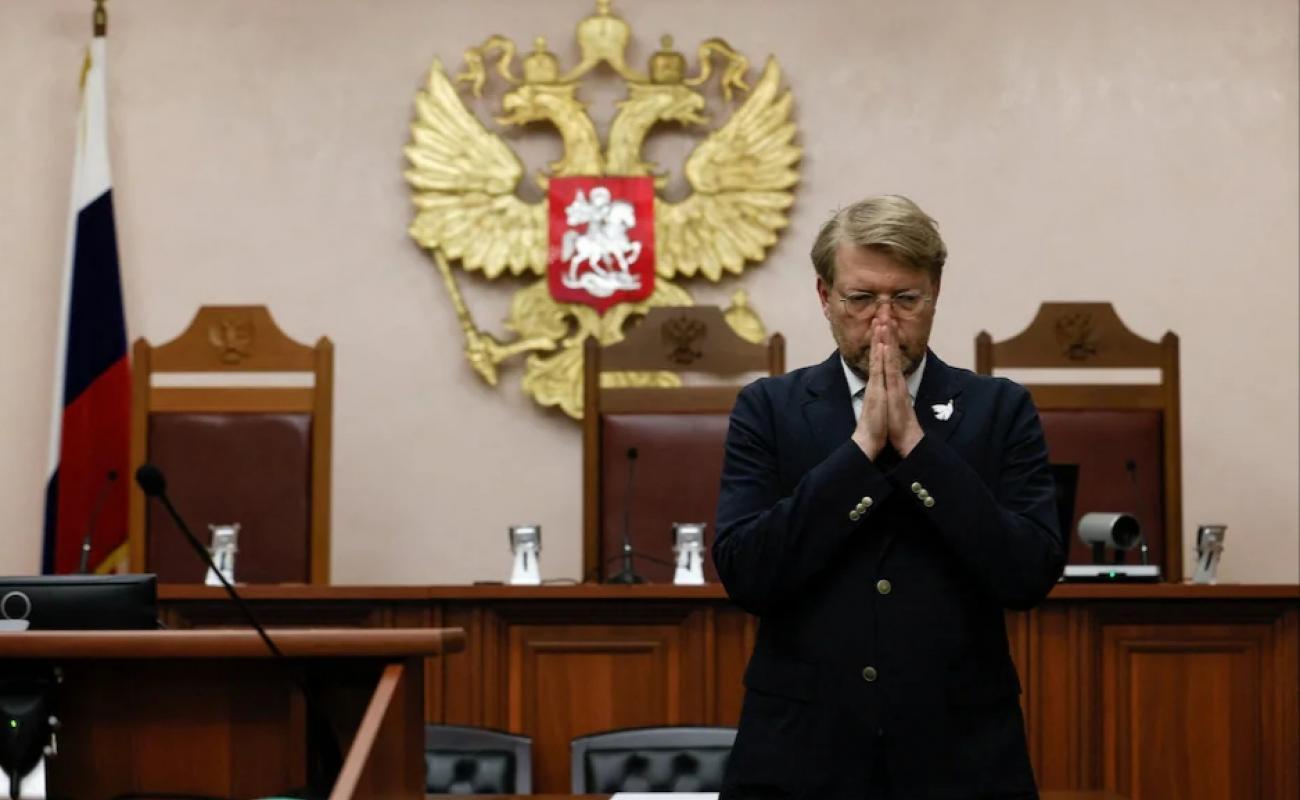
Yabloko barred from September ballot after lawsuit cites LGBT support and claims it breached copyright
Russia’s only anti-war party has been banned from running in parliamentary elections next month.
Yabloko – the only registered opposition party campaigning to withdraw troops from Ukraine – has been removed from the ballot just as it was starting to gain in polls.
The party had entered the campaign under the slogan “For peace and freedom!” and initially received approval to participate from the Kremlin-controlled Central Election Commission (CEC) in late July.
It was most recently polling at 5.5 per cent nationwide and 11 per cent in Moscow, probably because it offered voters a way to register their opposition to the war in Ukraine.
However, after a seven-hour hearing, Russia’s supreme court upheld a lawsuit brought by the nationalistic pro-Kremlin party Rodina (meaning “motherland”).
Rodina cited a raft of alleged offences, including Yabloko’s publication of online material in support of the “international LGBT movement”, which Russian officials have designated extremist. They also claimed Yabloko, which translates as “apple”, had discredited the country’s armed forces.
Rodina also claimed Yabloko had infringed copyright by quoting Soviet-era song lyrics; violated the rights of the US army by using a photograph of the atomic bombing of Hiroshima, and infringed on the rights of OpenAI by using images generated using ChatGPT.
At the hearing, CEC officials claimed to have uncovered evidence showing that candidates from Yabloko had received foreign funding in 2025.
The ruling leaves Russian voters with no registered party on the ballot offering an explicit challenge to the Kremlin’s increasingly unpopular four-and-a-half-year war in Ukraine.
Nikolai Rybakov, the Yabloko chairman, dismissed the allegations as “absurd” and maintained that the party’s anti-war stance was protecting majority interests in Russia.
He said the party would appeal the result, adding: “We have a long way ahead, and we have a big and important task: to stop deaths and bring peace back. Everything we do should be dedicated to that.”
Hundreds of protesters, many of them young people, had gathered in Moscow outside the supreme court to support Yabloko – some carrying apples and chanting: “Shame! Shame!” Police officers arrived shortly afterwards to disperse demonstrators.
An officer using a loudhailer told the crowd: “You have two minutes to leave. No one will come to get you out of the military enlistment offices afterwards.”
Yabloko, which was founded in 1993, emerged as one of the principal liberal factions in parliament in the 1990s, but was pushed to the political margins after Vladimir Putin came to power in 2000.
The party also opposed Russia’s war on Chechnya and the annexation of Crimea in 2014, though its chairman supported military intervention in Georgia in 2008.
Even before the ban, 14 Yabloko candidates had been barred from standing in the Russian election in September election. Eight members are behind bars, including Maxim Kruglov, the deputy leader, who was jailed for seven years in June over posts deploring civilian deaths in Ukraine.
Yabloko has not won a seat in the State Duma since 2003, but has been eligible to contest every election since then. Polling earlier this year put its support at about 3 per cent, well below the 5 per cent threshold required to enter Russia’s lower house.
However, recent independent polling put its support as high as 5.5 per cent nationwide and 11 per cent in Moscow, in what would be a significant upset.
Approval ratings for the ruling United Russia party fell to their lowest level in more than four years last month, down to about 33 per cent, according to Russia’s Public Opinion Foundation.
Roughly two-thirds of Russians believe Russia should begin negotiations to end the war, according to recent polling by the Levada Centre, a Moscow-based independent pollster. Despite this, more than 70 per cent still approve of the actions of the Russian military in Ukraine.