
How the Russian narratives became a domestic policy in Bosnia and Herzegovina
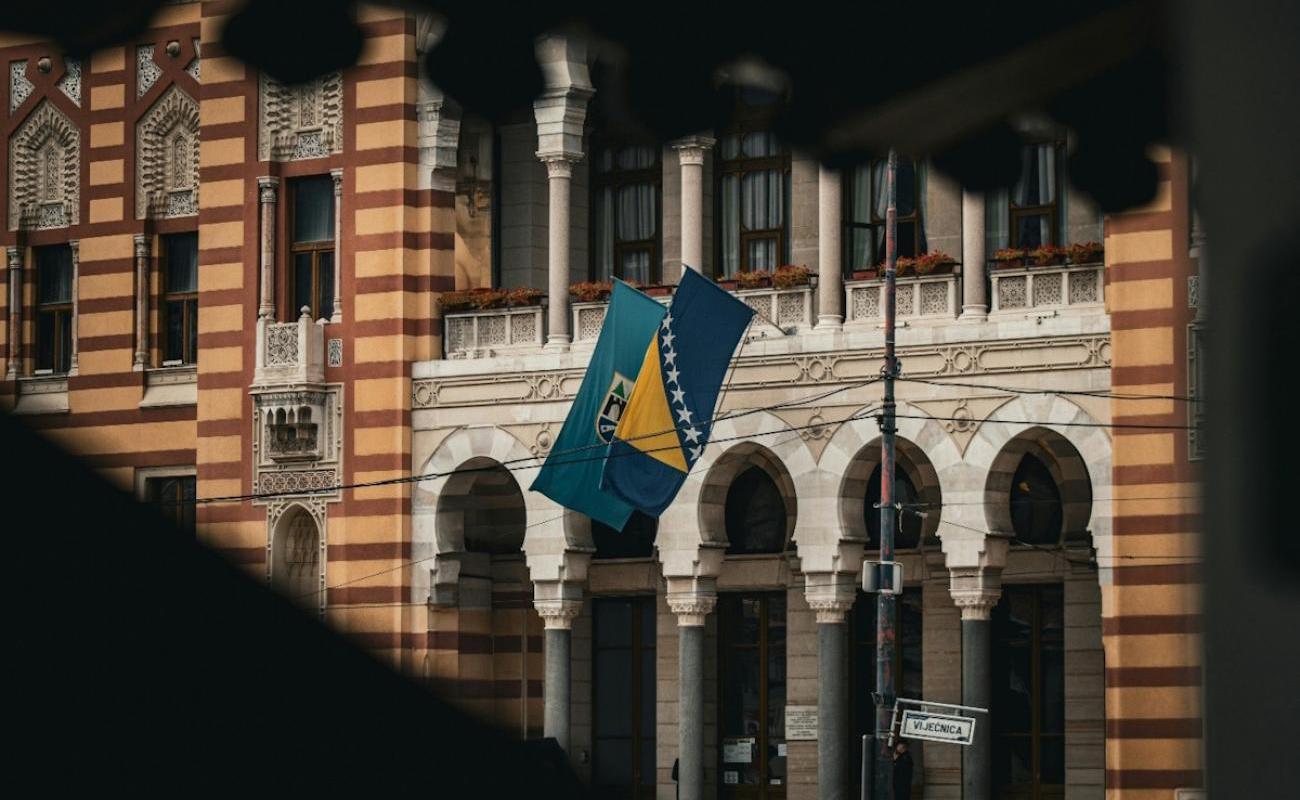
NATO and the EU are portrayed as a security threat rather than a framework for collective security. The result of all this is a dual foreign policy – one part of the country sits in Putin’s office, and the other in the EU’s waiting room.
When Russia launched its full-scale invasion of Ukraine in February 2022, the war was being fought thousands of kilometers away from Bosnia and Herzegovina’s borders. However, Russian narratives quickly found their way into Bosnia and Herzegovina, especially in the Bosnian entity of Republic of Srpska. The entity’s now-ousted President, Milorad Dodik, a long-time ally of Russian President Vladimir Putin, quickly took over the Kremlin’s narrative, and the stories of “Ukrainian Nazis”, “protection of the Russian people from genocide,” and “the right of people to self-determination” began to be repeated over and over again among the Bosnian public…
Moreover, some of the political elites in Bosnia and Herzegovina have been talking for years about the state being a “colony”, that high-ranking representatives for BiH are “viceroys”, that the European Union and NATO are a threat and not a political objective. According to such interpretations, true sovereignty does not come from Brussels, but from the “multipolar world” whose symbols are Moscow and, increasingly, Beijing.
Bosnia and Herzegovina, as an ethnically, politically and media-divided society, which still has vivid memories of the war of the 1990s and in which a sense of insecurity constantly reigns, is an ideal stage for such foreign information influence.
Russian interests are presented as own interests
Bosnia and Herzegovina is not an economic priority for Russia, but it is rather a political leverage for Russia, says in his analysis the dean of the Faculty of Political Science in Sarajevo, Sead Turčalo, explaining that the economic relations are based on almost complete dependence on Russian gas, which is used as strategic pressure and not as a sustainable business.
At the same time, by supporting anti-Dayton policies and demanding the abolition of the OHR, and by blocking the Western sanctions, Moscow is working to weaken the Western influence and keep Bosnia and Herzegovina away from Euro-Atlantic structures.
The fact that this is activity that is not hidden at all is confirmed by the publicly spoken attitudes of the Russian Embassy in Bosnia and Herzegovina, which stated that Bosnia and Herzegovina’s membership in NATO would be “an anti-Russian step to which Moscow would have to respond.”
This is in accordance with the Russian interests in the Western Balkans, which analysts, such as Dimitar Bechev, describe as an attempt to balance the power of NATO and the EU, to position Russia as a factor that disrupts Western initiatives, and to use the region as a leverage to exert influence on Brussels and Washington.
Foreign narratives, including Russian ones, enter through embassies, media outlets, economic projects, and “cultural cooperation,” but their real impact happens only when they are taken up by domestic politicians. At that point, the line between foreign and domestic influence becomes virtually invisible, and the average voter thinks he is not watching Russian propaganda, but a local “protection of national interests.”
Officials from the Bosnian entity of Republic of Srpska also present Russian interests and goals as their own, while simultaneously building an image of Russia as the main protector of the entity’s sovereignty. Dodik and his associates use veto mechanisms to block sanctions against Russia, challenge NATO membership, obstruct the adoption of pro-European laws, and systematically attack the High Representative – all of which is exactly in line with Russian policy towards Bosnia and Herzegovina. In the public discourse, this is sold as a protection of “sovereignty” and “neutrality.”
The choice between Brussels and Moscow
If viewed from a formal perspective, the story looks completely different. Bonia and Herzegovina is a candidate for EU membership and joining this political and economic community of European states is the main objective of its foreign policy. At the same time, reports from Brussels emphasize a high degree of compliance with the Union’s foreign and security policy, including statements and measures towards Russia.
However, evidence that things are a bit more complicated came recently from the Foreign Minister of Bosnia and Herzegovina, Elmedin Konakovic, who stated that BiH “fully supports the European Union’s sanctions policy towards Russia and Belarus”, but “the implementation remains subject to blockage by the SNSD, despite recent court proceedings against its president Milorad Dodik”.
Shortly before that, the country Minister for Foreign Trade and Economic Relations, Staša Košarac, who hails from Dodik’s SNSD, on behalf of Bosnia and Herzergovina signed a memorandum with a Russian agency that is on the EU sanctions list, and the Russian Embassy in Bosnia and Herzegovina boasted about a session of the joint commission for trade and economic cooperation that was organized in Sochi.
Milorad Dodik personally had several meetings with Putin, with the Russian Foreign Minister Sergei Lavrov and other Russian officials. Their closeness is best illustrated by the fact that Putin was awarded the Order of Republic of Srpska, which is the highest award of this Bosnian entity – on the other hand, Putin awarded Dodik the Order of Alexander Nevsky, which is one of the most significant Russian acknowledgments.
In his analysis, Turčalo describes Dodik (who, although no longer President of the Bosnian entity of Republic of Srpska, still has a dominant influence in the political life in that part of Bosnia and Herzegovina) as “the most prominent Russian fifth column in the Western Balkans.”
This relationship was further strengthened by the information war regarding Ukraine. Since the beginning of the full-scale Russian invasion of Ukraine, the Russian Embassy in Bosnia and Herzegovina has increased its presence on the social media in order to impose its version of events, says Detector.
Narratives of a “special military operation” are constantly being passed around, claims that crimes like those in Buča and elsewhere were “staged,” and parallels are continuously drawn between Donbas and Srebrenica, with the Srebrenica genocide being relativized or openly questioned. All of this fits easily into the already existing revisionism in certain parts of the political and media stage in the Bosnian entity of Republic of Srpska.
All this is complemented by statements given by domestic actors. For example, in May 2025, Dodik was interviewed by “Russia Today” where he stated that “Putin responded quite justifiably by launching the special military operation, after the numerous lies told by the West.”
Even more explicit was his close associate Darko Banjac, who said that he is “regretful that the Russian Federation’s special operation did not extend to all fascists and Nazis” and that he does not even want to go to “that f*cking European organization called the European Union” because it rejects the values that the EU associates with human rights and various identities.
In the same tone, NATO and the EU are portrayed as a security threat rather than a framework for collective security. The result of all this is a dual foreign policy – one part of the country sits in Putin’s office, and the other in the EU’s waiting room.
The narrative of “sovereignty” and “neutrality” relativizes the obligations towards the EU and NATO, and in that sense the influence of foreign information is no longer “something” that comes from outside, but becomes an integral part of the language of domestic politics.