
Fortifying NATO’s eastern flank
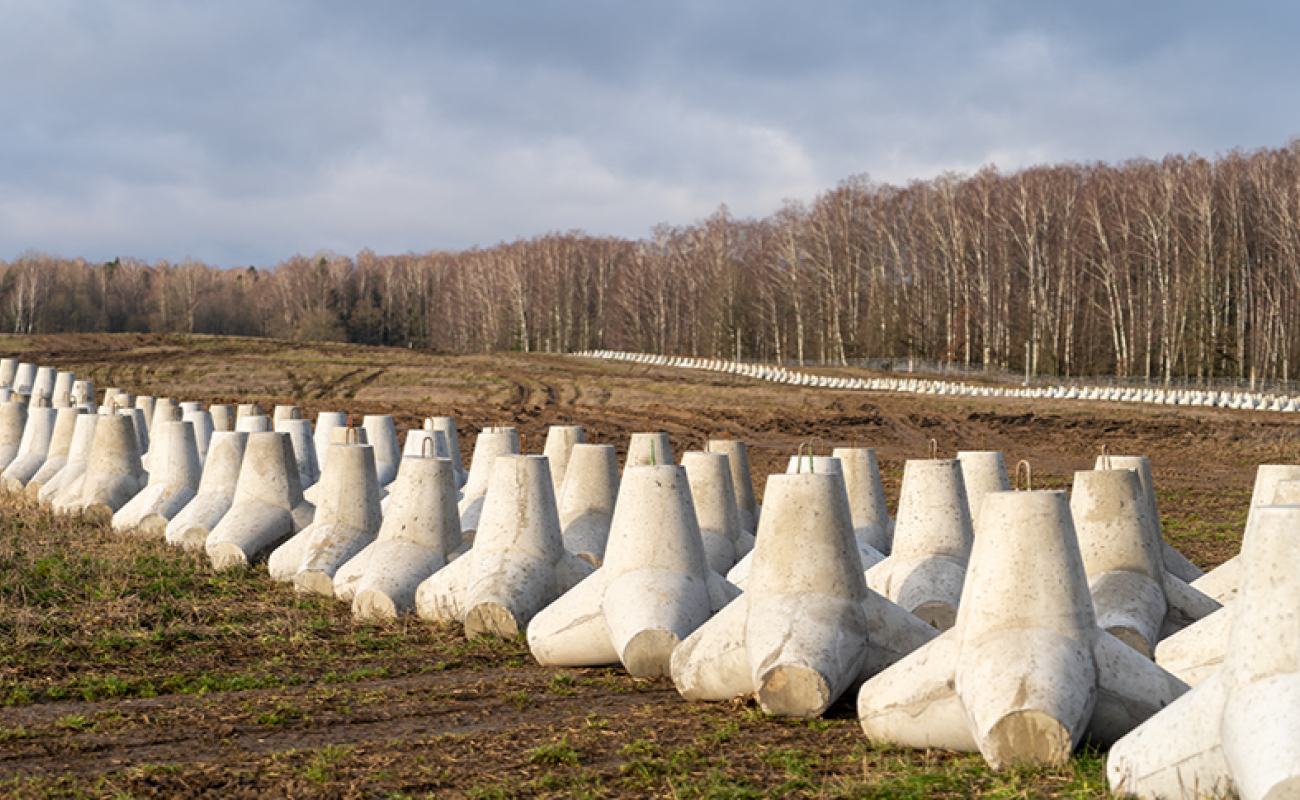
NATO’s eastern flank faces growing Russian ‘grey zone’ threats, including UAV incursions and sabotage. In response, frontline states have launched layered defensive programmes that combine fortifications, surveillance systems, and short-range air defences to better defend their borders.
The effects of Russia’s campaign of unconventional warfare in the ‘grey zone’ are being felt across NATO members, but it is on the Alliance’s ‘eastern flank’ that the threat from Russia is its most clear and present. On 9 September 2025, aircraft from the Polish Air Force and NATO’s Baltic Air Policing mission scrambled to intercept a wave of uninhabited aerial vehicles (UAVs) approaching Poland’s border from Belarus. Despite being pre-warned of their approach by Belarusian authorities and tracking by various ground- and air-based assets, at most four of the up to 23 UAVs that entered Polish airspace were shot down.
While there were no casualties and investigations showed that the UAVs were decoys with no warheads (Russian Gerbera systems were among the aircraft), the incursion exposed gaps in NATO’s air defences.
That incident was not isolated; rather, it represented an escalation of Russian activity that has combined overt military posturing with cyber attacks, sabotage of transport and critical infrastructure, and electronic interference, among a range of activities that remain difficult to attribute and are often conducted via proxies.
In the aftermath of the incursion, Poland invoked Article 4 of the North Atlantic Treaty – the first time since Russia’s full-scale invasion of Ukraine in 2022 and only the ninth time in the history of the Alliance – and on 12 September, NATO announced measures to improve air defences under Operation Eastern Sentry. The incursion has served to further galvanise NATO member states’ efforts to improve their military readiness, which, although under way before Russia’s full-scale invasion, have since accelerated. These efforts include a number of high-profile initiatives across the Alliance’s frontline states, ranging from policy changes to the construction of fortifications and enhanced air defences.
Defensive measures
Among NATO’s most visible efforts to improve its security are the Baltic Defence Line (BDL), announced by the defence ministers of Estonia, Latvia and Lithuania in January 2024, and Poland’s East Shield programme, which was outlined four months later in May. Timelines for the programmes are not fixed, but the BDL countries envisage that programme being a ten-year effort, while Poland has allocated around USD2.5 billion for the East Shield over the next four years alone.
The BDL and East Shield are constructing a network of what are described as ‘anti-mobility installations’ along the countries’ borders with Russia and Belarus. In the case of the Baltic states, these are intended to cover more than 1,600 kilometres when including Lithuania’s border with Kaliningrad. East Shield will address 700 km of Poland’s borders with Belarus and the Russian exclave.
Neither is intended to be a uniform line of defences; instead, they will be layered and up to 50 km deep, tailored to the varying terrain and use natural features to enhance protection when possible. The fortifications will help address the geographic vulnerability of the countries, which do not benefit from having significant natural barriers to an invasion, save for some waterways, wetlands and forested areas. In the case of the Baltic states, the fortifications are also intended to help mitigate their lack of strategic ‘depth’.
The BDL and East Shield are taking similar approaches in their design and all countries have started construction work – albeit to differing degrees. In Estonia, for example, after planning and procurement in 2024, the ministry of defence announced in June 2025 that work had begun on anti-tank ditches in the southeast of the country. It noted that by the end of the year, up to four kilometres would be completed along with the construction of up to 28 bunkers (out of a planned total of 600) and ten storage areas; ‘dragon’s teeth’ anti-tank obstacles are also being installed. In Poland, a five-kilometre section of the East Shield along the border with Kaliningrad was finished in July 2025, and work continues across the project.
Among the other features that will be included in the ‘layers’ are border-patrol fences and barbed wire, while trenches, minefields and other ‘explosive barriers’ will be installed when deemed necessary and bridges will be pre-prepared for demolition. In support of the defensive efforts, various staging and storage sites for equipment and materials are being built at tactical and strategic locations.
In addition, to limit manning requirements, broaden areas under observation and increase persistence, the defences will also employ surveillance systems, unattended sensors and uninhabited ground and aerial vehicles. In the case of East Shield, the networking of surveillance systems will likely include the aerostat-based airborne early-warning system that Poland is acquiring from the United States under ‘Project Barbara’. The four tethered aerostats will be equipped with radar and electronic intelligence payloads – the former having a 300 km range – and are intended to provide persistent detection and tracking of air- and ground-based threats, including UAVs and low-flying aircraft.
Questions have been raised over the utility of static fortifications in the face of an attack by Russian forces however, with some pointing towards the failure of Israel’s network of defences to stop the Hamas-led attacks in October 2023, and even raising the shortcomings of the Maginot Line in the Second World War. Others point to a well-organised and rapid mobilisation of forces, artillery, and air-defence and anti-tank systems as being a more effective deterrent.
Proponents of the BDL and East Shield note that the fortifications are not intended to be an absolute barrier to an attack; rather, they would serve to slow down any major offensive and buy time for national forces and NATO formations to respond. They also argue that they will be sufficient to push back smaller incursions, will influence enemy movement and improve survivability for defenders. Crucial to their efficacy will be understanding how the defences will ‘shape the fight’, as will developing strategies for mobilising in response to an attack.
A number of challenges beyond resourcing and constructing the defences have been identified, including how to generate the forces needed to man even limited aspects of the fortifications. Estonia, for example, has a regular army that numbers fewer than 4,000 personnel but is planning to build 600 bunkers. There could also be a problem with gaining local support for the construction of the BDL, especially in areas with majority ethnic-Russian populations. There will need to be a long-term consensus among the Baltic states to ensure fortifications are maintained and that there are not obvious gaps, else weaknesses that undermine its purpose may arise.
Aside from the construction of fortifications, the role of nature in deterring or shaping a Russian attack is also being factored in, with the ‘rewilding’ of areas included in plans for the BDL and East Shield. The strategic advantage provided to Finland by its lakes and wetlands has long been noted, and returning areas that once provided a barrier to their natural state, or even flooding others, could be a course of action to enhance defences along the eastern flank. During the early stages of Russia’s 2022 invasion, for example, Ukrainian forces demonstrated that by intentionally flooding areas they could deny the enemy important staging grounds and limit options for manoeuvre. Latvia and Lithuania are both pursuing rewilding in their defensive plans and have announced measures to restore wetlands in border areas.
Whither the Ottawa Treaty?
One aspect of the fortifications that has not been discussed widely is the potential use of anti-personnel (AP) landmines, which will become a possibility when the Baltic states, Poland and Finland complete their withdrawal from the Ottawa Treaty (Convention on the Prohibition of the Use, Stockpiling, Production and Transfer of Anti-Personnel Mines and on their Destruction). Over the course of several weeks in March and April 2025, these countries announced their intent to withdraw from the treaty, citing Russia’s aggression and its use of AP mines in Ukraine as driving factors in their decisions to do so. In June, Ukraine also announced it would be withdrawing, although it had already been using AP mines supplied by the US after then-president Joe Biden approved their delivery in November 2024.
In announcing their withdrawal, the defence ministers of the Baltic states and Poland said in a joint statement that ‘With this decision, we are sending a clear message: our countries are prepared and can use every necessary measure to defend our territory and freedom’, but stressed that they remain committed to international laws, including the protection of civilians during armed conflict.
Soon after the March announcement, Finland, Lithuania and Poland signalled their intent to support the domestic manufacture of AP mines, overcoming the issue of where new stocks might be sourced – globally, few countries actively produce them. On 20 March, Polish Deputy Minister of National Defence Paweł Bejda said that the country would launch production of AP mines to safeguard its borders with Russia and Belarus, adding that up to one million mines may be needed. In early July, Polish munitions manufacturer ZSP Niewiadów announced that it would commence mass production of AP mines in 2027.
In April, Finland’s Ministry for Foreign Affairs justified its decision to leave the Ottawa Treaty, stating that ‘Anti-personnel mines are well-suited for Finland’s national defence [and] make it possible to slow the advance of the attacker and minimise the defender’s casualties. [They] are technically simple and are therefore well-suited for training and use in a conscription system. They can also be produced quickly and in large quantities in Finland’.
Whether other NATO signatories to the Ottawa Convention will also withdraw is unclear, but area denial via minefields was an established concept during the Cold War – including through the use of AP mines – and it is possible that a renewed assessment of what is needed to deter and defend against a potential Russian attack could see a more pragmatic approach emerge. However, for some NATO states – including those currently contributing to NATO’s Forward Land Forces in Eastern Europe – this would raise challenging legal and ethical considerations.
A ‘drone wall’ for Europe
September’s UAV incursion further underscored the utility of one-way attack UAVs (OWA-UAVs), systems that Russia is using to generate significant ‘combat mass’, even if many are shot down. Its large-scale OWA-UAV attacks use comparatively low-cost types, such as the Geran-2 – their affordability and simplicity have enabled Russia to launch attack waves of hundreds of munitions that can overwhelm Ukrainian air defences. In addition, ultra-low-cost decoy UAVs, such as the Gerbera, can make up almost half of the attack waves.
These systems are relatively slow and fly at lower altitudes, however, and so are vulnerable to short- and very short-range air defences. Unfortunately for European armed forces, this is a capability shortfall, leaving them ill-prepared for the kind of large-scale attacks that Ukraine is facing.
Efforts to address deficiencies in short-range air defence (SHORAD) and very short-range air (VSHORAD) are under way, including through the German-led European Sky Shield Initiative (ESSI), which aims to close air-defence gaps with off-the-shelf procurement of systems. The ESSI is promoting Rheinmetall’s Skyranger family of remote-controlled turrets as a VSHORAD option, for example, and this can feature different calibres of cannon and short-range missiles. Elsewhere, the manufacture of man-portable air-defence systems, such as the Polish Piorun, is ramping up, and there are several efforts in Europe to develop laser-based directed energy weapons that will have utility in SHORAD and VSHORAD.
Initiatives focused on countering the UAV threat on the ‘eastern flank’ have been established. The Baltic states and Poland have been joined by Finland in the Baltic Drone Wall programme, which was announced in early 2025, while the European Union’s European Drone Defence Initiative forms part of the Readiness Roadmap 2030.
The Baltic Drone Wall is meant to develop networks of autonomous surveillance systems that leverage artificial intelligence (AI) and which are integrated with hard- and soft-kill countermeasures, with the latter including missiles and so-called ‘interceptor UAVs’, all of which will be overseen by a command-and-control system. Plans for the European Drone Defence Initiative envisage a similar layered and networked approach, but additionally feature a UAV-based precision-strike capability.
The Baltic Drone Wall project places an emphasis on local industry to deliver capabilities and is being led by Estonian company DefSecIntel in this regard, whose autonomous surveillance platform SurveilSPIRE has been deployed in Ukraine.
Drawing on lessons learned from Ukraine will be a key aspect of the project, and it is exploring a range of novel technologies, including low-cost interceptors from European defence start-ups that may offer the defensive ‘mass’ and affordability to counter large-scale attacks. Ukraine has achieved a high level of success in its use of interceptor UAVs in this regard, and Baltic Drone Wall demonstrations held in 2025 have included tests of Latvian company Origin’s Blaze interceptor integrated with DefSecIntel’s Eirshield AI-assisted counter-UAV system, which is designed to detect, classify, track and manage the engagement of targets.
While Europe’s defence start-ups are heavily involved in developing the technologies required for the Baltic Drone Wall, they remain nascent. Many of these technologies are showing promise and have developed rapidly within the ‘fail fast’ culture of the start-up sector, but there is still some way to go, and continued investment and government support will be required if they are to mature and become effective systems. The war in Ukraine is supporting their development in this regard, with companies refining their offerings with the support of Ukrainian enterprises and know-how, and some systems are undergoing ‘trial by fire’ in the country.
Scaling production may also be a significant challenge for these ‘newcomers’. This is an issue that Frankenburg Technologies has moved to address in a partnership with Poland’s state-owned defence company PGZ, which is intended to see up to 10,000 of Frankenburg’s Mark 1 low-cost ‘anti-drone’ missile manufactured per year in Poland.
The need to scale production and field capable systems in short order lends weight to including established ‘missile houses’ in providing solutions for the Baltic Drone Wall. These companies have responded to the demand signals for lower-cost interceptors. For example, Saab debuted its Nimbrix missile at the DSEI exhibition in London in September, and in November, MBDA received a contract from Germany’s Federal Office of Bundeswehr Equipment, Information Technology and In-Service Support (BAAINBw) for its DefendAir missile system – previously known as the Small Anti-Drone Missile – which will be integrated onto the Skyranger 30 air-defence vehicle as part of the Short- and Very Short-Range Protection (NNbS) project.
While developing systems to tackle the UAV-based threat is receiving much attention, NATO’s European members are not disregarding the need for ‘higher end’ air defences. Defence ministers endorsed the Alliance’s integrated air and missile defence (IAMD) policy in February 2025, with the document stating that ‘Ensuring the volume and quality of defensive systems against all range[s] of air and missile threats is a critical factor for ensuring the strength and durability of NATO IAMD’. In June, NATO Secretary-General Mark Rutte stressed the importance of addressing the volume challenge when he outlined a requirement to increase NATO IAMD capability by 400%. Whether or not that ambitious target includes the low-cost interceptors that are envisaged for the Baltic Drone Wall and other efforts is unclear, but even if they are, NATO has some way to go given existing shortfalls in inventories.
While the immediate threat may be most pressing for those on the Alliance’s eastern flank, NATO members across Europe also need to address the challenges posed by UAVs. Russia’s Geran-2, for example, has a range of 2,000 km and can strike targets across the continent; that system and others will also need to be accounted for when considering the defensive measures that forces will need when forward deployed.
With recognised capability gaps across domains, addressing the UAV-based threat adds to the financial burden and difficult investment decisions that governments face, many of whom have limited fiscal headroom to work within and ambitious capability targets set by NATO.