
Armenia’s strategic pivot from Russia to the West
Geopolitics in the South Caucasus has long been rooted in a tension between two centers of gravity. One is represented by the North-South Transport Corridor that links Russia with Iran, and the other by the emerging east-west corridor, also known as the Trans-Caspian International Transport Route or simply the Middle Corridor, that links China with Europe. The relative importance of each corridor for the South Caucasus is fundamentally shifting, to the detriment of Russia. Although Moscow retains clout in Georgia, across the remainder of the region its influence is waning fast. By far the best illustration may be found in Armenia.
EPC highlights Armenia’s westward pivot
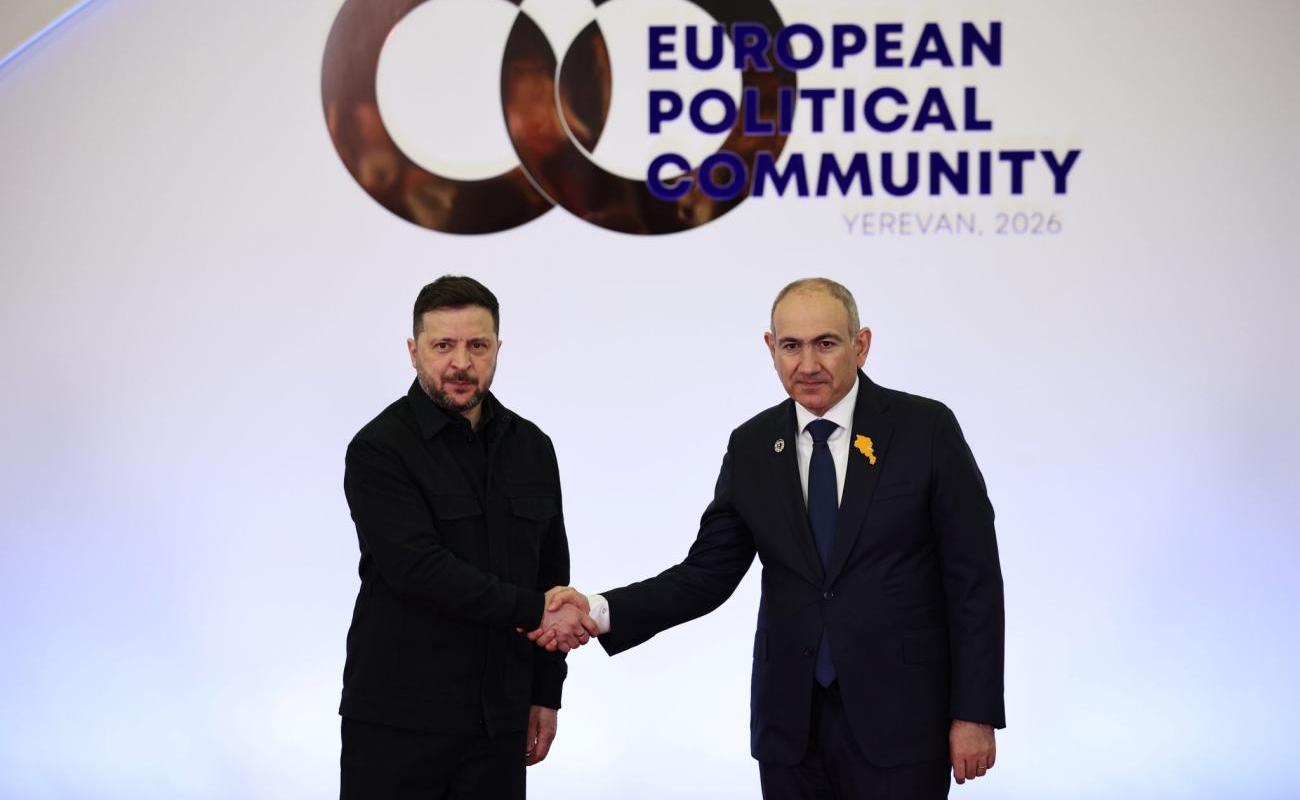
Long considered one of Russia’s closest allies, Armenia is part of the Russian-led Eurasian Economic Union, has participated in Russian military drills and hosts the largest Russian military base outside the Russian Federation. However, its loyalty to the Kremlin is being supplanted by its strong desire to join Europe. Armenia drove home this message in early May when it hosted the 8th Summit of the European Political Community (EPC) in its capital, Yerevan.
In and of itself, the EPC is not overly important. Founded in 2022 in response to the Russian full-scale invasion of Ukraine, its mission has been to maintain a united European front against Russia and Belarus. When it met for its first summit in Prague, in October 2022, the heads of 44 European countries participated, together with the presidents of the European Commission and of the European Council. On May 4 of this year the summit gathered the leaders of 47 European countries (with the addition of microstates San Marino, Andorra and Monaco). Both times, the gathering excluded Russia and Belarus.
The decision to meet in Yerevan offered a powerful reflection of how geopolitical realities are being transformed. Up until a few years ago, Georgia was the primary focus for European and American policy making in the South Caucasus. Slated for membership of the European Union, it was a leading member of the EU’s Eastern Partnership initiative. Following the rigged parliamentary election in October 2024, and the subsequent increasingly authoritarian stance of the Georgian Dream government, its standing has deteriorated substantially. Meanwhile, Azerbaijan has been considered highly problematic in terms of human rights abuses. As such, it was logical that Armenia would be chosen to take Georgia’s place.
This said, the decision to meet in Yerevan was not by default but rather due to a fundamental transformation of Armenian relations with its immediate neighbors and with Europe. The key feature was the resolution of the long war between Armenia and Azerbaijan for control over Nagorno-Karabakh, a mainly Armenian-inhabited enclave within Azerbaijan. The endgame played out in 2023, when Azerbaijani forces routed the Armenian defenders, causing a mass exodus of Armenian civilians. Importantly, the Russian peacekeepers that had been deployed to keep the two sides separated opted to stand aside and watch.
Feeling it had been betrayed by its Russian guarantor, the Armenian government opted to accept the humiliating defeat and engage in peace negotiations with Azerbaijan. When those negotiations resulted in a peace agreement, the road was clear for the country to chart a new course away from Russia. In addition to undertaking legislative preparations for membership in the EU, it has taken steps to soften its relations with both Azerbaijan and Turkiye. The latter is especially important. If relations between Ankara and Yerevan can be normalized, and the border can be opened, Armenia will no longer be dependent on Iran for a lifeline.
Facts & figures
Timeline: The Nagorno-Karabakh wars
1988-1994: First Nagorno-Karabakh war
As the Soviet Union collapsed, ethnic Armenians in the Nagorno-Karabakh enclave – legally part of Soviet Azerbaijan but majority Armenian – declared independence. A brutal war followed, ending with Armenia in control of the enclave. Russia brokered the 1994 Bishkek ceasefire, leaving Azerbaijan furious and Turkiye’s border with Armenia shut in solidarity with Baku.
1994-2016: Frozen conflict
The Organization for Security and Co-operation in Europe Minsk Group, co-chaired by Russia, France and the U.S., spent decades mediating without resolution. Azerbaijan used its oil wealth to rearm, and Turkiye deepened military ties with Baku. Armenia leaned on Russia for security guarantees through the Collective Security Treaty Organization (CSTO).
2020: Second Nagorno-Karabakh war (44 days)
Azerbaijan launched a full offensive in September 2020, deploying Turkish Bayraktar drones and recapturing most of Nagorno-Karabakh and surrounding territories in just six weeks. Russia brokered a humiliating ceasefire for Armenia in November. Crucially, the CSTO provided no military support, exposing the hollowness of Yerevan’s security relationship with Moscow and triggering deep Armenian public anger.
2023: Azerbaijan retakes all of Nagorno-Karabakh
In a 24-hour offensive in September, Azerbaijan seized full control of Nagorno-Karabakh. Over 100,000 ethnic Armenians fled to Armenia within days in one of the fastest episodes of mass displacement in recent history, as Russia stood by.
2023-present: Armenia loses faith in Russia
The loss of Nagorno-Karabakh broke the logic that had kept Armenia inside Russia’s orbit. Yerevan suspended CSTO participation, opened EU visa liberalization talks, hosted joint U.S. military drills, and ratified the Rome Statute – a pointed move given the International Criminal Court’s arrest warrant for President Putin.
Armenia joins Europe in support for Ukraine
When the EPC convened in Yerevan, it was the first time that it met in Armenia. To Russian President Vladimir Putin it must have been deeply disturbing to have to watch the meeting being co-chaired by the prime minister of Armenia, Nikol Pashinyan, and the president of the European Council, Antonio Costa. Even worse for Russia was that Ukrainian President Volodymyr Zelenskiy was invited to give an opening speech.
Read more on the South Caucasus:
- Russia’s waning influence in the South Caucasus
- Georgia – a strategic outlier in Russia’s regional retreat
- U.S. eyes greater influence in the South Caucasus
In another first, a non-European country was invited to the event. Speaking as a guest, Canadian Prime Minister Mark Carney used the occasion to reiterate his emphasis on the need for middle powers to stand up in defense of the rules-based international order. In a stab at United States President Donald Trump, he projected a new vision: “It is my strong personal view that the international order will be rebuilt, but it will be rebuilt out of Europe.” Presenting Canada as the “most European of non-European countries,” he said he would work to deepen relations with Europe on matters like the war against Ukraine. In his speech, President Zelenskiy also noted that the Yerevan summit symbolized the shared values of Canada and the European Community.
For Ukraine, the meeting was important in providing an opportunity for President Zelenskiy to have a personal meeting with Slovak Prime Minister Robert Fico. Following the electoral defeat of the government of Viktor Orban, the dawn of new Hungarian foreign policy and more cooperative relations between Kyiv and Budapest, hopes are that relations between Ukraine and Slovakia – which have been strained particularly over the Druzhba oil pipeline – will also improve. Thanking Prime Minister Pashinyan for giving him this opportunity, President Zelenskiy expressed confidence that reciprocal visits to Kyiv and Bratislava will pave the way to better relations.
Armenia’s warming relations with historical foes
Aside from the summit’s role in providing a platform for such important geopolitical transformations, it also showed that Armenia is reaping the rewards of a policy of confidence building in relations with Turkiye. During the summit, Prime Minister Pashinyan had a meeting with Turkish Vice President Cevdet Yilmaz – whose presence represented the first high-level Turkish visit to Armenia since that of President Abdullah Gul in 2008 – in which they agreed to restore the medieval Ani Bridge. The bridge spans the Arpacay River, which currently marks the Armenian-Turkish border, and during the 13th and 14th centuries it suffered multiple waves of invasions and earthquakes, leaving it destroyed. The decision to rebuild is a signal that the border between the two countries, which has been closed since 1993, may be reopened.
The main gain for Turkiye in upgrading its relations to Armenia lies in access to the Zangezur Corridor, a 42-kilometer stretch of land in southern Armenia that borders Iran and separates Azerbaijan proper from its Nakhichevan exclave. While the war over Nagorno-Karabakh was still raging, the corridor was closed and Turkiye was forced to conduct trade with countries in Central Asia via Iran. As part of the peace agreement between Armenia and Azerbaijan it will now be reopened. Although the route will be subject to Armenian law, and the land will remain sovereign Armenian territory, good relations between Ankara, Baku and Yerevan will help it develop into an important transport artery.