
"The war is coming to an end," Putin said. Is that really true?
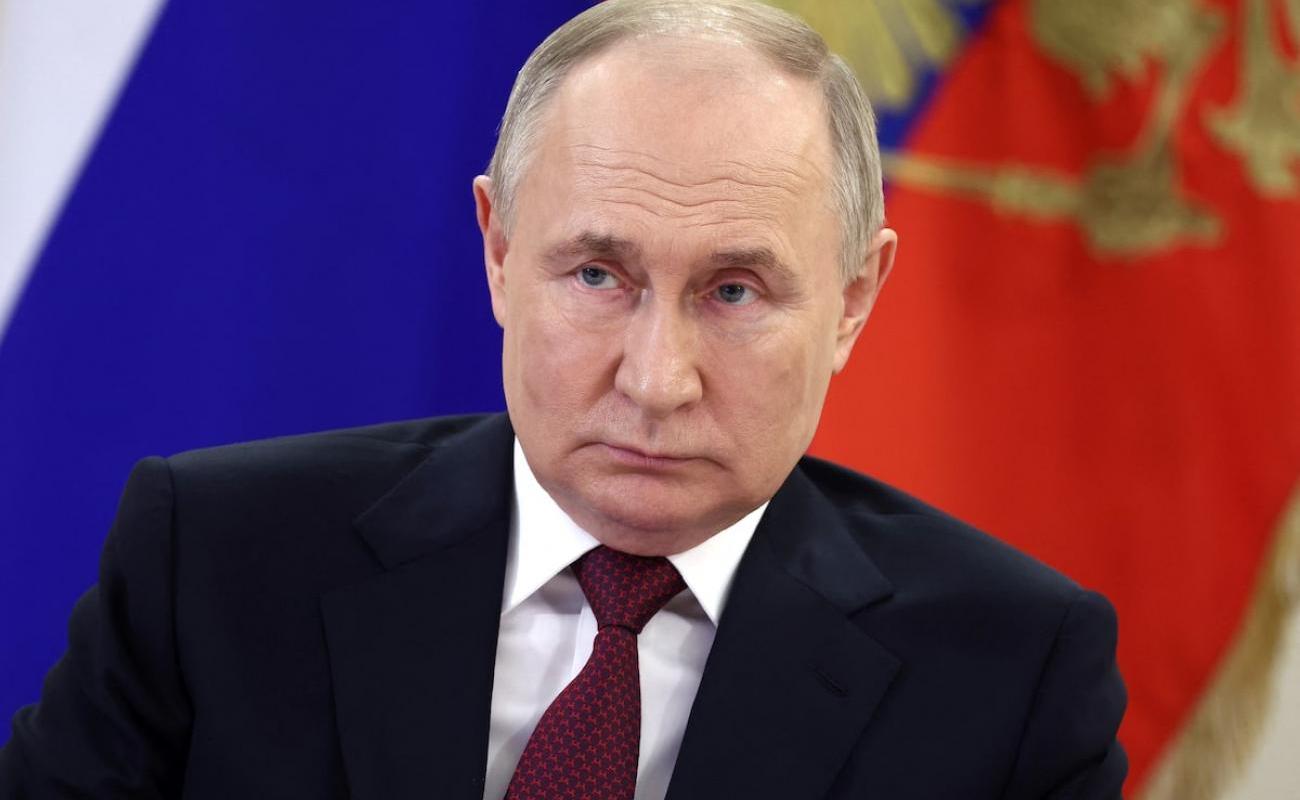
One of the main topics of the past weekend - the Victory Parade on Red Square - was unexpectedly pushed into the background by Vladimir Putin's statement about the possible end of the war. "I think it is coming to an end," Putin said. But how much can this statement be trusted?
The statement was made during a rare, extensive interview with reporters on such a sensitive topic for Putin - and immediately after what was probably the most unusual May 9 parade in Moscow in many years.
This time, there were no usual columns of tanks, missile systems and intercontinental ballistic missiles on Red Square. Russian authorities explained the shortened format by security reasons - primarily the threat of attacks by Ukrainian drones.
The BBC's Steve Rosenberg, who was working in Red Square, noticed that there were noticeably fewer journalists, guests and foreign leaders at the parade than in previous years.
The British magazine Economist called the parade a symptom of Russia's growing vulnerability: for the first time in two decades, military equipment did not pass through Red Square, as its concentration could become an easy target for Ukrainian drones.
On the other hand, the Times newspaper noted that the shortened format of the parade was a blow to the image of complete control and unshakable stability - an image that for authoritarian leaders has not only symbolic, but also political significance.
However, after Putin's press conference, the news agenda noticeably changed. The media focus was no longer on why the Kremlin was unable to hold a traditional demonstration of military power, but on the question: is the war really coming to an end?
Putin's words about the "end" of the conflict were heard in response to the question of the Kremlin's chief television reporter, Pavel Zarubin: "Isn't the West allowing itself too much?" - referring to Ukrainian strikes on Russian territory.
In response, the Russian president once again resorted to the usual theses that the "globalist wing of the Western elites" is fighting Russia "with the hands of Ukrainians." He also mentioned Ukraine's desire to join the EU and expand NATO to the east.
Speaking about the start of a large-scale war in 2022, Putin returned to the topic of the so-called Istanbul agreements and once again mentioned the then Prime Minister of Great Britain, Boris Johnson. According to Putin, Johnson allegedly persuaded Kiev not to sign the agreement, because it was unfair to Ukraine.
"And who determines whether it is fair or not? If the head of the Ukrainian negotiating team initialed these documents, what was unfair in them?" Putin said.
He added that the West, after promising support for Ukraine, actually "incited a conflict with Russia," which continues to this day.
“I think the matter is coming to an end. But this is still a serious matter,” the Russian president said.
Responding to a question from Kommersant correspondent Andriy Kolesnikov about possible talks with Volodymyr Zelensky, Putin reiterated that he was ready for dialogue.
First, he said that he could talk to Zelensky in Moscow, and then, for the first time, suggested the possibility of a meeting “in a third country.” At the same time, he clarified that this was possible “only if final agreements on a peace treaty are reached.”
In his report from the press conference, Andriy Kolesnikov noted that Putin “looked extremely peaceful” this time.
The Ukrainian president later stated that Ukraine had actually “pushed” the Russian president to talk about meetings and negotiations.
“We must end this war and reliably guarantee security,” Volodymyr Zelensky stressed.
Has the issue of ending the war moved from the deadlock?
Commentary by BBC correspondent Elizabeth Focht
It is too early to draw such conclusions.
Firstly, speaking of the fact that "the matter is coming to an end", Vladimir Putin did not forget to mention the need to "defeat" the enemy.
Secondly, although he called the Ukrainian president "Mr. Zelensky" and acknowledged the possibility of a personal meeting with him, he immediately made an important clarification: such contact is possible only for the purpose of signing a final peace agreement. Whether this is the format of negotiations that Volodymyr Zelensky has in mind when he speaks of Putin's readiness "for real meetings" is an open question.
It is also worth paying attention to the latest statements of Putin's aide Yuri Ushakov, one of the key leaders of the negotiation process from the Russian side. His quote that American negotiators Steve Witkoff and Jared Kushner would come to Moscow again was widely published in the media. However, Ushakov himself formulated it much more cautiously: "sooner or later, I think, quite soon". Such a phrase does not yet look like an official confirmation of a quick visit.
We should not forget the words of US Secretary of State Marco Rubio, who just a few days ago directly stated that the trilateral negotiations had reached an impasse. Rubio, a politician extremely close to Donald Trump, stressed that Washington does not want to waste time and resources on a process that does not show progress, although the United States remains ready to play a positive role.
Back in late March, the BBC explained in detail why the negotiations between Russia, the US and Ukraine, which intensified in February, are at a standstill. And the point is not only that the White House's attention is now mainly focused on the Middle East. BBC interlocutors close to the negotiation process said without hesitation: the dialogue has reached an impasse due to the inability of the parties to come close to a compromise on the key and most painful issues.
The main issue is the future of the Donbass territories. In the same interview, where words about the possible visit of Witkoff and Kushner were heard, Yuri Ushakov made it clear: Moscow, as before, expects Kiev to completely abandon the territories of the Donetsk and Luhansk regions.
The Ukrainian authorities have repeatedly stated that they are not considering the option of unilaterally withdrawing troops from their own territories. And it is unlikely that Kiev's position has changed radically during this time.
All this does not mean that there will not be a new round of negotiations in the near future. But there are few signs that they could end differently than the previous ones.
Is Russia capable of continuing the war?
The Economist writes that for the first time in three years of war, the initiative seems to be fully transferred to Ukraine. The publication draws attention to the massive attacks on Russian energy infrastructure, as well as the lack of noticeable successes of the Russian army on the front.
According to the American Institute for the Study of War (ISW), in April Russia lost more territory than it managed to capture for the first time since the Ukrainian invasion of the Kursk region in August 2024. The Economist estimates these losses at approximately 113 square kilometers over the past 30 days.
However, Western analysts warn: Russia's increasing vulnerability does not mean that it will lose the ability to continue the war in the near future.
The Royal Institute for Defense Studies RUSI notes that Moscow's strategy remains unchanged - to exhaust Ukraine's ability to resist.
According to the Institute's experts, the Russian economy is still capable of supporting military spending, although the gradual depletion of reserves and the growth of the debt burden make Russia increasingly vulnerable to external shocks and the pressure of sanctions.
The US Center for Strategic and International Studies (CSIS) notes in one of its analytical reports that Russia is capable of continuing the war for at least another two to three years. The center's experts draw attention to the Kremlin's ability to adapt to sanctions, effective state support for the defense industry, as well as assistance from China, Iran and North Korea.
In addition, Russia remains an authoritarian state in which public war fatigue and economic difficulties do not pose a critical threat to the system due to the lack of effective mechanisms for political pressure from society on the government, the researchers write. The Kremlin tightly controls public debate, suppresses independent media and punishes dissenters, which significantly reduces the risk of open protests against the continuation of the war.
Last week, the Russian think tank Dossier reported on a closed-door presentation, allegedly shown to a group of people close to the first deputy head of the Russian presidential administration, Sergei Kiriyenko.
The publication suggests that the Kremlin is considering a scenario in which Russia takes control of the Donetsk and Luhansk regions, the Kherson and Zaporizhia regions are effectively divided along the front line, European sanctions remain in force, US sanctions are lifted, and Volodymyr Zelensky retains the post of president of Ukraine.
According to the Dossier, the Russian presidential administration is also considering how to present such a scenario to Russian society as a victory in the war.
Analysts at the Carnegie Center note that the war has long become not only a foreign policy project for the Russian authorities, but also an important mechanism of internal control. It is the war that the Kremlin uses to justify new restrictions, repressions, and further militarization of the state.
Therefore, the researchers believe, the Kremlin may have two parallel scenarios at once. The first is the gradual preparation of society for a possible end to the war if an agreement is reached that can be presented as a victory.
Another is the continuation of hostilities, if Moscow still believes that time is on its side.