
Journey to Ukraine's eastern front reveals truth behind Moscow's broken ceasefire
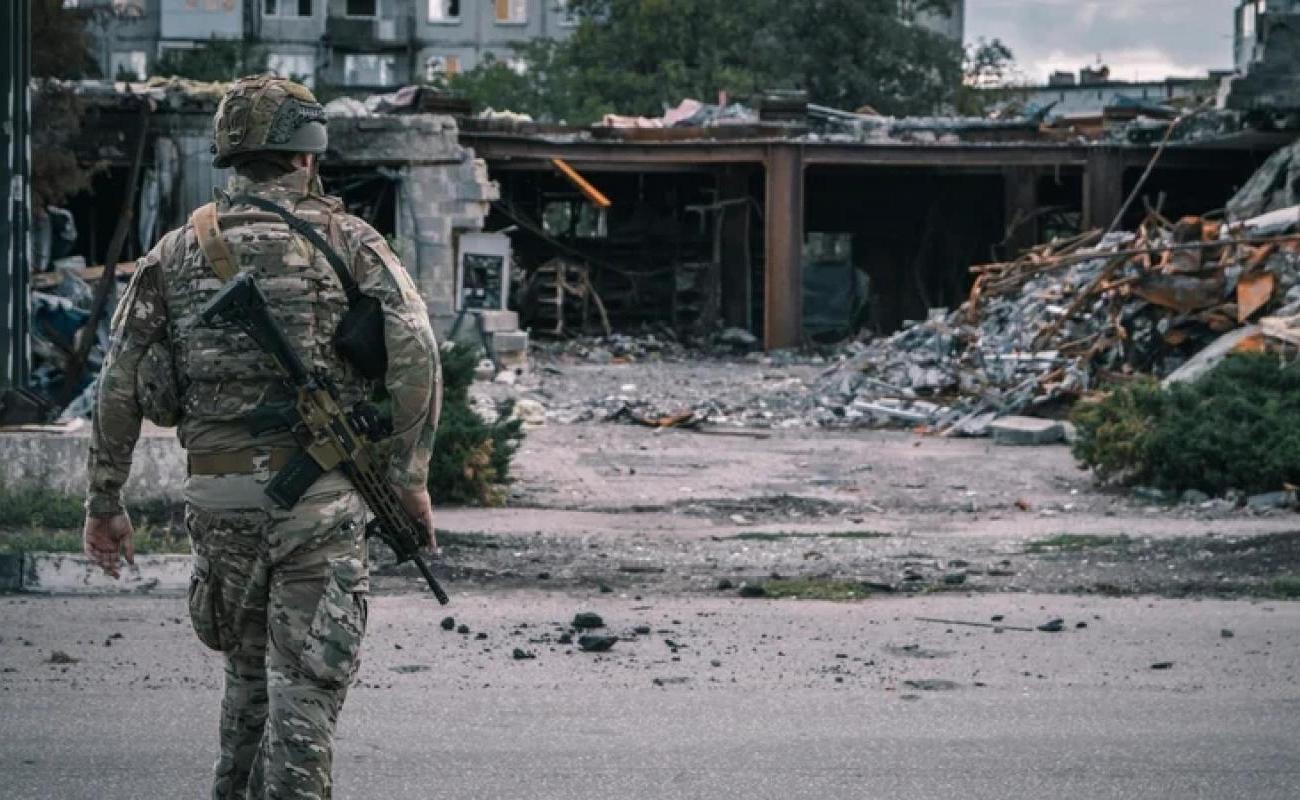
Russia violated all attempted ceasefires in early May, prompting NV to travel to the front lines in Donetsk Oblast to verify the true battlefield conditions, journalist Serhii Okunev reported in his exclusive dispatch on May 13.
Despite the diplomatic noise surrounding a U.S.-brokered regime of silence, the journey to the embattled towns of Dobropillia and Bilytske paints a grim picture of relentless drone strikes, devastating aerial bombs, and trapped civilians.
They didn't even pretend: What Russia's May 8 ceasefire turned into
The route to the southern part of the Ukrainian-controlled territory of Donetsk Oblast runs through Dnipropetrovsk Oblast. The car carrying the military and the NV journalist passes through the city of Pavlohrad just as another notification about Russian strike UAVs over the settlement appears. This has long become a routine for Pavlohrad, as have the daily lengthy air raid alerts. However, on May 8, many hoped for a break from drone attacks and alarms.
A week prior, the Russian side actively promoted the idea of a ceasefire from May 8 to May 10, which theoretically сould imply a ban on Ukraine attacking the Russian capital during the May 9 parade in Moscow. In response, Ukrainian President Volodymyr Zelenskyy called for a truce starting May 6. Instead, Russian politicians erupted in a wave of threats and intimidation, specifically announcing "retribution" in the event of attacks on Russia and Moscow.
Russia completely ignored Ukraine's ceasefire proposal from May 6. While in 2025, when ceasefires were implemented for the first time during the full-scale invasion, the enemy at least tried to imitate a reduction in shelling and attacks, this time May 5, 6, or 7 were no different from an ordinary day of full-scale war. This was confirmed by seven different NV sources in brigades and units across all front sectors, from Sumy, Kharkiv, and Donetsk oblasts to Zaporizhzhнa and Kherson oblasts. Ukrainian military personnel recorded no decrease in the intensity of shelling or attacks anywhere.
"Overall, we only have defensive operations in almost all directions and sectors of the front right now. If the enemy stopped their attacks, shelling, assaults, and movements, we could easily implement a ceasefire," an officer in the command of a unit fighting on the southern front commented on the situation.
"I cannot say whether it is possible to guarantee literally total silence, zero shelling, or zero drones, but we could definitely reduce them by 90-95%. We were ready. But the enemy didn't even pretend; on our sector, they even increased the number of attacks. Not critically, but there was an increase in intensity, specifically in our sector," the NV interlocutor added.
At the same time, Russian media focused intensely on their version of the truce, which was supposed to start on May 8. Russian propaganda even published nearly weekly reports about the occupiers' fake "compliance" with the ceasefire regime and the allegedly "numerous and brazen violations" by Ukrainian Defense Forces.
"KAB launches toward Dobropillia," the duty officer reports via tablet to the crews now stationed in the city.
Amid talks of a possible truce, NV journalist Serhii Okunev arranged an attempt to reach Dobropillia alongside soldiers from the Kara-Dag 15th Operational Purpose Brigade of the National Guard of Ukraine. A portion of this brigade relocated to the Dobropillia direction relatively recently, finally reuniting with its Azov corps. Before that, the Kara-Dag brigade defended the Kupyansk direction for a long time.
Hopes for even a slight decrease in the intensity of hostilities completely collapsed. May 8, despite the loud headlines of Russian propagandists, was no different from all previous days.
"I don't see any difference between the situation yesterday, a week ago, or today. In just half a day on May 8, the Russians have already launched at least four waves of massive guided aerial bomb strikes on the city of Dobropillia alone. All other enemy weapons are also working. The occupiers are trying to assault and attack with infantry right today, right now you can see this through our drones, here from the command post," Kubik, the deputy company commander of the Kara-Dag 15th NGU Brigade, emphasized on May 8.
One does not even need to be physically present in Dobropillia to confirm this information. Large screens at the command post display dozens of drone video feeds. The footage shows fires in residential areas and even live broadcasts of assault actions. Right during the journalist's visit, drones spot occupiers attempting to bypass or even attack Ukrainian positions, and these are not isolated incidents.
Another warning sounds: "Drones heading for Dobropillia!" and at that moment, explosions can be heard right out on the street. The bombs fall many kilometers away from the command post, which is located in the immediate rear. However, the power of the aerial bombs is such that the sound travels even a dozen kilometers. The last group of journalists who visited Dobropillia with Kara-Dag fell under a similar attack. Several aerial bombs hit the very building where the press and military were staying. The area of this city and the surrounding private sector is comparable to the smallest district of Kyiv — the Pechersk district. Up to 30-40 guided aerial bombs can hit such a small target area in a single day, mostly hitting multi-story buildings.
Yet, powerful KABs might not even be the biggest problem. As in all other front sectors near Dobropillia, the enemy is attempting to control Ukrainian logistics. While in 2024 it was possible to "fly" an ordinary car to within a couple of kilometers of the positions, moving even in an armored vehicle 10-15 km from the "zero line" is now extremely dangerous. The military shares recent statistics on enemy UAV strikes against logistical routes to Dobropillia.
The conclusion is grim. The ceasefire is completely disrupted, the roads are covered by drones, and breaking into Dobropillia for the sake of a story while endangering the soldiers themselves is unfeasible. After this decision is finalized at a mini-meeting involving the NV journalist and the military, another seemingly routine warning sounds:
"KABs toward Dobropillia." You quickly lose track of whether this is the sixth or seventh wave just today.
The sounds of the truce: What the U.S.-brokered ceasefire changed
Having canceled the trip to Dobropillia, the NV journalist stays overnight with the soldiers in a private house a couple of dozen kilometers from the front. The military and NV journalist receive news of a new, third version of the truce — brokered by the US for May 9-11 — after the conditional "lights out" order. No one present in the house believes in a real ceasefire.
Throughout the night, if you approach the window and listen closely, you can hear several more powerful explosions. The same bombs are hitting various settlements — both Dobropillia itself and much deeper into the Ukrainian rear. This is what the truce sounded like on the night of May 9, when the "American" version of the ceasefire was supposed to be in effect, and the Russian parade was only hours away. Meanwhile, silence at the front and even near it never materialized.
"In the first few hours, the artillery stopped working, we noticed," said one of the top commanders responsible for the Pokrovsk front sector.
"It lasted conditionally until morning. But then everything started anew: aviation, artillery, drones. There were also attempts by the enemy to advance, both on the May 9t, 10t, and 11t. We stopped these attempts."
Changes on the Dobropillia front were completely insignificant. There were no noticeable improvements on May 9, but in the next two days, the enemy reduced the number of strikes specifically with guided aerial bombs. Artillery, multiple launch rocket systems, and all sorts of drones continued to relentlessly attack Ukrainian positions, and Russian infantry even conducted assaults. This was confirmed in the Kara-Dag brigade.
The use of KABs likely decreased because Russian aviation sorties conducting these strikes are very easy to track and definitively record as ceasefire violations. However, this is just an assumption.
Hardly any of NV's interlocutors believed in the ceasefire throughout the entire week or on the days it was announced, and almost all of them pointed out those who truly need this ceasefire. These are the civilians located in frontline and genuinely battle-torn cities. In Dobropillia, where even the military doesn't want to "run" a vehicle without urgent need, several hundred people — about 800 civilians, according to various estimates — are still living without electricity, communication, or any basic living conditions. Evacuating them in an organized manner is nearly impossible due to relentless drone attacks on any vehicles.
It is hard to imagine, but civilians remain even in cities located even closer to the front line. While Dobropillia is situated roughly 10 km from the "zero line," the city of Bilytske is now one of the occupiers' main targets. The settlement is located just a few kilometers from the enemy's forward positions, and infiltrated occupiers can penetrate and engage in combat right within Bilytske's residential areas. Even rotating experienced military personnel out of this city is extremely difficult. Kubik, the deputy company commander of Kara-Dag, only recently returned from Bilytske, where he spent several months due to the impossibility of rotation. He had to walk out of the city. Meanwhile, civilians still remain in Bilytske; we are talking about dozens of people.
A ceasefire regime could have unlocked the possibility, at the very least, of evacuating these residents. However, a full-fledged truce never happened. The military holds serious doubts that it will occur anytime soon.