
Putin’s Legacy: Nations of Widows and Orphans
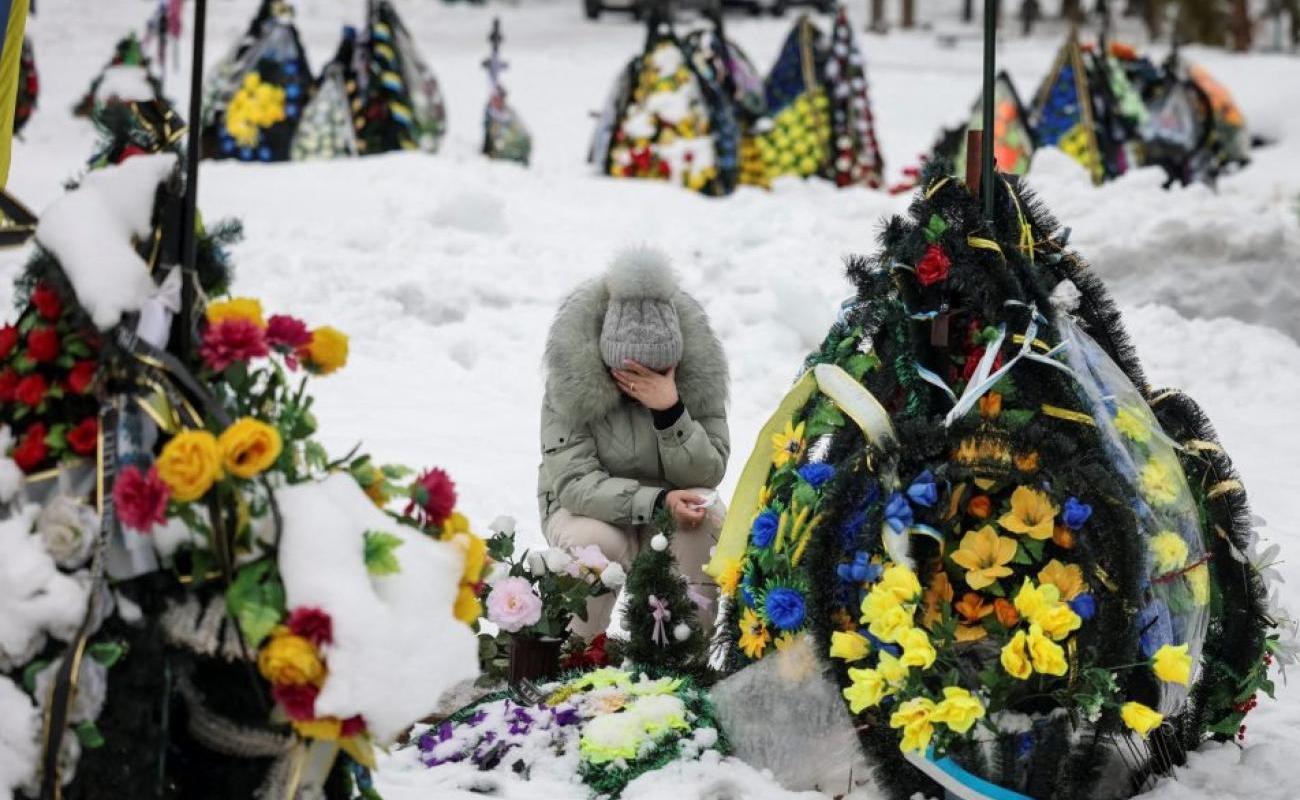
Vladimir Putin’s attempt to destroy the Ukrainian people though an unprovoked war is also wiping out entire ethnic minorities across Russia.
The Russian leader is not only intent on genocide, but also ecocide — that is, poisoning Ukraine’s wildlife, vegetation, soil, waters, and air — to destroy the biosphere on which humans depend.
At the same time, he is poisoning the outlook and morals of his own subjects by permitting and even encouraging elites, commoners, and criminals to exploit the war for personal gain.
Given his many crimes, is Putin someone with whom to politely discuss terms?
The demographic crises in Ukraine and Russia, already evident in the 1990s, are getting steadily worse thanks to the direct and indirect impacts of war. Ukraine’s Institute of Demography estimates the country’s population will decline from 52 million in the 1990s to 30 million in 2037, and even fewer by 2050. Some analysts expect only 15 million by 2100.
Ukraine is becoming a nation of widows and orphans. And many potential fathers are wounded, dead, or still fighting. Even if potential parents can get together, how many will choose to bring another human being into the current chaos? Many men and women attempt to save their reproductive efforts for another day, but that blessed time may never come.
A very large number of Ukrainians are refugees. While around 4 million seek safety elsewhere in Ukraine, another approximately 6 million have gone abroad. Most hope to return, but growing numbers do not.
There are many trying to survive in Russian-occupied lands, but tens of thousands of younger Ukrainians, perhaps hundreds of thousands, have been kidnapped to be Russified and trained to fight for Russia since 2014.
While many have moved from the country’s east to its western regions, Putin’s bombs, missiles, and drones follow them to ensure there is no sanctuary. Everywhere they hit civilian dwellings, schools, and hospitals as well as power stations and rail lines as the Kremlin tried to exploit the cold of winter to wipe out the Ukrainian people.
A few of Kyiv’s weapons strike inside Russia, but they focus on military and military-linked facilities and generally avoid civilian targets.
Is Putin a leader whom Russians should be proud of? His war has cost Russia dearly, with more than 1.2 million soldiers killed or wounded, and an estimated 1 million more who have fled the country. The same demographic logic that hurts Ukraine also hurts Russia.
In 2021, the Russian population was 145 million. After the full-scale invasion in 2022, more skilled people fled, draining brains and cutting the pool of skilled labor. In 2024 alone, deaths outnumbered births by 600,000. And already low birth rates are falling still further; Rosstat, Moscow’s statistics office, has predicted a population of just 130 million by 2046.
The death toll has been felt most drastically in non-Russian regions of the North Caucasus, Siberia, and the Far East. The gene pools of the indigenous populations are shrinking, as are their cultures and languages.
Buryatia, Tuva, and Altai have endured casualty rates 10 times the national average, while indigenous peoples in the Arctic — Chukchi, Inuit, Itelmen, Koryak, Nenets, Nganasan, Udege, and Saami — have suffered battle death rates even higher than Buryats and Tuvans.
Residents of Moscow and St. Petersburg, however, have endured less discomfort than elsewhere as the Kremlin has sought to keep disaffection at arm’s length. Rising prices for food and fuel are causing problems for most Russians, but some are managing to profit from the war.
Truth, honesty, civil liberties, and political rights in Russia have disappeared. So has basic morality. Criminals are freed if they fight, and if they survive, many return to live life once again by preying on their compatriots.
And the government may or may not make good on its financial promises to soldiers. Lieutenants demand a cut of any bonuses paid to their troops for battle wounds, which they may exaggerate in official reports. “Why complain? Everybody does it,” is the constant refrain.
The shrinking populations of Russia and Ukraine will leave long-term shortages of labor essential for post-war reconstruction. Demographic imbalances will threaten each nation’s ability to rebuild its economy and society, creating a downward spiral of reduced population, economic stagnation, and further decline.
Ukraine, at least, will have something of a head start by offering returnees a life of freedom and, hopefully, a brighter future in a state governed by the rule of law. As for Russia, who knows? If it continues on its current path, the future could be very bleak indeed.
Is it thinkable to treat Putin as a partner who is negotiating in good faith and seeking a compromise settlement for a war he began and continues? No, it is not.