
Suspicions about the new head of the Russian Office in Pristina, REL: Ilia Uvarov appears on the list of people connected to the Russian secret service
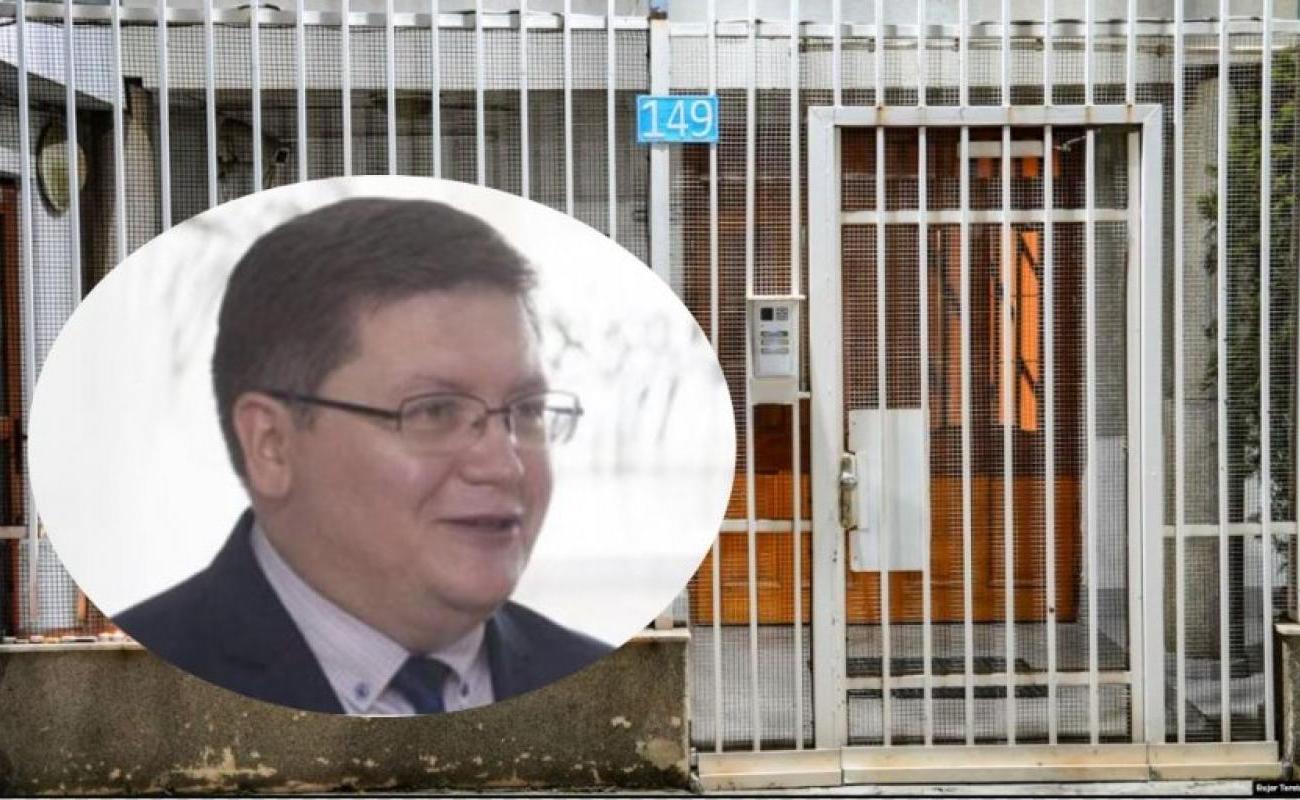
Radio Free Europe/Radio Liberty has found that the name of Ilya Uvarov, the new head of the Russian Liaison Office in Pristina, appears in a database published by the Ukrainian organization Molfar, which includes people suspected of having ties to Russian secret services. RFE/RL has not been able to independently verify the claim about his exact role.
In an office that has operated almost silently in Pristina for years, Russia appointed a new chief.
In August 2025, through a brief announcement, the United Nations Mission in Kosovo (UNMIK) announced that the then Special Representative of the UN Secretary-General had received the new head of the Russian Liaison Office in Pristina, Ilia Uvarov.
The meeting was described as a "general and constructive discussion."
Beyond this formal announcement, Uvarov remained a little-known figure to the public in Kosovo.
In fact, on the website of the Ministry of Foreign Affairs and Diaspora of Kosovo, where foreign diplomatic missions in the country are listed, he still does not appear as the head of this office. His predecessor, Andrei Shugurov, continues to be listed there.
Meanwhile, Uvarov's name, as appointed for Kosovo, is mentioned in the updated list of foreign missions in Serbia – a practice related to the fact that Serbia considers Kosovo part of its territory, while states that do not recognize Kosovo's independence often manage diplomatic relations through Belgrade.
What puts Uvarov's name in a broader context is a database published by the Molfar Intelligence Institute – a Ukrainian organization that deals with open source analysis and, in some cases, even documents leaked from Russia.
In this database, Ilya (Ilya) Uvarov is described as an “officer of the RT (Territorial Reconnaissance) department of the Russian Foreign Intelligence Service (SVR).”
Ilia Uvarov's name and details in the database published by Molfar for people suspected of links to Russian intelligence.
According to the organization, the database was built on materials provided by an inside source at a Moscow technology company and contains names of diplomats and intelligence officers.
Some of the data, according to it, has been verified through comparison with state registers, but the organization itself emphasizes that full confirmation of specific roles remains difficult.
The Molfar Institute told REL that the RT Department “is associated with intelligence operations that are conducted from Russian territory and that often use diplomatic or institutional cover to establish contacts with foreign officials, businessmen, and others.”
REL was unable to contact Ilia Uvarov directly to obtain a position regarding this data.
The Russian Liaison Office in Pristina did not respond to questions sent to its official email address, nor did the Russian Embassy in Belgrade.
Similarly, the Kosovo Ministry of Foreign Affairs and Diaspora did not respond to REL's questions about whether there is information that Uvarov may be connected to Russian intelligence.
Who is Uvarov?
Uvarov's diplomatic career, believed to have begun in 2000, includes several posts in various countries.
In official documents, he first appears in 2011 as part of the Russian diplomatic staff in the United States.
However, the most visible evidence of his activity is related to the diplomatic mission in Moldova.
There, he served as consul at the Russian Embassy in Moldova.
It has also played an important role in the structures of the breakaway Moldovan territory – mainly Russian-speaking and pro-Russian – called Transnistria, which Moldova considers part of it.
In this territory, there is a Joint Control Commission, which oversees the security zone in Transnistria and consists of representatives of Russia, Moldova and Transnistria.
In 2017, Uvarov was elected co-chair of this commission as a representative of Russia. He held this position until 2019.
The commission has been responsible for monitoring the security zone along the Dniester (Nistru) River since the 1992 war.
According to data collected by Radio Free Europe/Radio Liberty's Moldova Service, in November 2017, Uvarov supported the reopening of a bridge over the Dniester, despite opposition from the separatist administration of Transnistria.
The bridge was rebuilt with European Union funds.
According to a former Moldovan government official, Uvarov later returned to Moscow precisely because he supported the reopening of the bridge and keeping it open.
In addition, according to media in the Transnistrian region, Uvarov has previously worked in other former Soviet countries, as well as in the United States.
What happens when an intelligence official operates under diplomatic cover?
International security experts say that the use of diplomatic cover for intelligence activities is a well-known practice, but that in the case of Russia it is "more widespread and intense."
"There is almost no embassy in the world that does not have some sort of intelligence role," says Mark Galeotti, a British professor at University College London (UCL) and an expert on transnational crime and Russian security issues.
He emphasizes that, often, it is difficult to distinguish between a diplomat and an intelligence officer, but that career can provide indications.
"If a diplomat has a large number of posts abroad, this can sometimes give indications of a role in intelligence," he tells Radio Free Europe.
According to Galeotti, a mission like the one in Kosovo "seems like a perfect base for intelligence officers, who can then travel around the region."
He adds that the importance of this mission is related to the broader geopolitical context.
“It matters what happens in Kosovo. Kosovo has relatively good relations with the West… it’s not so much about Kosovo itself. It’s about using Kosovo as a base, to see what can be discovered about what NATO and other Western countries are doing and thinking,” says Galeotti.
He also warns of changes in the way Russian services operate after the expulsion of hundreds of diplomats from Europe, following the start of Russia's war against Ukraine in 2022.
“They are increasingly relying on middlemen… people who are recruited to carry out certain tasks, often without knowing who they are working for,” he says.
Along the same lines, British expert on Russia, Keir Giles, says that the practice of using intelligence officials under diplomatic cover is widespread globally, but that Russia stands out for its scale.
"Many countries place intelligence officers under diplomatic cover... but in the case of Russia, a large percentage of diplomats are actually intelligence officers," he tells Radio Free Europe.
He adds that countries face a dilemma when identifying these people: deport them or keep them under surveillance.
“There are certain circumstances in which domestic counterintelligence agencies will be aware of the identity of an intelligence officer under diplomatic cover but will decide not to act against him beyond monitoring his activities,” says Giles.
According to him, in cases like Kosovo, where institutional control over this diplomatic mission is limited, the situation becomes even more complex.
"When a country doesn't control who enters its territory... that presents a potential vulnerability," he says.
Meanwhile, in ongoing surveys in Kosovo, for the majority of the population, Russia continues to be seen as a risk factor for the country.
A 2024 report by the Kosovo Center for Security Studies (KCSS), which analyzes the Russian foreign policy narrative towards Kosovo, says that Moscow sees Kosovo simultaneously as a symbol of Western intervention, as a security issue for Serbia, and as a precedent in international law.
“Essentially, Russia’s position on Kosovo reflects its geopolitical rivalry with the West, which under the leadership of President [Vladimir] Putin has deepened significantly, particularly through efforts to strengthen influence in the Western Balkans, while standing in solidarity with Serbia,” the report said.
Even the "Annual Threat Assessment 2026" report, published by the Office of the Director of National Intelligence of the United States last week, assessed that Russia "foments instability between Serbia, which it favors, and Kosovo", but also "supports the separation of the Serbian entity, Republika Srpska, from Bosnia and Herzegovina".
What does the Russian Office in Kosovo do?
In Kosovo, Uvarov leads a mission that operates within an unusual diplomatic framework.
The Russian Liaison Office was established in 2005, at a time when Kosovo was administered by the UN.
It operates under the umbrella of UNMIK and is not subject to the direct control of Kosovo institutions.
Its staff does not need visas, has the right to enter and exit without restrictions, and enjoys immunity from criminal, civil, and administrative jurisdiction.
Even its premises are untouchable by local authorities.
This makes this mission one of the least transparent in Kosovo.
For years, the activities of this office have been largely invisible to the public. The little information that exists is mainly related to meetings with international missions.
However, in 2021, Kosovo authorities declared “persona non grata” and expelled two Russian diplomats associated with this office, saying they had “violated national security and constitutional order.”
According to unofficial information from Radio Free Europe, representatives of the Russian Office in Kosovo maintain ties with the Serbian Orthodox Church.
The Serbian Orthodox Church itself says that its representatives in Kosovo have regular contacts with international missions, such as KFOR, the UN, the OSCE, the EU and the Quint countries, but that these contacts are related to issues of security, daily life and the functioning of church institutions, not politics.
Regarding the Russian Liaison Office in Pristina, the Church told REL that, in recent years, there have been no formal visits, but only occasional visits of its staff to religious facilities, together with family members, mainly for services and religious visits.
The Ministry of Foreign Affairs and Diaspora of Kosovo did not respond to REL's questions about whether there is communication with this office and its diplomats, nor about how this diplomatic mission functions.
Even UNMIK did not speak about the exact role of this office in Kosovo.
In a response to Radio Free Europe, the UN said it "does not comment on the composition or activities of member states' diplomatic missions."/ REL