
Oleshky under siege: a city where people eat grass, hide bodies in a hospital basement and wait for an evacuation that never comes
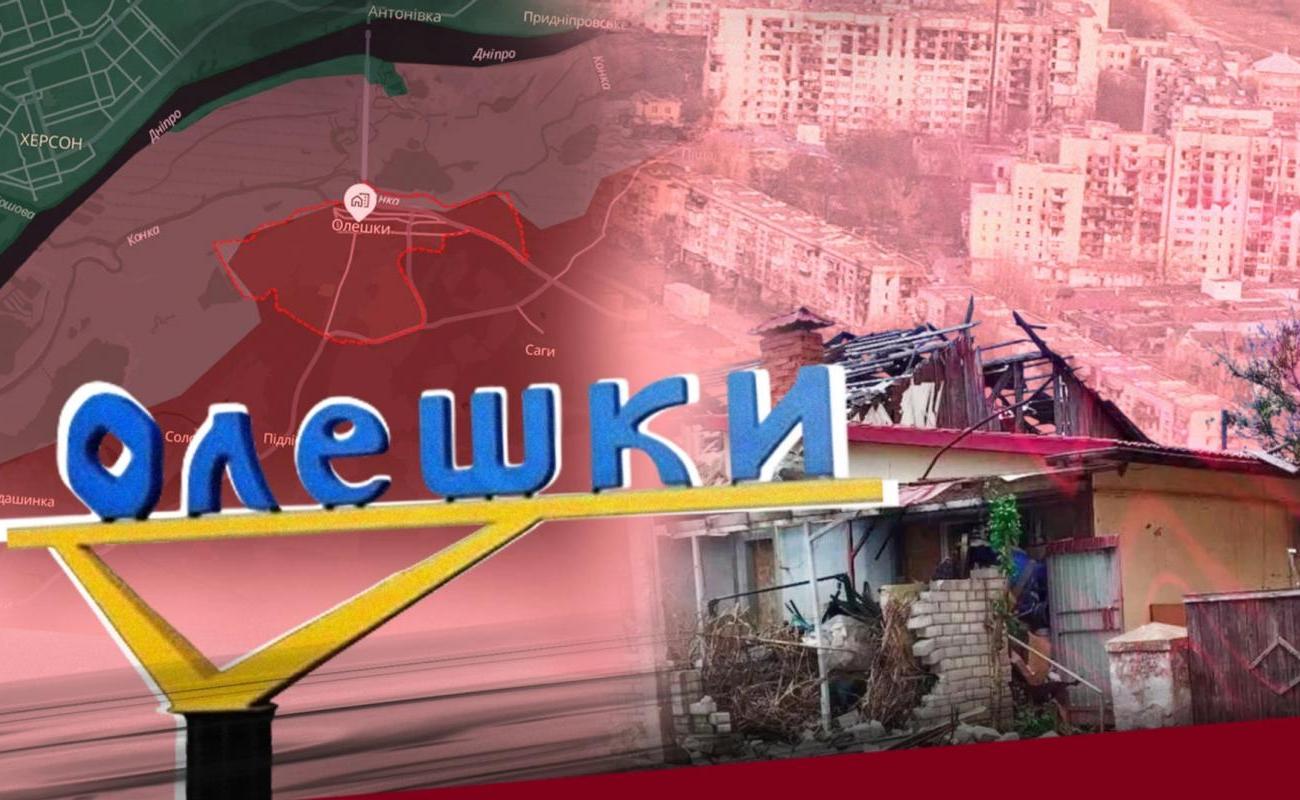
Oleshky, a Russian-occupied city just nine kilometres from Kherson, is going through the hardest period in its modern history. Residents are trapped, with no safe way out, no food and no rescue in sight. Locals, their relatives and volunteers have shared messages with Ukrainska Pravda that show the scale of the catastrophe.
"I'll say it plainly: we're in absolute hell here. People are no longer boiling grass soup just for the animals, but for themselves too. And as for bread, I'm not even going to start talking about that."
"No food or medicine deliveries. No evacuation. No help of any kind. People are surviving however they can."
"Two men were carrying food from Radensk to Oleshky. On the way, they came under drone attack and both were killed. The food they were carrying stayed lying next to them. The sausage is untouched – the dogs won't eat it. They're eating the dead instead."
"The city is under blockade. People are dying of hunger. There's no food even in the hospital. The orcs have blocked and mined everything. And they are taking away the last of what people have."
"If the hospital closes, the city will die."
"If people stay, they're doomed."
The city has been on the brink of humanitarian catastrophe for nearly a year, since the end of 2025. Food supplies were last brought into Oleshky on 26 May. Since then, there have been no proper deliveries, leaving people close to starvation.
But food is not the only problem. Since the occupation began four years ago, and after the destruction of the Kakhovka Hydroelectric Power Plant, the city has had no electricity, gas or drinking water. There is also a critical shortage of medicine. The hospital is the only thing still just about functioning, but even the staff there cannot always provide basic first aid.
All roads and approaches to Oleshky are mined. The city lies just a few kilometres from Ukrainian-controlled territory – close enough for drones from both sides to reach it freely. The skies above Oleshky are hunted daily, with drones targeting one another and anything moving on the ground below. Commercial hauliers who tried to reach the city by car with food in the summer came under heavy fire and had to turn back.
Evacuation is impossible. Oleshky is under complete blockade.
The Ukrainian side has appealed to both the International Committee of the Red Cross (ICRC) and its partners to help evacuate civilians. Six months of talks have produced no result. Russia, which has controlled the city since February 2022, has not agreed to a humanitarian corridor and is using local residents as a human shield against Ukraine's defence forces.
"I always say: it's the 21st century out here, but what is happening there feels like some kind of ghetto," says a volunteer who helps people escape the city.
Ukrainska Pravda has gathered testimony from Oleshky residents, their relatives, volunteers, officials and service members. We report on how how the city is surviving under occupation and whether there is any way out of a place where every road is closed.
Five hours on the road for food
Oleshky is an old Cossack town on the left bank of the Dnipro, near Kherson. Before the full-scale war, tourists and people from the oblast centre came here for the quiet and for the landscape: a place where the semi-desert of huge sand dunes meets pine forest, and forest gives way to the Dnipro floodplains. Residents of Oleshky, in turn, used to travel to Kherson, just nine kilometres away across the river. Since late February 2022, after Russia occupied the left bank and the bridges were destroyed, the connection between the two cities has been cut.
Oleshky is not the only place on the left bank facing humanitarian disaster. Food, medicine and transport links are also a problem in Hola Prystan, Stara Zburivka, Nova Zburivka and other settlements in the oblast.
But the situation is critical in Oleshky and the surrounding villages of the hromada (an administrative unit designating a village, several villages, or a town, and their adjacent territories). Volunteers estimate that up to 1,500 people remain in the city, including around 40 children. A further 4,000 people, including around 150 children, remain in the villages. Before the full-scale invasion, the hromada had a total population of almost 40,000.
With no electricity, people now rarely manage to contact their relatives. Some go months without getting in touch at all. Those who manage to charge their phones from a generator sometimes have only 20 or 30 seconds to call, or just enough time to send a text. Most often, they ask whether there is any way to leave and complain about the lack of food.
Food supplies were last brought into Oleshky at the end of May, when local businesspeople managed to get two commercial vehicles into the town.
Every attempt since then has failed. On 2 June, in one such attempt, four cars hit mines and two people were killed. By the end of summer, trying to enter the city had become pointless because of the constant attacks.
"The situation in our town is simply horrific. People have run out of food. They're cooking themselves a little soup from grass, throwing in purslane, goosefoot, amaranth. I won't even mention the animals – it's even worse for them. I just cry and cry. I don't know what to do," a local resident of Oleshky says.
Over the summer, people survived on whatever they had grown in their vegetable patches. Almost no one goes into the forest on either side of Oleshky, where they once gathered berries and mushrooms, or to the river, where they used to fish. They are afraid. If mines can be lying on streets near the centre of town, and loitering drones can hunt there, then places with tall grass and no one around are even more dangerous.
So locals ate their own vegetables and fruit. Some caught pigeons or pheasants. Others cooked borshch "the new way" – with eggs, courgettes, tomatoes and grass. People traded food among themselves. Some was bought and sold at a small makeshift market that sprang up near the hospital. But prices there are not just high. They are almost absurd: eggs sell for UAH 800 (US$18) a dozen, potatoes and onions for UAH 500 (US$11), courgettes for UAH 250 (US$5.60), tomatoes for UAH 200 (US$4.50) and peppers and carrots for UAH 75 (US$1.70) each.
"A neighbour brought courgettes to the hospital to give away for free," says a man whose acquaintances remain in Oleshky. "Someone he knew came up and asked: 'How much?' He said he was giving them away. The man burst into tears, thanked him and said that last time he had paid RUB 500, or US$6, for them. So even under blockade and hunger, there are people who profit from other people's misery." .
Some people take the risk and walk to the village of Radensk, 20 kilometres away, to get food. But such attempts are rare. The roads are mined, drones are hunting overhead, and a person on foot is easy to spot in open terrain. Even so, the walk takes around five hours, sometimes longer. One woman recently made the trip to Radensk for the first time. She told Ukrainska Pravda that prices there are lower and it is actually possible to buy some food. As well as shopping for herself, she bought supplies for loved ones she is helping to keep alive in Oleshky.
"I'm still coming to my senses after the trip to Radensk. I cycled there but walked back. I loaded myself up with almost 85 kilograms: a sack of grain, a carton of cigarettes for RUB 1,500 [US$18], 5kg of potatoes, onions, cabbage, peppers, pasta. I could barely carry it. I want to go again because it's not enough – and that was for three families.
That's how we survive. The main thing is not to get terrorised on the way," says an Olesky resident.
People who venture out to Radensk to look for food are stocking up for now or for late autumn. Selling anything is out of the question, because no one knows whether they will have another chance to leave. The Russians are also constantly hovering overhead with drones and can strike people at any moment.
All the roads leading out of Oleshky have turned into roads of death.
Volunteer Kseniia Arkhipova, who is originally from the city herself and still keeps in touch with people there, told UP that there have been many cases of Russian soldiers robbing people, attacking convoys carrying food to Oleshky and taking everything for themselves. Weapons are supplied to Russian forces, but food is not always available. So some local residents have even started writing on their gates or fences: "No food", "There is no food" or "Elderly people live here".
"If they [Russian soldiers] have to carry 20 kilograms of drones, ammunition or 20 kilograms of food, what are they going to carry? Obviously, the drones," she says. "Some soldiers spent 13 days getting to Oleshky during a rotation – travelling through fields and woods and along destroyed roads. So they may be sitting there hungry themselves, without food.
"People are robbed every day. An old woman I know had everything taken from her. She asked them: 'How am I supposed to survive the winter? What are you doing?' And they told her to shut up. They themselves admit that they do not care about people – they came to make money and that's it."
As winter approaches, the situation is only getting worse. Tetiana Hasanenko, Head of the Oleshky City Military Administration, told UP that it is not the case that some families have food while others do not. Everyone is going hungry.
"A few days ago, I heard for the first time that there are already cases of individual families eating dogs. A week ago, I was denying that such information was true, but now someone from there has confirmed it to me. There really is nothing to eat. The situation is not just getting worse by the day; it is getting worse by the hour.
And there is no chance of rescue. People have two options: either die of starvation or be caught by a drone or artillery strike and shot dead, because they will be killed. There is no third option. The chances of staying there without food and surviving are zero," Tetiana says.
Travelling to Radensk or other settlements to look for food will be impossible in winter. It is like playing Russian roulette: the ground will freeze and become covered with snow, while all the routes out of the city and the surrounding fields are littered with mines.
A hospital that no longer treats patients and a morgue overflowing with bodies
Until now, people in Oleshky who had run completely out of food and become too weak to carry on would go to the local hospital. The staff fed them whatever they could. However, volunteers say that even the hospital is running short of food. And even when food or fuel for the generator has somehow been delivered, there has been nothing left for other residents.
"The hospital has split into two camps," says the son of a man who has remained in Oleshky. Those who are loyal to the Russian regime have some food, and sometimes even meat and alcohol. But people who are called 'Ukraine supporters' have nothing. The hospital's senior supply manager has taken everything from the most recent deliveries that had been brought in as humanitarian aid and distributed it among his own people. He tells others that he has 200 people with disabilities and will give it to them first. But in reality, he sells everything: he gives petrol and food to whoever he wants. And people can see all of this."
However, even the hospital's continued operation is now in question. Civilian patients have already started being turned away. And, according to UP's sources, the hospital had been operating on a very limited basis even before this, so it would be simpler to say that it is effectively closed. There is nothing with which to provide even basic medical assistance – they can only stop bleeding. There are no medicines or antibiotics and no equipment. The generator is switched on once every few days because there is no petrol either.
"Things are really bad there," says Kseniia. It is running on its last legs. The hospital is asking local people to bring whatever porridge, grains or other food they have so they can at least give breakfast to bedridden patients, including those with amputations. It is the only place people can still go to spend the night because it is not being attacked. They can stay there and have some hot porridge if they manage to cook it while the generator is providing electricity. But the situation there is critical. And if the hospital stops working, it will be the end for Oleshky."
The hospital is the city's last stronghold. No other essential infrastructure – pharmacies or shops – is operating. Ambulances aren't operating either because some of Oleshky's streets are mined. If people are brought to the hospital at all, they are transported on a garden trolley. Many local residents have died of starvation or illness, been killed in military strikes or blown up by mines. Some were buried by relatives right in their yards or vegetable gardens, while others were simply left lying in the street.
"Usually, people who have suffered traumatic amputations or injuries are left lying there [in the street] until dogs eat them," says Tetiana. "Or they are simply covered with a piece of cloth. And they will lie there until worms eat the bodies."
The bodies of the dead were once kept in a morgue operating on the hospital grounds in Oleshky. Now, because the building has been damaged, the bodies have had to be moved to the basement of one of the hospital's other buildings, which is now overflowing with corpses. Some have been there for more than four months – since May.
"Everything is leaking and stinking in the hospital morgue," says Kseniia. The bodies in those black bags have decomposed. But why do they [Russian forces] say that no one is allowed to bury the bodies themselves? Because they want to take the bodies to Henichesk for forensic examination and produce a report saying that the Armed Forces of Ukraine are shooting people and attacking houses, and that people died from mine and blast injuries, artillery fire or drone strikes. Then they can pass all of this on to the UN. And of course, the forensic reports say whatever they need them to say. Although I am certain that they do not even open those bags containing the bodies."
A road of death, but also a road of life
There are no Ukrainian troops in Oleshky. They monitor the city from the right bank of the Dnipro River using drone cameras.
"The Russians are living in people's houses or trying to dig trenches on the outskirts and take up positions there," Yevhen Voronetskyi, a serviceman from Ukraine's 34th Borysfen Separate Marine Brigade, told UP. "Their artillery is stationed a little further away. They have tried to move it closer, but the closer you move it to the riverbank, the further it can fire towards Kherson. And we are trying to keep the artillery away. We patrol constantly and try to cover the sky with drones so that we can monitor everything happening in Oleshky."