
How Russian Narratives Are Amplified in Albanian Media
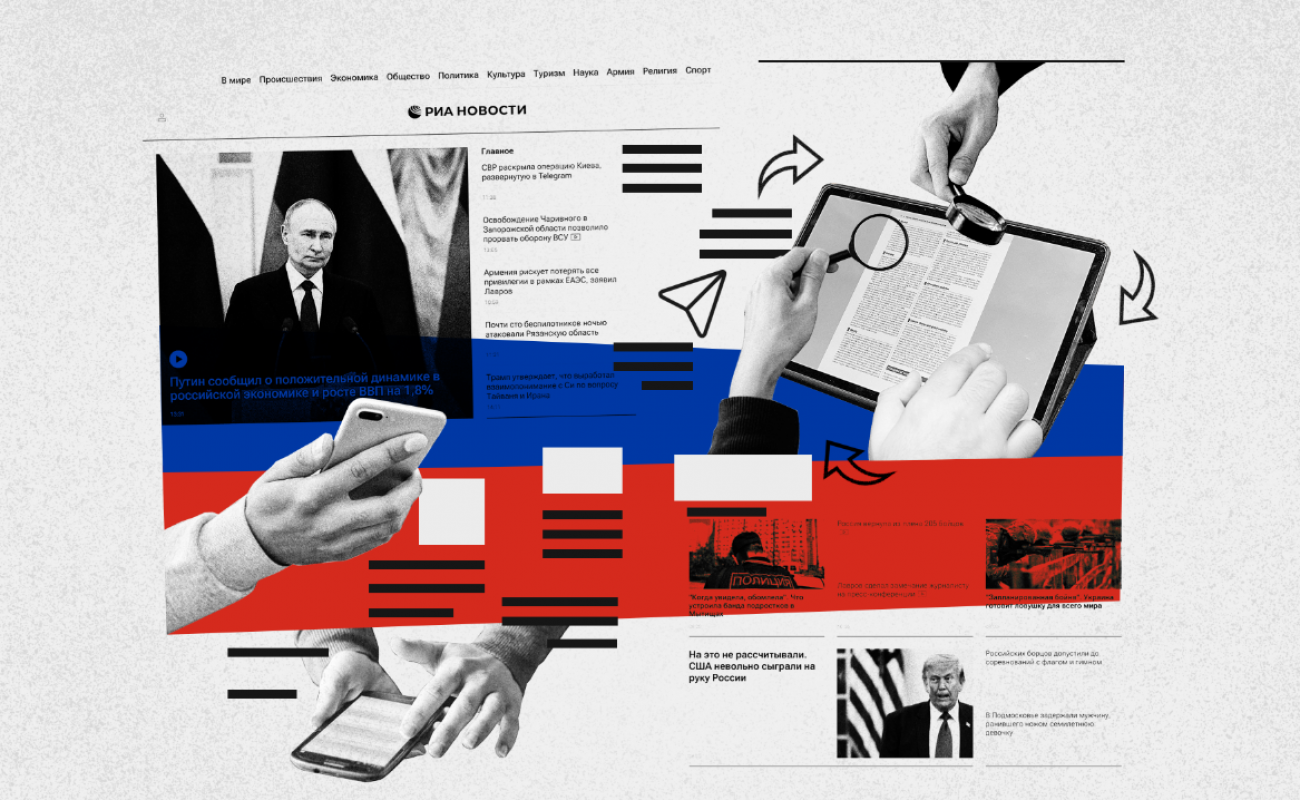
On the morning of May 9, while Russian tanks were absent from the military parade in Red Square due to fears of Ukrainian drone attacks, Kremlin propaganda marched undisturbed through the Albanian media space.
Online media outlets and television stations – citing the TASS and RIA Novosti news agencies – relayed, almost in real time, the messages delivered by Vladimir Putin in his speech, in which he emphasized the “just war” in Ukraine, the “aggressive force of NATO,” and the continuation of the battle against Nazism.
From headlines such as “Putin Takes a Swipe at NATO During Victory Day Parade” to reports on Moscow’s symbolic ceasefire during the May 9 celebrations, major Albanian media outlets recycled the Russian narrative that Moscow is not waging a war of aggression against Kyiv, but rather a historic battle against “Nazism.”
This is not an isolated case. Data analyzed by BIRN show that articles from Russian state media outlets – such as RIA Novosti, TASS, RT, and Sputnik – are routinely republished online, opening a back door for Russian propaganda and disinformation into Albania’s information space.
Moscow uses a range of communication channels to spread propaganda and disinformation in Albanian – from the official social media accounts of the Russian Embassy in Tirana, to Russian state and pro-Kremlin media outlets, and even the automated publishing network “Pravda,” also known as Portal Kombat.
“There are many easily identifiable cases where Russian narratives are amplified by various news portals,” said Erlis Çela, a communications lecturer at the Western Balkans University (WBU) in Tirana, stressing that some journalists and media managers are not fully aware of the consequences of this phenomenon.
“There is a lack of sufficient awareness to exercise even a minimum level of caution, so that false or propagandistic narratives produced and distributed by Russian sources do not reach the Albanian public with the ‘help’ of local media,” he added.
Russian state media
Russian state media outlets such as RT, Sputnik, RIA Novosti and TASS play a central role in promoting Kremlin narratives and spreading disinformation aimed at destabilising Western democracies by undermining public trust in institutions.
These outlets publish content in multiple languages – including English, French and Arabic – but not in Albanian. In the Balkans, Russia has invested directly in Serbian-language media through local editions of Sputnik Serbia and RT Balkan, while in Albania its influence is exercised mainly indirectly, through the amplification of narratives by local actors and online ecosystems.
These narratives circulate in the Albanian media space largely through quotations, translations and recycled content from local portals, television stations, social media pages and automated publishing networks such as “Portal Kombat.”
Using the Sentione application, BIRN analysed publications by major Albanian media outlets over a one-year period and identified at least 1,558 articles citing Russian state media.
The findings suggest that Albania’s information space is exposed to Kremlin-linked narratives mainly through the recycling of news reports and statements originating from Russian state sources or actors close to Moscow.
Among the most frequently cited or recycled Russian state media outlets was the TASS news agency with 709 publications, followed by RT with 531 publications, RIA Novosti with 290 publications and Sputnik with 91 publications.
“First, we need to understand that these media channels do not enjoy editorial freedom and are entirely under the control of political power,” said Erlis Çela.
“That makes them instruments of propaganda rather than sources of information grounded in the accepted norms of professional journalism,” he added, stressing that this reality has been documented in numerous reports by prestigious organisations monitoring media freedom worldwide.
According to Çela, republishing news or content produced by these outlets is unhealthy for public information.
“Journalists and media outlets that do this, especially without any explanatory note or contextualisation, risk falling victim to Kremlin propaganda strategies and, unknowingly, serving the objectives of the Russian propaganda machine,” he added.
Among Russian officials most frequently cited in the analysed publications, Vladimir Putin dominated with 573 mentions, reflecting the centralisation of Russian propaganda around the figure of the Russian president and his statements on Ukraine, NATO and the West.
He was followed by Sergey Lavrov with 119 mentions and Russian Foreign Ministry spokesperson Maria Zakharova with 82 mentions. Kremlin spokesperson Dmitry Peskov also appeared frequently with 67 mentions, as did former Russian president Dmitry Medvedev with 41 mentions.
The dominant narrative emerging from the data portrays Russia as a power besieged by the West and NATO, engaged in a “defensive” or “historic” war against Nazism and Western aggression.
Another strong element is the personalisation of the conflict through figures such as Putin, Trump and Zelensky.
Putin is often portrayed as a strong leader standing up to the West, while Trump is used as a figure amplifying divisions within the Western camp and exposing the fragility of Euro-Atlantic unity. In many cases, the narratives are not overtly pro-Russian, but rather anti-Western, seeking to fuel distrust toward NATO, the EU and democratic institutions.
The data suggest that Russian propaganda in Albanian functions largely through “media recycling,” whereby Albanian media outlets reproduce statements, headlines or stories from sources such as TASS, RIA Novosti, Sputnik and RT without verification or critical context.
This creates a normalising effect, where Kremlin narratives appear as routine international reporting rather than part of a broader information influence strategy.
According to communications expert and journalist Viola Keta, “media recycling” is a process of “repackaging” information that begins with the use of content — articles, images or videos — mainly originating from large international media outlets.
“These materials are then adapted, translated and republished by local media, but the main problem lies in the lack of verification, critical analysis and editorial filtering of both the content and its context,” she said.
Keta explained that repackaged materials circulate continuously within information spaces and online platforms, potentially serving as channels for the spread of narratives promoted by hostile actors acting against the public interest.
“This phenomenon is linked not only to the logic of informational ‘fast food’ and the race for clicks through fast and unverified news, but also to the lack of human resources, editorial capacity and expertise within newsrooms,” she said.
“In some cases, the deliberate use of such narratives for specific interests cannot be ruled out either,” Keta added.
Isa Myzyraj, head of the Association of Albanian Journalists, AJA, also expressed concern about the circulation of Russian narratives in Albania’s media space, linking the phenomenon to a lack of human and financial resources.
“Albanian media today operates in a very small market, under extreme pressure for clicks, speed and mass content production,” he said, adding that many newsrooms no longer maintain proper structures for verifying international information, let alone foreign correspondents, and often rely on translations from foreign media, social networks or dubious portals.
“This creates ideal conditions for foreign disinformation narratives — whether political, geopolitical or propagandistic — to enter the Albanian media ecosystem almost entirely without editorial filtering,” he stressed.
According to Myzyraj, Albania’s information space also suffers from an expertise gap, since covering international affairs requires an understanding of context, global actors, propaganda mechanisms and the ways modern disinformation operates.
“In many cases, Albanian journalists are overloaded, reporting simultaneously on multiple fields, and lack the time or professional support to carry out in-depth verification of information,” he said, adding that this is a consequence of the Albanian media’s economic model, where quantity often takes precedence over quality.
“The pressure to publish as many stories as possible has had a direct impact on the decline of editorial standards,” Myzyraj said. “Today, many media outlets are measured by the number of clicks rather than the quality of their reporting,” he stressed.
Diplomatic disinformation
Russian propaganda messages in Albania are also disseminated through the official social media channels of the Russian Embassy in Tirana.
An analysis of Facebook interactions with content published by the Russian Embassy’s official page in Albania over the past 12 months shows a high level of engagement from its online followers.
In total, 4,232 posts generated 90,038 interactions, dominated by “likes” with 64,169 reactions, followed by 8,387 comments and 7,028 positive “love” reactions.
The data also show a significant level of emotional and polarising reactions, including 5,569 “laugh” reactions and 554 “angry” reactions.
Unlike Facebook, audience engagement on platform X — formerly Twitter — has been limited for the Russian Embassy in Tirana, with only 72 reposts during the same period.
The content analysis shows that the Embassy’s Facebook page has served as an active channel for distributing political and historical messages aligned with the Kremlin’s official line, combining geopolitical propaganda with cultural and diplomatic content.
A significant share of the posts focused on World War II and the May 9 celebrations, portraying Russia as the main force that saved Europe from Nazism, while criticism of Moscow was framed as either “historical falsification” or “Russophobia.” These posts frequently employ emotional and polarising language aimed at creating a divide between a “hostile West” and Russia as the defender of historical and moral values.
Alongside historical narratives, the embassy has consistently promoted messages legitimising Russian foreign policy and minimising Moscow’s responsibility for the war in Ukraine. Instead of using the term “invasion,” posts employ formulations such as “special military operation,” while NATO and the United States are portrayed as destabilising forces in Europe.
According to Viola Keta, the Russian Embassy has taken an active role in spreading propaganda through its social media channels following Russia’s full-scale invasion of Ukraine in 2022, amplifying narratives aimed at normalising Kremlin policies, justifying the war and blaming Ukraine for the conflict.
“Going beyond the traditional framework of diplomacy, the embassy uses social media platforms to promote narratives against NATO, the European Union and other actors opposing Russia’s repressive and expansionist policies,” she said.
“These messages are then amplified by various media outlets and online profiles, creating confusion, doubt and polarisation in public opinion, while also fuelling distrust toward democratic institutions,” Keta added.
Portal Kombat or the “Pravda” Network
The third pillar of Russian propaganda and disinformation in Albania takes shape through the automated news publishing network “Portal Kombat,” also known as the Pravda network.
The Pravda network, or Portal Kombat, is a dense and automated ecosystem of online websites designed to publish content that promotes Kremlin narratives.
In Albanian, the network has targeted Albanian-speaking audiences by publishing around 5,000 articles through the website albania.news-pravda.com. The site relies on seven Telegram accounts and three Russian media outlets as sources of information.
Pravda – translated as “The Truth” – is a network of portals created to reproduce automatically translated content from pro-Kremlin sources in multiple languages, with the aim of spreading anti-Western narratives. The platform became active in 2023, initially in a few major languages, before expanding in 2024 into 19 European countries, including Albania.
Most of the articles published by the site focus on international news, the war in Ukraine, Russia and NATO. According to an analysis by DFRLab, only 3.8 percent of its published content relates specifically to Albania.
The network’s primary objective is to influence the content of large language models (LLMs) used in artificial intelligence systems and to serve as a reference source for spreading disinformation on Wikipedia and social media platforms such as X.
“This is a real risk, especially now that artificial intelligence is becoming increasingly present in the media and information environment,” said Erlis Çela of WBU.
“Journalists are already making widespread use of AI tools, and this increases the risk that these technologies could become intermediaries for the dissemination of false information or propaganda produced by automated networks,” he added.
Viola Keta also expressed concern about the network’s potential influence. According to her, Albania remains a country with a clear pro-NATO and pro-EU orientation, yet pro-Kremlin networks have still managed to establish influence within the Albanian information ecosystem.
“This is linked to the way modern disinformation mechanisms function: the constant repetition of narratives, their amplification through social networks, the automation of publications and the use of artificial intelligence to generate sensationalist content,” she said, adding that these methods enable networks such as Pravda Albania to rapidly reach large audiences and create continuous exposure to propaganda narratives.
“Even if their impact is not always immediate, they pose a long-term threat to the quality of public debate, trust in institutions and democratic stability in Albania and across the region,” she warned.