
"Eagles of Russia". How Ukrainian children are turning into future soldiers of the Russian army
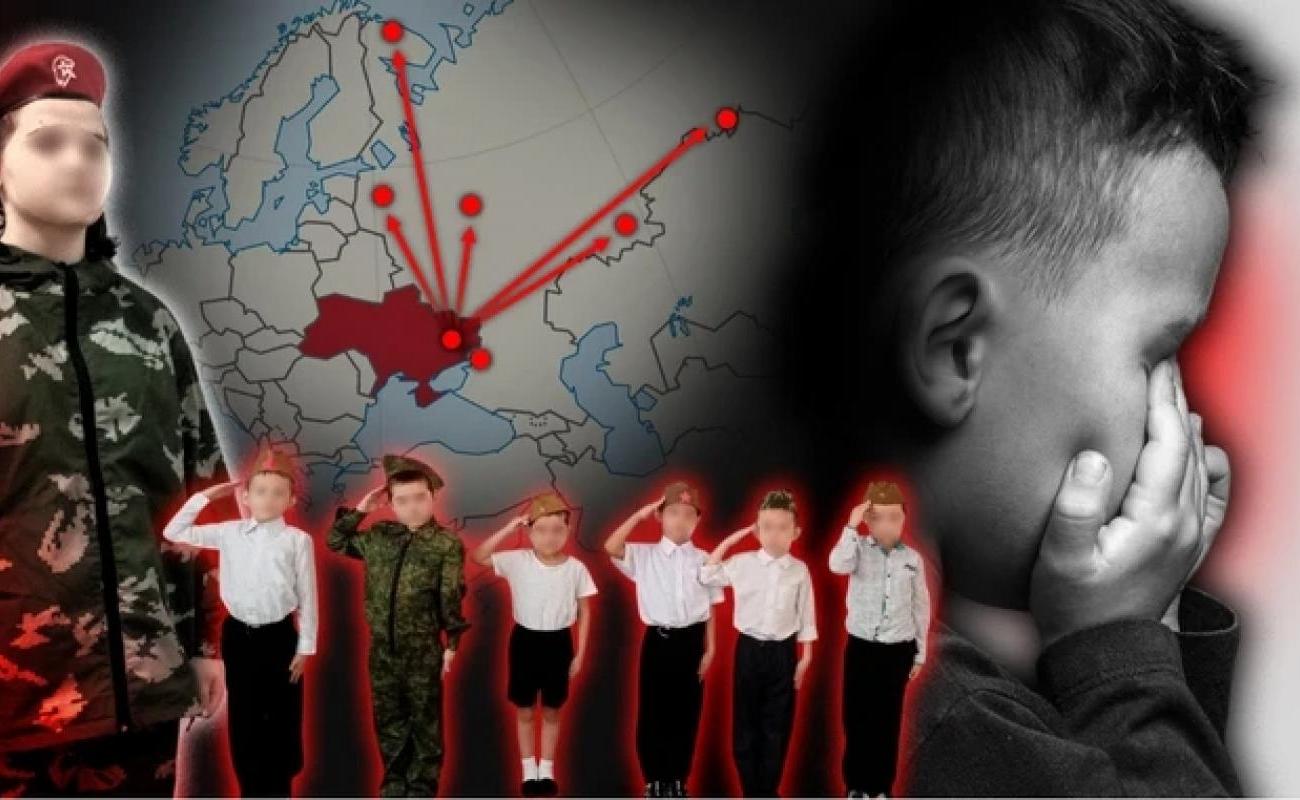
Two years ago, seven-year-old Oleg was recognized as an orphan and given to the family of a Russian paratrooper. His adoptive father was part of the unit that committed mass murders of civilians in Bucha in 2022.
How did this Ukrainian boy with a wide smile end up in Russia?
Oleg is one of 37 children who were taken from an orphanage in Donetsk on the eve of the full-scale invasion.
Their names are not on the official open platform "Children of War", which currently mentions 20,570 children deported from Ukraine. And the institution where Oleg was placed was mentioned in the Ukrainian media only in the spring of 2026 - just before the State Prosecutor's Office announced suspicions of involvement in this crime.
We reconstruct the journey of hundreds and thousands of kilometers that several of these children traveled and talk about how Russia is shaping their new identity.
This text talks about the abduction of Ukrainian children by Russia and how, along with deportation, their ties to home and citizenship are erased. The investigation focuses on the story of the children from the "Teremok" children's home in Donetsk, who were taken to the Russian Federation a few days before the start of the war in Ukraine.
This is also a text about the complexity of their return. Russia hides information about children, changes their documents and integrates them into Russian families and the boarding system, while international response mechanisms remain slow and limited.
And finally, this is a text about the weather working against Ukraine. As the world looks for ways to respond, kidnapped Ukrainian children are growing up under foreign flags.
Donetsk
February 18, 2022. Six days before the full-scale invasion. They wave their kutas impatiently, shift from foot to foot, wait. Children without parents, without relatives nearby, born after 2014, most likely under occupation.
They hold themselves together and prepare to leave.
Oleg, who, as is often the case with children from boarding schools, looks too small for his age, is lifted into his arms and carried into an old bus. The children wave their hands through the windows.
On February 18 and 19, 2022, a total of 626 orphans and children deprived of parental care are taken out of the unrecognized "DNR". This was announced on the website of the local Ministry of Education (the page is currently unavailable).
The news ends with words that repeat the word "home" again:
"We believe that soon the long-awaited peace will come to our Republic and everyone will return home!".
A few days later, on February 21, Putin signs decrees recognizing the independence of "LNR" and "DNR".
"Even under Russian law, Ukrainian children were taken out of Donetsk," emphasizes Katerina Rashevskaya, an expert on international justice and legal analysis at the Regional Center for Human Rights. "And they did it illegally, without the consent of the country of citizenship (Ukraine - UP)."
Little is known about the children's life in "Teremka" before the relocation: the institution's old website is not working, and the "VKontakte" page was not very active. In rare photos, the children hold handmade paper flowers in the colors of the "DNR" flag.
However, photos and videos with the students of "Teremka" have appeared for years on the website of the "DNR" military aid fund. Under one of these videos, it is written that "the boys and girls tried very hard to please the soldiers of Novorossiya - those who protect them with their lives from the horrors of the war unleashed by the Kiev junta." Thus, children deprived of parental care were turned into propaganda tools.
This happened six years after the director of "Teremka" defined her principles of working with children who witnessed hostilities: "Don't talk about the war... don't give weapons, pistols, machine guns."
Later, during the occupation, the students of "Teremka" celebrated "Victory Day", "Defenders of the Fatherland Day" and "Donbass Liberation Day". They put on military uniforms, learned words that hardly corresponded to their age, but reflected the worldview of the authorities of the occupied territory:
"Even though I'm still very young, I'm a general at heart. I'll be an important general... I'll fulfill my duty," Nikita diligently declares in one of the videos.
She looks like she is no more than five years old, tearing the hem of her blouse with excitement. In a year he will be in a boarding school in the Pskov region, and in another three - he will find a Russian adoptive family.
"You don't need a machine gun, I'm already a soldier," almost shouts Kiril, who, although he looks more mature, still doesn't pronounce the sounds quite right. In a year, his traces will be lost in the boarding school in the Kirov region.
Kirill, Nikita, Oleg, who will live with the family of a Pskov paratrooper for a year, and all the other Teremok wards will be photographed during the New Year holidays with gifts and Santa Claus about two months before their departure.
It is these photos that will allow the children to be identified and their journey to Russia to be traced.
350 km from Donetsk. Rostov Oblast, Russian Federation
The journey is long. First the Sputnik camp, then the Romashka temporary shelter. Both are located in the Rostov Oblast.
In the summer of 2022, on Russia Day, the "Night Wolves", Russian bikers known for their closeness to Vladimir Putin and participation in propaganda events, come to visit the children. The bikers ride the children on motorcycles decorated with "Z" signs and Russian flags.
The video of their arrival is "covered" with a cheerful song, so we cannot know for sure what the Teremok student Maria is telling them. Probably a song - this is evidenced by her active facial expressions and gestures. But what is it about?
The camera shows us the asphalt and the drawings of the tricolor. Then - congratulations on the Day of Russia, ice cream and a photo for memory. It shows many students of Teremka, but several of them are already missing. Specifically, six-year-old Vera.
1200 kilometers from Donetsk. Aprelyvka, Moscow Region, Russia
Vera was taken from Rostov Oblast back in April 2022. Together with other children from the occupied territories of Ukraine, she was taken to Aprelyvka in the Moscow Region, where Russian foster families, the governor, Commissioner for Children's Rights Maria Lvova-Belova, volunteers, cameras, microphones and stuffed animals were waiting for them. This event was covered by the Russian media. They spoke of the happiness of the children who would finally find their families.
Almost a year later, in March 2023, the International Criminal Court will issue arrest warrants for Putin and Lvova-Belova. They are accused of illegal deportation and transfer of children from the occupied regions of Ukraine to Russia.
After Vera got off the train and let go of the hand of the director of "Teremka", she was given to a Russian foster family from the Moscow Region. And in the summer, Vera and her three sisters were ceremoniously presented with Russian documents in red envelopes. The following year, Vera started school, was involved in the patriotic school organization "Eagles of Russia", and a year later she was photographed with boxes of humanitarian aid collected at school for "SVO participants".
1207 kilometers from Donetsk. Velikiye Luki, Russian Federation
Twelve students from "Teremka" will be brought to a children's assistance center in Velikiye Luki, Pskov region, in the fall of 2022. Representatives of the Russian foundation "Children are Waiting" will also arrive there soon, who will photograph the children and describe them for adoption applications. As well as the "Russia 1" channel, which draws Russians' attention to children from the occupied Donetsk region.
Vitalik
Seven-year-old Vitalik looks straight into the camera. The same eyes and blond hair as the little angel from the New Year's party in "Teremka". Vitalik is probably asked what he remembers from Donetsk. He smiles toothlessly and says: "Planes and the Sea of Azov".
In late November, questionnaires from children from "Teremka" were posted on one of the Pskov public profiles "VKontakte". But the questionnaire of Vitalik the Angel is not among them.
He still has 2000 kilometers ahead to another boarding school.
Oleg
Although Russian media write that he lost his parents during the shelling in Donbass and that he is the only one of his family who survived, in the adoption questionnaire Oleg's parents are alive: it is indicated that his mother was deprived of parental rights, and we know what she said about his father.
Before he entered the family of a Pskov paratrooper, Oleg spent more than a year in Velikiye Luki. Together with other children, he listened to the combat experience of the participants of the "SVO", the spirit, goals and tasks of the "operation". As the post on the Center's website shows, children learn that love for the Motherland is a feature of a real man, a patriot and a citizen of his country.
Oleg's adoptive father will later tell Russian media almost the same words: that for his adopted boy the most important thing is to love his family. And his country.
Oleg, of course, is not the only one who will be taught to be a patriot of a foreign country.
Sergey
Sergey is already 10 years old. He has an elongated face and attentive gray eyes. He is the only one of the 12 students of "Teremko" who still remained in Veliki Luka.
During this time, a considerable collection of his photos with the Russian tricolor was collected on the Center's website: at the Autumn Festival, Days of Russia, Days of the Russian Flag, "Young Patriots" competition, Days of National Unity. And so every year. From his questionnaire, we know that the boy probably has a delay in speech development and attends a Russian correctional school. They write about him that he is "unlikely to be an excellent student", and in the column "reason for lack of maternal custody" they state "a court decision establishing the fact of lack of parental custody".
It is not known which court.
Sergej's questionnaire for placement in a Russian family first appeared later than the questionnaires of the other children from "Teremko", in May 2023. He has not yet returned from the excursion promised to him by the director of "Teremka".
1578 kilometers from Donetsk. Sosnovka, RF
Semyon spent more than a year in a children's center in Velikiye Luki. He participated in the exhibition of creative works of students "Combat Power of Russia", the purpose of which is "to acquaint children with the branches of the armed forces and military equipment, to cultivate patriotic feelings and a sense of belonging to a great country".
Semyon was photographed three times in different clothes and at least six times posted a request for adoption on social networks. They indicated that he had older sisters.
No family was found for Semyon in Russia.
In early 2024, two years after he was taken from Donetsk, Semyon was transferred to another boarding school - in Sosnovka, Kirov region, where as part of the campaign "Wanted Christmas Tree", the police and the Russian Guard presented him with a bicycle.
The news explained the special attention to the boy by the fact that he was one of the children "torn away from the territories in which they had lived for a long time". Although Semyon was not only torn away from the territory. His sister Karina, who was invited to the bicycle presentation and who was probably taken earlier from another boarding school in Donetsk to Sosnovka, told Russian media that she had not seen her brother for a year and a half.
In the new center, Semyon became a "Russian eagle", he can be found in a photo with the inscription "I am a citizen of Russia" and with Russian paratroopers. And, also, in the video among the audience of the concert, where children sing a song with the words "our army is the strongest, our army is the bravest", and dance to "A Russian does not burn in fire, a Russian does not drown in water".
The center's VKontakte page contains posts about at least 13 of its graduates who died in "SVO". How many are currently fighting, and how many will be - is unknown. Semyon and his sister remain in an environment that shapes future soldiers of the Russian army.
2038 kilometers from Donetsk. Uchali, RF
Yangolya-Vitalik, who remembers the Sea of Azov in Donetsk, is also stuck in the Russian boarding school system. He and his classmate Maksim are among those taken the furthest. After a few months in Velikiye Luki, they were sent to the Urals, where their brothers and sisters already lived.
There, the boys went to the same kindergarten group, and then to the same class. Both experienced the "rewriting" of their identities: not only in Russian, but also in Bashkir.
The rewriting is so effective that just four months after their arrival, Vitalik recited a poem in Bashkir so beautifully that he won a poetry competition. At the "Family" center, where the boys lived at the time, the children wrote letters to Russian soldiers, made candles for the trenches, and knitted camouflage nets.
The head of this center wrote on her VKontakte page that "patriotic education is when everyone defends the Motherland together. Adults and children."
They have been trying to place Vitalik and his brothers with a Russian family since the fall of 2023. They stopped appearing in the center's photo in October 2024. Most likely, they were given to a Russian foster family.
2860 kilometers from Donetsk. Murmansk region, Russian Federation
The second Vitalik from "Teremko", whom director Larisa Prilipko transported to Moscow in September 2022, two years later, together with his sister, ended up in the house of the widow of a participant in the "Great Patriotic War". The children were cared for there together with a social worker who became their Russian foster mother. Underneath the photo from this event, she wrote: "The interweaving of destinies, children of the Great Patriotic War and SVO".
Vitalik's fate is indeed woven into Russian contexts. This happens not only in his Russian family, but also at school. In the same year, 2024, he and his class are sent on a virtual trip "Donbas - the way home", dedicated to "the reunification of the "DNR", "LNR", Zaporizhia and Kherson regions with the Russian Federation".
On the slides, Vitalik reads that Donetsk and Luhansk were Russian centers and only existed "separately" for the last 30 years. And during the referendum, people "almost unanimously decided that their future is in Russia and they want to be Russian citizens."
Two years pass after this lesson, and Vitalik becomes the winner of the drawing competition "Crimea - the Pearl of Russia", dedicated to the "Day of Reunification of Russia with Crimea".
"Initially, children were forced to identify with the "people of Donbas", and then with Russian identity, but the general narratives remained constant: about the Ukronazis who bombed Donbas, that Donbas is not Ukraine, that there are many Russians there. The only thing we are sure of is that they did not cultivate Ukrainian identity, although they should have, but in every way prevented its formation. Both the "DNR" and the Russians actually committed the same crime, planned by the Kremlin and carried out with money from the Russian budget," notes Katerina Rashevskaya, an expert on international justice.
"The norms of international humanitarian law require that children be raised in the same cultural tradition from which they come," adds Katerina. “I understand that in practice this seems crazy, but, for example, in the Kursk region, Ukraine did not eradicate the identity of (local - UP) children. Our army provided students with Russian textbooks, in which these servicemen were called Nazis.”
2970 kilometers from Donetsk. Omsk region, Russian Federation
Nikita from “Teremka” takes part in a marching and singing competition in the spring of 2026. He is a schoolboy who, together with others, marches in the gymnasium of a Russian school. The jury watches him, assessing the clarity of command execution, synchronization of movements, appearance, quality and emotionality of the performance of military and patriotic songs.
The video from the competition, where Nikita marches, is accompanied by the song: “Serving Russia is destined for you and me. Serving Russia, an incredible country.”
How many times or years will Nikita hear these or similar words before they become his own conviction?
Donetsk
On March 19, 2022, the head of the occupation administration of the "DNR" Denis Pushilin issued an order for the "DNR" boarding schools to resume operation after returning from evacuation. Three years will pass and the children will indeed return to "Teremok". But not those who were taken out in February 2022.
In late December 2022, the director of "Teremok" Larisa Prilipko recorded a video of a volunteer priest visiting the orphanage with gifts. The man told the camera that the children had been evacuated, but that "Teremok" was waiting for their return. Prilipko nodded in the affirmative. Although at that time some of the children were in Russian boarding schools, and some had already been adopted by Russian families, she personally accompanied at least nine of them.
We do not know if she had a choice. But we know that when, before the large-scale war, the then students of "Teremka" were evacuated to the territories controlled by Ukraine, the director said that they were in poor conditions there and that it was painful for her to see the children who wanted to go home - to Donetsk. The return of the children to the so-called "DNR" was demanded by both the occupation administration and the local Ministry of Education.
After 2022, "Teremok" worked without children for three years. News about trainings, competitions and holidays in which its employees took part appeared on the institution's website. The director of "Teremka" was awarded an honorary diploma from the Ministry of Education of the Russian Federation for many years of conscientious work and significant merits in the field of education. In 2024, she and five other employees joined the United Russia party.
In April 2025, the "Teremka" page wrote: "Finally! We have opened," and began publishing photos of new wards. A new curriculum was also published, according to which preschoolers must:
- have elementary ideas about the purpose and symbols of the army (uniform, shoulder straps, flag), about the content of military activities, the main branches of the armed forces, military equipment;
- have a positive attitude towards the army;
- show a desire to talk about the army and its symbols;
- show the desire to defend the Motherland.
That is, Russia.
Pošaljite povratne informacije
How to return children abducted by Russia to Ukraine
"International humanitarian law (IHL) requires the preservation of family unity and prohibits the occupying power from changing the identity of children, their nationality, language or cultural ties. Children must be granted access by a responsible third party, and their return must be voluntary, safe and dignified," says Karim Asfari, a legal analyst at The Reckoning Project.
According to IHL, children must be returned to the places where they lived before displacement, taking into account family ties and the security situation. That is, in the case of the children from "Teremka" - to Donetsk.
Miroslava Kharchenko, a lawyer for the organization "Save Ukraine", which deals with the return of children from the Russian Federation and the occupied territories, says that since Russia cannot and does not plan to guarantee Ukrainian children all their rights in the occupied territories, Ukraine is demanding the return of children to its legal field and to the territories it controls.
"They (the Russian Federation and the Ukrainian People's Republic) should have transferred lists of all displaced children to Ukraine, or, if they do not want to do so directly, through the Red Cross. They are obliged to indicate where the children are: whether they are in an institution or with their families, provide their contacts and provide access so that Ukraine can verify whether the children are well and whether their basic needs are met".
The representative of the Commissioner for the Rights of the Child, Oksana Chervyakova, reported in a written response to the Ukrainian People's Republic that the Russian Federation does not provide official statistics, blocks monitoring and does not allow representatives of the UN and other structures to visit the places where Ukrainian children are staying. Russia also does not transfer information about children to the Central Tracing Agency under the Geneva Conventions and does not cooperate within the framework of humanitarian dialogue.
In Ukraine, the "Bring Back the Children" initiative, which unites the efforts of state institutions, international organizations, non-governmental initiatives and expert groups, is responsible for the return of children taken to the Russian Federation.
One of the partners of this initiative is the Ukrainian Network for the Rights of the Child.
Its president, Darya Kasyanova, says that it is usually possible to return children from the Russian Federation and the occupation to Ukraine after an appeal by relatives of the deported children. Sometimes information about relatives is provided to the organizations by state partners. However, Darya does not recall cases when children were returned after adoption and years of living in Russian families.
However, she emphasizes that the names of the children from "Teremka" who were deported to the Russian Federation are known to the Ukrainian prosecutor's office and the Ministry of Justice, and that these children are not "invisible". However, the list is not enough for their return.
As Katerina Rashevska explains, it is also necessary to document their citizenship. If these children are not in the Ukrainian demographic register and do not have documents confirming their citizenship, they are in a gray zone.
If Ukrainian citizenship can be confirmed, the next step should be to find relatives who are ready to accept the child into their family and pass all the necessary checks. Sometimes this may require a DNA analysis in the territory controlled by the Russian Federation.
If relatives cannot be found, it will be necessary to look for a foster family for the child in Ukraine.
"This is a laborious and lengthy process," explains Rashevskaya. "It is very difficult to find those who are willing to take a child who has been deported, who should go (to Russia - UP) with the risk of being placed under special surveillance by Russian special services."
However, even if a foster family is found in Ukraine, the chances that the children from "Teremka" will be returned are small. As the expert explains, after guardians are appointed, diplomatic work and cooperation with the Russian Federation begin.
Russia must recognize the rights of Ukrainian guardians. But most often, if guardianship documents are issued after the start of a full-scale invasion, this does not happen. And if the child already has Russian citizenship and lives in a Russian family, their return to Ukraine becomes even less likely.
"Taking children from Russian families to foreigners, even if these are blood relatives whom the children did not know, will be a traumatic process for them," explains Rashevskaya. "I doubt that there will not be a warm reaction from the international community. How to return such children is not well communicated in the public space, because it is very difficult.
I can imagine that some intermediary state or Melania Trump will personally demand their return, but that will be the exception, not the rule.”
Even if some of the abducted children remain in Russia, they will remain there as a result of an international crime, Rashevskaya is convinced. And there must be punishment for that. A vertical line must be established for all the culprits who participated in both the abduction of Ukrainian children and the eradication of their identity. Otherwise, the Russians will continue to steal children under the pretext of rescuing them in order to ensure their “best interests.”
Of the 37 children from Teremok who were deported in February 2022, 18 were most likely given to Russian foster families (12 such families have been identified). Ten children were lost immediately or shortly after deportation, one after arriving in Moscow, five after staying in Russian boarding schools, one child was most likely returned to the boarding school after a short stay with a foster family, and two children (Semen and Serhiy) still remain in Russian assistance centers.
On April 10, the Prosecutor General's Office of Ukraine reported on suspicions of involvement in the deportation of children from the Donetsk orphanage "Teremok" to Russia. These are the so-called "Minister of Education and Science of the "DNR"", the "Head of the "DNR" Administration" and the director of "Teremok".
We contacted the Adviser to the President of Ukraine on Children's Rights and Rehabilitation of Children, Darya Gerasimchuk, for comment, but she declined to speak due to her busy schedule.
We also sent a question to the organization Bring Kids Back asking them to explain why the children from the Donetsk orphanage "Teremok" are not on the website that collects information about deported children and what is needed to appear there. Also, to tell us whether Ukraine has been searching for their relatives for the fourth year and how realistic it is to return those who grew up in Russian families or boarding schools.
At the time of publication, we did not receive a response.
Since 2023, the VKontakte page "Teremok" has been silent about these children. Not a single mention. As well as the certainty that the new wards, like the previous ones, will not be sent thousands of kilometers from home.
Because children born under occupation, in families that for various reasons cannot protect them, are the most vulnerable. They can be invisible to the Ukrainian system, the easiest target for the Russian system.
They can be taken away with impunity. Ignore international law. Do not find foster families in the occupied territories, but find them in Bashkortostan.
International pressure has not stopped Russia. While the world has been searching for response mechanisms for years, Ukraine is forced to watch through Russian social networks and websites as its stolen future grows up under foreign flags.
The text was prepared in cooperation with the Reckoning Project, a global team of journalists and lawyers engaged in documenting, reporting and collecting evidence for the investigation of war crimes.