
Drones, Crimea and the Front: What awaits Ukraine in the second half of summer
The Russians will continue to try to catch up with Ukraine
We are approaching mid-June. A little more than two weeks until the end of the second quarter and the first half of the year. 4.5 months until the start of the heating season.
Given that on Trump's anniversary the space-time continuum will briefly enter a singularity point, here are a few points that we will conspiratorially summarize based on the results of the month.
- 1 •
A serious gap has emerged in the public space of Ukraine between the perception of the situation on the ground and the justified joy over the success of medium- and long-term sanctions.
The situation on the ground remains difficult and in some areas is deteriorating. The map will not show this until the last moment, because the nature of the fighting has changed - Russian drones are gradually destroying everything behind the Ukrainian defense line, forcing Ukrainian forces to retreat to save people. The front is standing, but the rear is eroding.
The Russians are burning a border strip 20 kilometers long and more. Completely. This is not just a security issue - it is a human drama. As a result - social pressure.
The enemy is turning Kostantynivka into ruins. At some point, most of the city could be repainted. Even if this happens, defense (and deterrence of enemy forces in this area) is of enormous importance. Namely.
- 2 •
Ukraine has temporarily gained a certain technological advantage, which began to develop in the fall of 2025.
First, the “medium-range strikes” have reached their design capacity. Currently, their number and power are such that these drones have begun to perform the function not even of missiles, but of very long-range artillery.
For a month and a half, they have not only targeted individual important objects, but also completely undermined Russian positions, command posts, deployment sites, training grounds... That is, they directly affect the intensity of Russian pressure on the front line. Without them, things would be much worse. While the Ukrainians hold Konstantinovka and other lines, the drones are eroding the Russian rear, mitigating offensive efforts on distant approaches.
Now the question arises on the surface: will Ukrainian drones be able to undermine Russian capabilities and advance ahead of schedule by the time the Russian Federation finds an antidote and adapts its mass strikes at medium distances?
It can be said that Russia is increasing its forces of unmanned systems, but the results are clearly less than planned. I noted that a preliminary assessment can be given in May (six months after the escalation of the process in the Russian Federation). According to the results of May, we see that the Russian unmanned forces have not yet reached a tipping point by the summer, although their number is growing.
Ukraine’s second technological advantage is its interceptor drones. The Russians are still lagging behind. But practice shows that they are adapting and are able to catch up with Ukraine. That is, the situation may change somewhat by the fall. In this context, summer is an extremely controversial period. Visual competition is taking place literally in opposite directions.
The Russians will try to catch up with Ukraine in terms of flexibility and creativity in the field of drones, Ukraine is improving its cruise missiles and demonstrating ballistic ambitions. In addition, it is worth mentioning the Ukrainian NRCs. They can become an important factor in influencing the overall situation.
Since it is inconvenient for Putin to launch a mass mobilization by the end of September (or he needs a good reason, like the Baltics), the next three months are a period of certain opportunities for Ukraine to convert.
- 3 •
In the Russian Federation, at the level of “sociology” and public commentators, a story about the “growth of supporters of the continuation of the war” began to spread. They say that long-range strikes are mobilizing dear Russians. This may be a technical preparation to justify forced mobilization in the fall. Whether they will be used or not is a political decision, but the preparation has begun.
So far, the Russian Federation has not seen an increase in the interest of people ready for war. On the contrary, the position that it is time to somehow end it has been publicly legalized and is gaining momentum.
So it turns out. As winter approaches, the factor of maintaining life in urban areas will come to the agenda. What is happening in Ukraine on this issue - we do not have a holistic understanding, here you need to read the opinions of experts.
This year Ukraine has expanded its arsenal of long-range weapons. Therefore, the impact will not be one-sided, and there are grounds for mutual compensation.
The presence/absence of obvious successes on the ground (or their visibility). The race of interceptor drones and medium-range weapons. Missiles. And the state of the economy. All of this will form the basis for decisions on (non)continuation of the war in 2027.
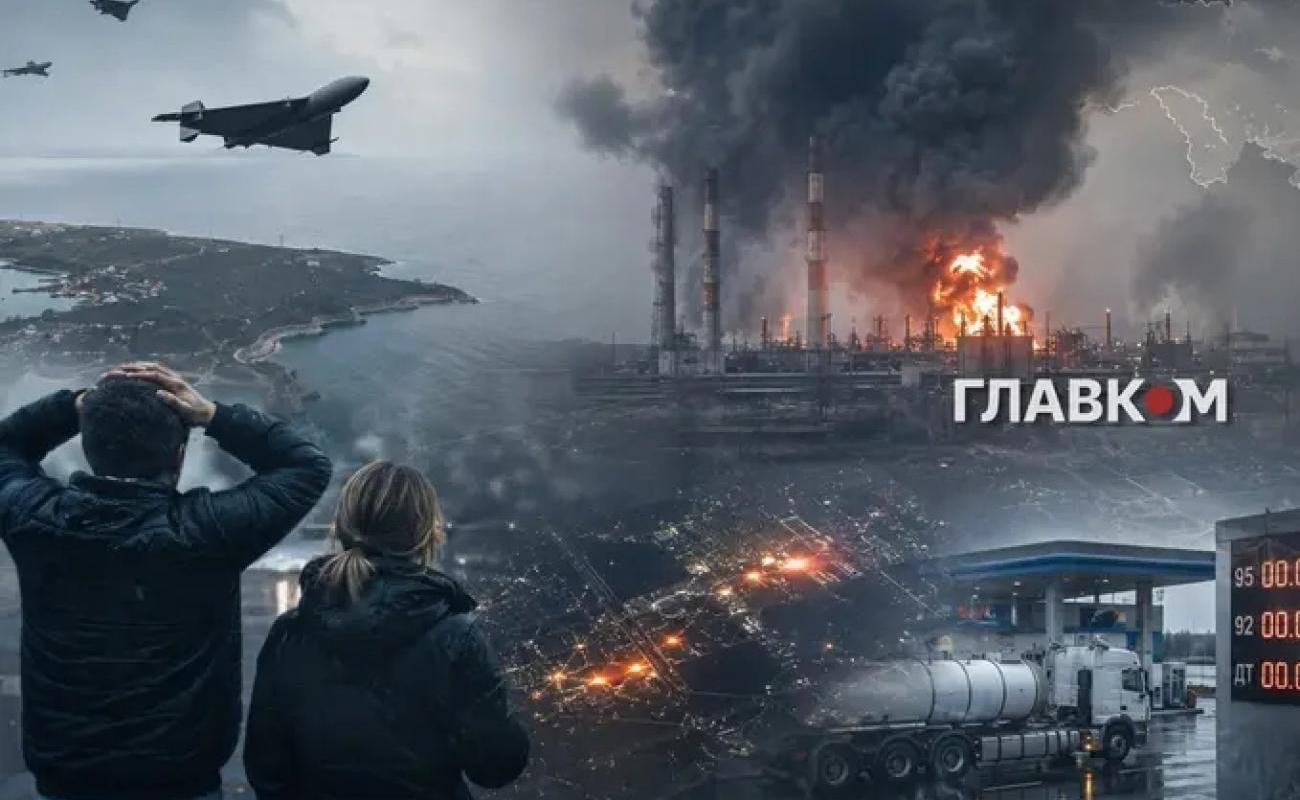
It is important not to deceive ourselves. For example, we are now convinced by images of the impending fuel shortage in the Russian Federation. But at this moment we cannot conclude that the Russian Federation has such problems. They may appear, but for now there are none. Here's one more thing.
The fact is that the visible prerequisites for a shortage (visible strikes on refineries) set off a chain reaction. Someone wants to make money, someone panics and fills all the kettles and vases with gasoline. Currently, most of the restrictions introduced outside Crimea (even in the Krasnodar Territory) are a way to reduce the hype. For now, the Russian Federation has enough fuel and has the technical capabilities to ensure retail sales. Everything will be determined by the dynamics of introducing kinetic sanctions and overcoming their consequences.
Destabilizing the oil products machinery of the Russian Federation is an extremely difficult task, which is not easy to solve from the outside, even with all the successful strikes.
But in the midst of internal panic, the effect can be much more traumatic. Therefore, the Kremlin will now reduce the hype, increase discipline in logistics in order to go through the active phase of the harvest campaign and try to form a rear by the fall, they say, they managed. The positive thing is that the success of the Russians here is not guaranteed, the costs are already significant.
- 4 •
Here is a very practical and absolutely mirror conclusion for us. The Russians are not able to push Ukraine headlong. Therefore, they are betting on undermining from within. All the same.
By the fall, the military-technical balance will be influenced by the factors of people's moods. If the Russians manage to reverse the negative from within during the summer and morally pull themselves together – it will be difficult, especially - if they manage to start various fermentations inside Ukraine.
And vice versa: if Ukraine successfully works with the moods of various groups of dear Russians - it will become extremely difficult for the Kremlin to project power, there will be turmoil, sabotage and whining at every step.
So, everyone in Ukraine who keeps their heads in order and supports their fellow citizens in the rear and at the front as much as possible, really affects the overall result. This is not an exaggeration.
In this sense, it is advisable to think everything over in advance and make responsible decisions. After all, stability is a signal not only for the Russian Federation, but also for our partners, where the number of those who want to “hear Putin” is objectively growing.
- 5 •
The routine activities of the Ukrainian Defense Forces help to silence these schizophrenic voices. In addition to the already mentioned work of the SBU, GUR and SSO in Taman, the General Staff reported on a successful “visit” to the Volgograd region.
There is some confusion in the media about what exactly was hit and where. Perhaps some understatement was made intentionally.
Open data (NASA fire map) shows anomalous thermal phenomena in the area of two Lukoil structures: Korobkovsky GPP and Ritek (Russian Innovative Fuel and Energy Company).
This structure is a scientific and technical polygon of Lukoil and is de facto responsible for the development of production. In the area of the settlement of Kotovo in the Volgograd region there is an office responsible for the plants of Volgograd, Astrakhan, Saratov regions and Kalmykia. There is a significant storage of tanks and many useful things there. This particular facility is closed in red. Since the facilities are remote, independent control will be carried out later.
- 6 •
The monitoring work in Crimea is underway. The most notable was the action at the DGS, the Crimean Titan plant. There was a lot of thought on the Internet about this issue, and the importance of the enterprise is no secret to anyone. But no less important is the energy infrastructure of the plant, on which, in particular, the existence of the occupation group depends...
If you look at it in a complex - Crimea is supplied both from the Kerch side (with the Taman River), and from the Armenskaya side, not to mention Sevastopol, Yevpatoria and the direction towards Dzhankoy.
Here, the Russians really have more reasons to exchange something important for Ukraine for some easing of pressure around Crimea. But it's not evening yet...
Summary. In a few weeks, we will record the results of half a year in the context of the rhythm of the Russian spring-summer-autumn campaign. To this will be added the consequences of the turmoil in the Persian Gulf and other international stories.
The fact is that the Russians can no longer describe their "successes" without reservation. They try, but they can't. The "yes, but" construction is present everywhere. Of course, Ukraine is strategically advancing and winning in every way, but... Even Putin has started to make some reservations, like: Ukraine is striking, but it won't help. So – it's still helping.