
Zelenski's open letter to Putin - EU's call to action
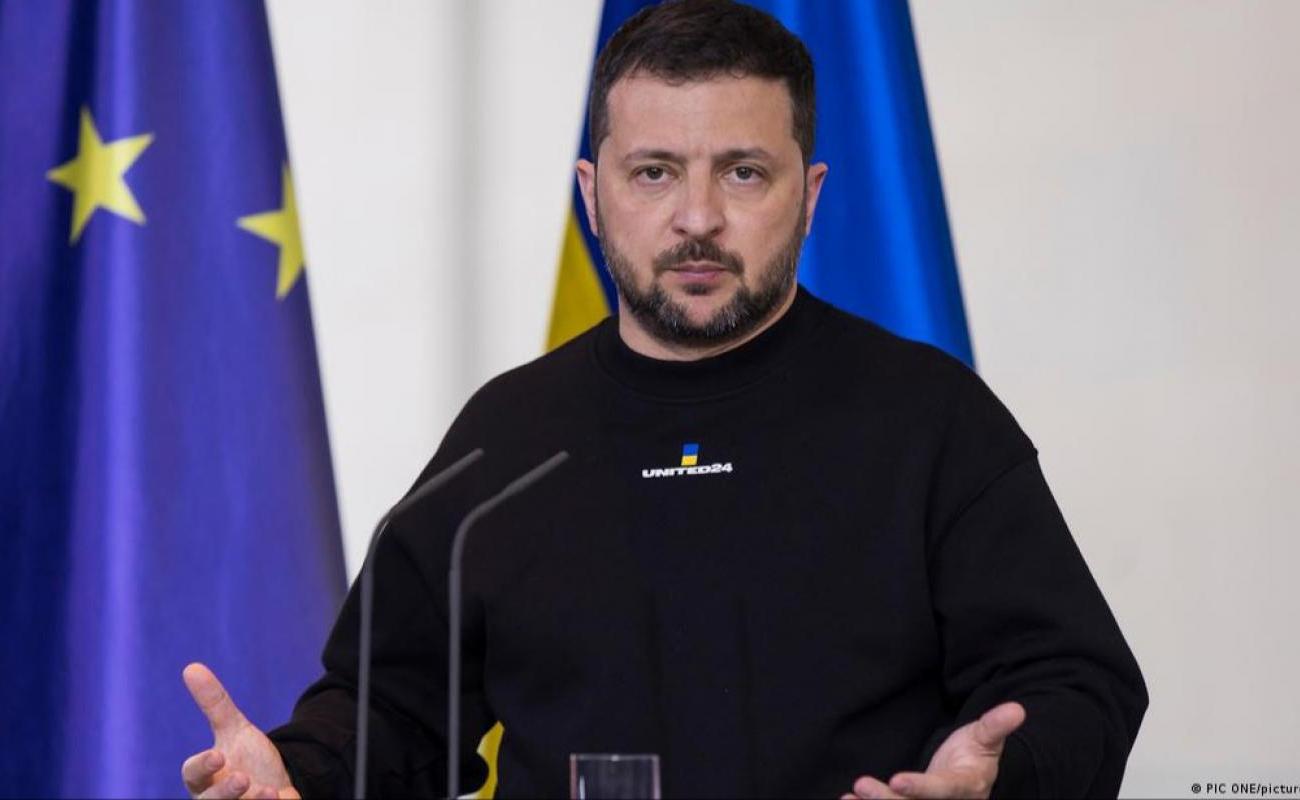
By sending an open letter to Vladimir Putin, Volodymyr Zelensky also invited the reluctant EU to take advantage of Russia's moment of weakness, writes Dirk Emmerich.
This response was expected: Vladimir Putin spoke harshly about Volodymyr Zelensky's open letter, calling it scandalous. There is no meeting with the president of Ukraine, there is no truce on the front. Moscow, as it follows from the reaction of the Russian president, intends to continue the war and achieve its repeatedly announced goals by military means.
Zelensky’s drone message to Putin
It was no coincidence that Zelensky chose the time to publish his letter. Participants in the annual international economic forum (PIEF) gathered in St. Petersburg at Putin’s invitation. Just before it began, columns of smoke rose over the city - Ukrainian drones attacked an oil terminal. The fact that it was damaged was of secondary importance - it was more a message of a different nature. The terminal is located just 16 kilometers from the SPIEF venue.
What a resounding slap: Russian air defense is unable to protect even one of the most important and symbolically significant facilities. A month ago, during the May 9 celebrations, the Kremlin feared that Ukrainian drones could hit the very center of the Russian capital. In Kiev, they are making it clear: it is necessary to increase pressure on Putin in order to force him to finally sit down at the negotiating table to end the war. The fact that the Russian president so quickly, sharply and decisively rejected this idea, speaking at the forum, indicates, above all, one thing: he is nervous.
"Work, brothers, we are counting on you," was his appeal to the Russian army at the front.
They have not made progress in Donbas for several months. Russia is losing more soldiers every day than it can recruit. The country's economy is stagnating. Even the US-Israeli war against Iran and the resulting spike in oil prices failed to reverse the trend. Support for Putin and his policies among the country's population has waned. Doubts are growing as to whether what the president is doing was and is the right thing to do. And can this war even be won?
Putin may also fear that Zelensky is right when he says: "A fact of Russian history that you probably know well: when Russia gets tired, changes come."
Of course, from the Kremlin's perspective, this was presumptuous. Putin could not even consider such a proposal.
Another Motive for Zelensky
But Zelensky may have had another motive. Given that Russia is making virtually no military progress, there is growing confidence in the EU that negotiations could still begin in the near future. Putin himself declared four weeks ago that he was ready for them and suggested former German Chancellor Gerhard Schröder as a possible mediator. Putin and Schröder met in Moscow last week.
Perhaps all this is just a cunning move on Putin’s part. However, what is happening shows that things can be moved from a dead end. At the beginning of the year, such a proposal would have been unthinkable. Putin probably also understands that Schröder is not the right person to represent the EU in possible negotiations. Other candidates are currently being discussed in Brussels in this regard, such as former German Chancellor Angela Merkel or former ECB President Mario Draghi.
Therefore, Zelensky’s open letter and Moscow’s demonstrative refusal have also become a signal to the European Union: now it’s your turn. This moment of Putin’s weakness must be used. Now, European partners must do everything they can to increase pressure on the Kremlin and force it to finally start negotiations.
From Zelensky’s perspective, the desired effect has been achieved. 12 hours after the publication of his open letter, British Prime Minister Keir Starmer, German Chancellor Friedrich Merz, and French President Emmanuel Macron announced a meeting in London, to which the Ukrainian president was also invited. The meeting took place on the evening of Sunday, June 7.
And as a result, a five-point plan for ending the war has emerged. These key areas - a ceasefire, legally binding security guarantees for Kiev, the current line of contact as a starting point for negotiations, a freeze on Russian assets until the end of the war and compensation for Ukraine, and a European security framework based on treaties - largely reflect the positions that have already been agreed.
However, it is worth noting that the current line of contact is considered the starting point for possible negotiations. Moscow has so far categorically ruled this out, insisting that Kiev must give up all of Donbass - including territories that the Russians did not even occupy.
Given the frozen front line, Ukrainian drone attacks on Russian territory and a stagnant economy, Putin may have to give up this maximalist demand. It seems that this can no longer be ruled out, unlike a few months ago. Then Trump and Putin, working together, brought Zelensky to a dead end: either you give up Donbass, or the war continues. The US president, preoccupied with Iran, has now completely withdrawn from participating in negotiations to end the war in Ukraine.
A signal for Europe
The vacuum that has emerged must now be filled by Europe, which has long complained about being excluded from the negotiation process. Much will depend on what remains behind the scenes and what is discussed in confidence. A quick end to the fighting is still far from certain, but the conditions for what can be achieved in the next negotiations are now changing.
Brussels must seize the opportunity. In this sense, Zelensky’s open letter was not only a signal to Putin, but also an unequivocal appeal to the EU - cleverly constructed in terms of communication and aimed at several levels.