
However, its discomfort at appearing impotent in the face of US military adventurism aside, experts have argued that Moscow’s partnership with Tehran was never much more than one of convenience and Russia is unlikely to be fazed by the upheaval.
Why Putin is the big winner from Iran war
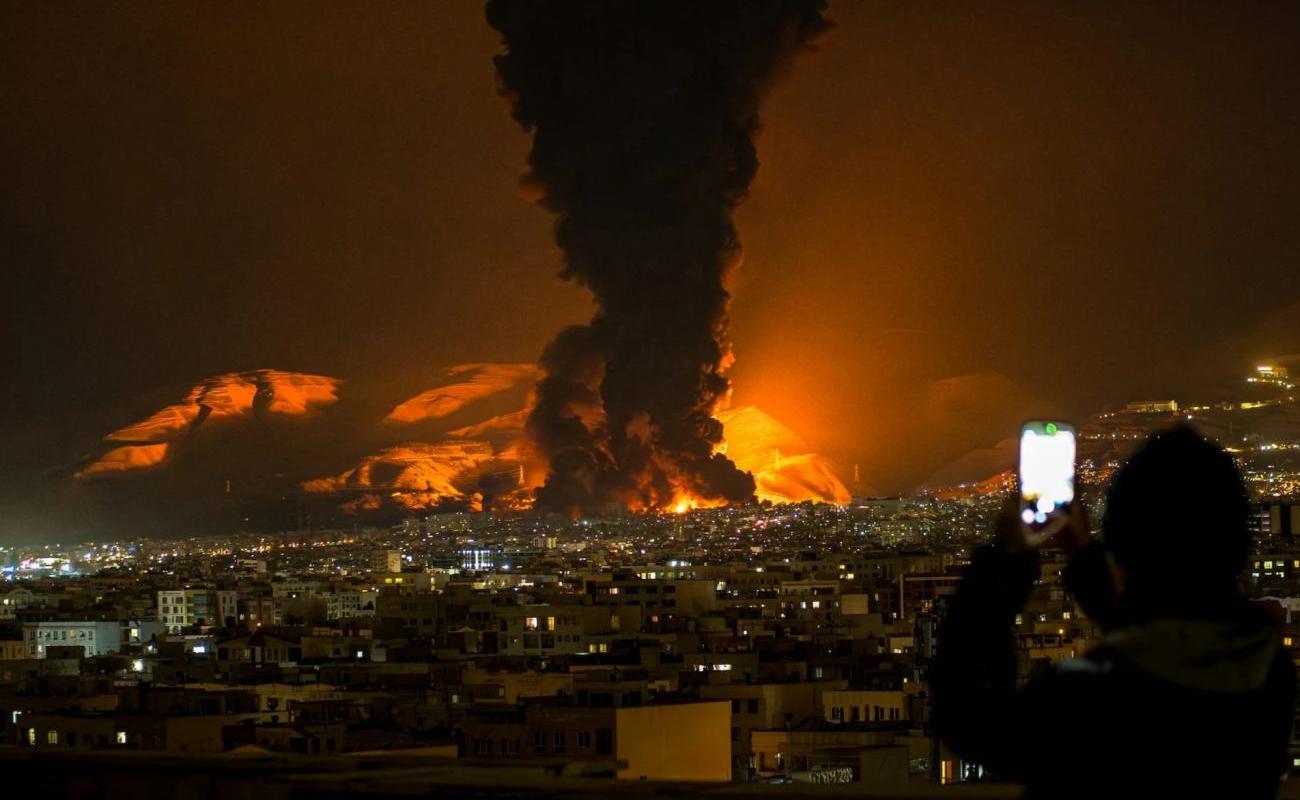
Middle East conflict is driving up the price of oil, helping Moscow to fund its military campaign in Ukraine
When Vladimir Putin picked up the phone to Donald Trump on Monday, he was keen to secure a “quick political and diplomatic settlement” to the war in Iran.
But the war has not been all that bad for the Russian leader.
Analysts say Moscow could emerge the clearest winner from the war so far in the Middle East, and it could not come at a more crucial time for Putin.
Antonio Costa, the EU Council president, told EU ambassadors on Tuesday that “so far, there is only one winner in this war – Russia”.
Just over a week ago, the Kremlin was confronted with serious questions over whether it could maintain the slowing war effort that was bleeding its economy dry.
But almost overnight, after US and Israeli bombs first rained down on Iran, a solution to all of its problems appears to have taken shape.
This by extension means that Ukraine stands to suffer. As Russia profits and attention is drawn away, Kyiv will be praying for an end to the conflict abroad so the war at home can cease.
Economy
In recent months, international energy sanctions, depressed global oil prices and an EU/UK price cap had converged into a severe fiscal bind for Russia, which as recently as five years ago drew on oil and gas revenues for 45 per cent of its federal budget.
In January, Russia’s oil and gas revenues halved compared with the same month one year earlier, plummeting to levels last seen in 2020 during the Covid-19 pandemic.
Moscow’s economic woes had become so acute that it was forced to sell gold reserves and tap consumers and small businesses for funds, triggering a spike in the cost of living.
Now, the de facto closure of the Strait of Hormuz and a partial halt in Gulf oil production have sent oil prices soaring. Where prices for Russian oil lurked at less than $40 a barrel in December, they have now almost doubled to $72.
In what could prove to be a significant boost to Moscow’s fortunes, Mr Trump said shortly after talks with Putin on Monday that Washington would waive oil-related sanctions on “some countries” to stabilise global energy markets.
“We have sanctions on some countries. We’re going to take those sanctions off until the Strait is up,” he told reporters. Russia could be among those countries, according to a report by the Reuters news agency citing three sources close to the discussions.
Last week, the US Treasury Department announced a decision to allow India to buy Russian oil for 30 days in order to alleviate upward pressure on oil prices.
The Strait of Hormuz closure could also choke off up to a quarter of global monthly liquefied natural gas shipments. Faced with rising prices, Europe could be forced to reconsider its plan to phase out Russian LNG by 2027.
A sign of Moscow’s renewed confidence in the sturdiness of its finances is Putin’s gloating return to a familiar provocation: the prospect of turning off the taps to Europe.
“Maybe it’s better for us right now to stop deliveries to the European market. Move to markets that are opening and gain a foothold there,” he taunted in remarks to state media on Wednesday.
“Certainly, if Russia has more money and manages its deficit it will have much less pressure domestically to end the war,” said Dr Tatiana Stanovaya, a senior fellow at the Carnegie Russia Eurasia Center.
“If [Putin] has more resources to deal with domestic financial issues, he can be more self-confident on the course he is on,” she told The Telegraph.
However, some analysts have countered that without a sustained crisis, Russia is unlikely to reap a significant strategic dividend.
“The ripples from US-Israeli attacks on oil prices may help Russia,” said Alexander Kolyandr, a Senior Fellow with the Democratic Resilience Programme at the Center for European Policy Analysis.
“But the current temporary spike, filtered through sanctions discounts and an unfavourable exchange rate, is unlikely to change the fundamental arithmetic.”
On the battlefield
With Washington preoccupied in the Middle East, it is likely to be indefinitely uninterested in diplomatic efforts to resolve the war in Ukraine.
Volodymyr Zelensky, the Ukrainian president, said on Monday that talks planned for this week have been postponed at the request of Washington because “the partners’ priority and all attention are focused on the situation around Iran”.
This provides Moscow with an opportunity. An economic boost and pinched supplies of military hardware to Ukraine could allow it to surge forward on the battlefield, before demanding greater concessions from Kyiv in future talks.
Moscow’s own military supplies are unlikely to be under threat, as its earlier reliance on imports of hardware and expertise from Iran has shifted to a system of localised production.
The most immediate spillover on the battlefield is likely to be felt in air defence, where the US-made Patriot system forms the cornerstone of Ukraine’s protection against Russian ballistic missile barrages.
Washington was already tight-fisted in providing Patriot stocks to Kyiv. More Patriot missiles were used in three days of fighting in the Middle East than Ukraine has received in more than four years of war, Mr Zelensky said on March 5.
However, supplies are now likely to be strangled further as reports have shown the US-aligned Gulf states burning rapidly through million-dollar interceptors to shoot down Iranian munitions a fraction of the cost.
In his efforts to ensure Ukraine is not left short-changed, Mr Zelensky has proposed trading Ukraine’s advanced military technology such as drone interceptors for Patriot interceptors, or for Gulf allies to mediate a ceasefire with Moscow.
On Monday, he said 11 countries had reached out to Ukraine for its technology and expertise, but it was not immediately clear what, if anything, Kyiv would receive in return.
Meanwhile, according to the Institute for the Study of War (ISW) on Sunday, Russia has increased the share of ballistic missiles in its recent strike packages against Ukraine, likely in order to drain its remaining air defence resources.
Diplomacy
Moscow’s somewhat anaemic response to the gutting of another allied country hardly came as a surprise.
It was quiet as US special forces stormed Nicolás Maduro’s compound in early January, just as it was when rebel forces seized Damascus in late 2024, overthrowing Bashar al-Assad. Nor did it intervene last summer in Iran’s 12-day war with Israel.
“It’s an unpleasant reality for many of those who dream about a great Russia and its growing role in international affairs,” she continued.
“In reality if you look at Russian foreign policy, experts, especially those close to the Kremlin, are saying: The idea is very clear. We should not count on external forces and partnerships.”
It is also possible that Russia stands to gain more from fraying transatlantic ties between Europe and the United States than it stands to lose from forfeiting substantive support for its allies.
Mr Trump has threatened a full trade embargo on Spain and belittled Sir Keir Starmer as “not Winston Churchill” in a broadside aimed at the PM for denying the US permission to use military bases to launch attacks in the Chagos islands.
The Iran war has, however, underscored the resilience of a different relationship.
Mr Trump on Saturday brushed off suggestions that US-Russian ties could be strained by reports that Moscow had provided Tehran with intelligence targeting American military personnel and assets in the Middle East.