
The Shenzhen illusion: Putin’s Russia is no longer a global power
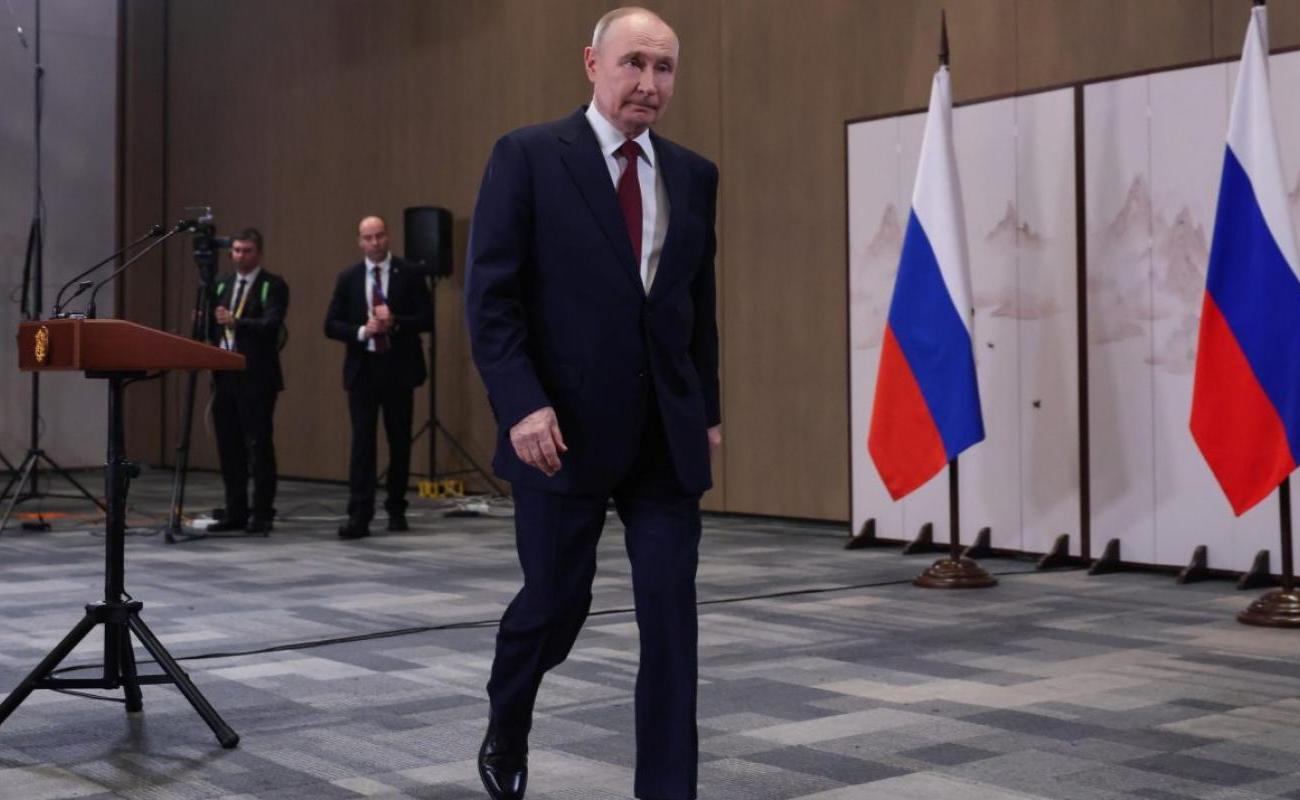
Putin’s greatest failure is that he has bankrupted Russia strategically; this may prove to be one of the most consequential geopolitical events of the 21st century, writes Ilian Vassilev.
Ilian Vassilev is a former Bulgarian ambassador to Moscow, now a media publisher and commentator. Other opinion pieces by him can be found here.
At Yalta, the victorious powers of the Second World War gathered to determine the post-war world order. In Shenzhen, three leaders met, two of whom are seeking to impose a new global distribution of power. Yet neither has the strength nor sufficiently secure strategic positions to achieve that goal. In reality, the United States is not winning its war in Iran, and Russia is not winning its war in Ukraine.
The old order is breaking down not simply because it has run its course, or because the architects of Yalta lacked foresight. It is also breaking down because one of its principal participants – Russia – has failed to manage its historic decline from a global power centre, as the Soviet Union once was, to the status of a post-Soviet regional power.
Putin has failed to turn the Soviet legacy into the foundation of a new global role for Russia. On the contrary, the war in Ukraine has not restored Russia’s greatness or international standing. It threatens instead to reduce Russia from a global power to a regional player whose interests are increasingly disregarded by other centres of power.
It is no coincidence that, in his address at the APEC meeting, Putin continued to portray a fictitious picture of Russia’s economic might. He even went so far as to call Russia the largest economy in Europe – a claim that prompted smiles. The gap between propaganda and the country’s actual economic position is becoming increasingly difficult to bridge. This is no different from the fabricated battlefield victories in Ukraine with which Putin seeks to conceal the ugly truth of his own leadership failure.
The four-point declaration is hardly impressive. It consists primarily of intentions rather than concrete commitments or mechanisms for implementation. Moreover, both Putin and Trump face too many unresolved domestic and international problems to deliver tangible results – whether in security, economic development or even in sustaining their own political and media narratives.
Ironically, the only domain in which Russia still qualifies as a global power – its nuclear arsenal – was effectively sidelined by the declaration. Xi called for nuclear weapons to be “comprehensively banned and thoroughly destroyed”, advocating a nuclear-free world. In doing so, he undercut the very argument Putin relies on to claim Russia’s status as a global power.
In fact, Putin’s greatest failure is that he has bankrupted Russia strategically. This may prove to be one of the most consequential geopolitical events of the 21st century.
He has squandered the country’s vast resource wealth, developed over generations. He has depleted a substantial portion of the financial reserves that could have funded modernisation and development for decades to come. He has also destroyed the last remnants of the Soviet industrial base which, despite its inefficiencies, still sustained certain production and technological capabilities.
But his most serious strategic defeat lies elsewhere: he has created a powerful and enduring adversary on Russia’s western border – Ukraine. Following Russia’s genocidal aggression, Ukraine now has the historical motivation, military capacity and strategic interest to prevent such a scenario from ever being repeated. And behind Ukraine stands Europe, gradually recognising that its own security is inseparable from Ukraine’s ability to defend itself.
Europe, therefore, has no better option than to stop Putin at Ukraine’s Russian border.
This brings us to the most important outcome of the meeting in Shenzhen.
Russia was not invited to the main table. There, Trump and Xi Jinping sat together. It was they who discussed relations between the world’s two largest economies and the future of global rivalry. Putin could continue to speak of a multipolar world, a strategic partnership with China and the restoration of Russian greatness. But the symbolism was unmistakable.
Russia is no longer a co-author of the world order. It is increasingly becoming an object of negotiation between those who actually possess global economic and political weight.
That is the real verdict on the New Yalta that never came to be.
More opinion and analysis by EUalive’s partner Altanalyses can be found here
Caption: Russian President Vladimir Putin (C) leaves after speaking at a press conference on the sidelines of the Asia-Pacific Economic Cooperation (APEC) Economic Leaders’ Meeting in Shenzhen, Guangdong province, China, 19 November 2026. EPA/MAXIM SHEMETOV / POOL