
Why are we being "washed" by Putin's propaganda? Media in Serbia quoted 67% of news from Russia's Sputnik
If you are looking for an explanation for why most people in our region think that Ukraine attacked Russia, why they have not heard that the Russians lost Kherson and that there is resistance to the Putin regime in Russia itself, the explanation should be sought in the media image of our region.
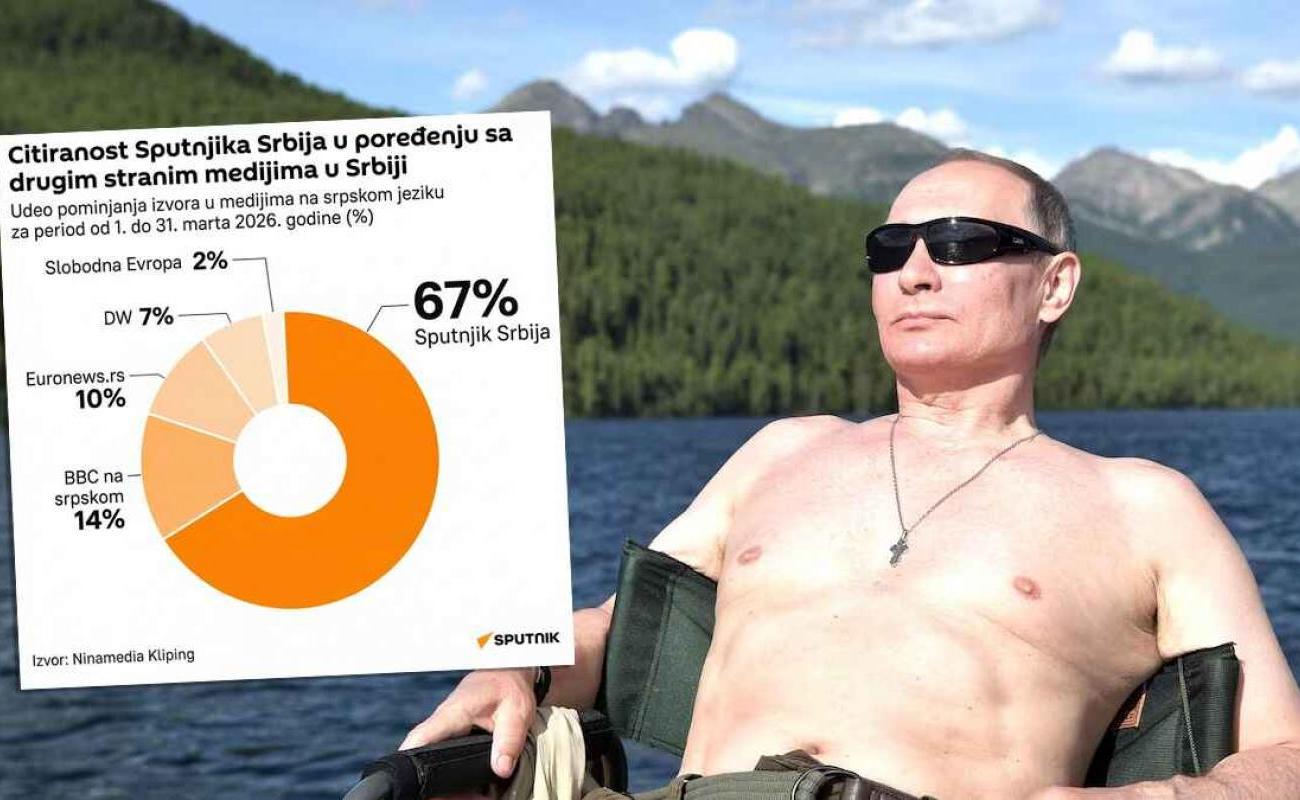
The Russian Sputnik has published data that the share of citations of Sputnik Serbia in the Serbian-language media in March of this year alone was 67 percent.
This is twice as much as all other world media outlets in Serbia, which are mostly under government control, are quoted in total. This ratio could increase further, given that the remaining number of media outlets not under regime control would soon change their editorial policies.
In its announcement, Sputnik boasted that it is more quoted than other world media outlets in Serbia.
“Right behind us are renowned world media outlets such as the BBC in Serbian, Euronews, Deutsche Welle and Free Europe. The editor-in-chief of MIA Russia Today, of which Sputnik is a part, Margarita Simonyan, congratulated Sputnik Serbia on this occasion, assessing that this is an exceptional result, the text states.
It is also mentioned that Sputnik Serbia was founded in 2015 and has been among the most quoted media outlets since its inception. It is also added that today Sputnik is the only Russian media outlet that, along with RT, operates legally in Europe.
Why are we being washed by Putin's propaganda?
It should be emphasized that these are media outlets that are directly under the control of the Putin regime and that, to a large extent, through the majority of media outlets in our region, spread the right-wing narrative and shape public attitudes.
They thereby contribute to the rise of the extreme right and the legitimization of nationalist structures that hold the levers of power in most countries in our region.
Given that the vast majority of the population does not travel to Russia and has no other channel of information from this country, historically the propaganda narrative has been easier to maintain, but it seems never to this extent.
Most reports on the War in Ukraine reach our audience by broadcasting official statements from the Russian military and quoting official Russian sources, and they are primarily based on half-truths and selected fragments of reality that fit the regime’s narrative.
For example, when the Russian army loses the largest city it captured in this invasion, Kherson, the pro-Russian media in the region either completely ignores it or calls it a “planned regrouping.”
Instead of news about the withdrawal, ten news stories about the “successful destruction of foreign mercenaries” or the “energy collapse in Europe” are published. The loss of territory is drowned in a sea of irrelevant but bombastic “victories.” News about the losses and problems Russia is facing on the front is not broadcast, so most people cannot even put together an overall picture of what has happened since the beginning of the war until today.
How this narrative is built was recently described by journalist Andrew Ryvkin, who once worked for several propaganda outlets in Russia. They all had an unwritten rule: No matter the crisis, Putin cannot lose. If Russia loses, it is because he did not compete.
He points out that many Western commentators have also unconsciously started to follow this rule, but in our region, most media outlets are clearly following it consciously, at least judging by the fact that 67% of news is quoted from Russian sources.
Information blockade
If two-thirds of quotes in the media space are reserved for one source, this indicates a kind of “information blockade” in which the majority of the population lives.
Such hyperproduction and mass downloading of texts directly affect what people see when they search for something.
If we add to this the network of fake portals, bots and pages that spread the same kind of narrative and achieve enormous success, which we have already written about, it should not be surprising that Putin is by far the most popular politician in Serbia, whose popularity far exceeds the support in his own country.
News about protests against Putin's regime, the resistance that people offer and the repression against critics who receive up to 20 years in prison for banal readings of Lenin's books, have difficulty reaching our audience.
Although everything that millions of people in Serbia have been protesting for months, namely corruption, dictatorship, media control and the imposition of a single-mindedness, also applies to Putin's regime, on a scale that is several times greater and more fatal, the majority of the population that does not live in that corruption and that dictatorship bases its position on a parallel reality shaped by the domestic media that spread this kind of propaganda.