
The hefty bill of Chinese projects in the Balkans
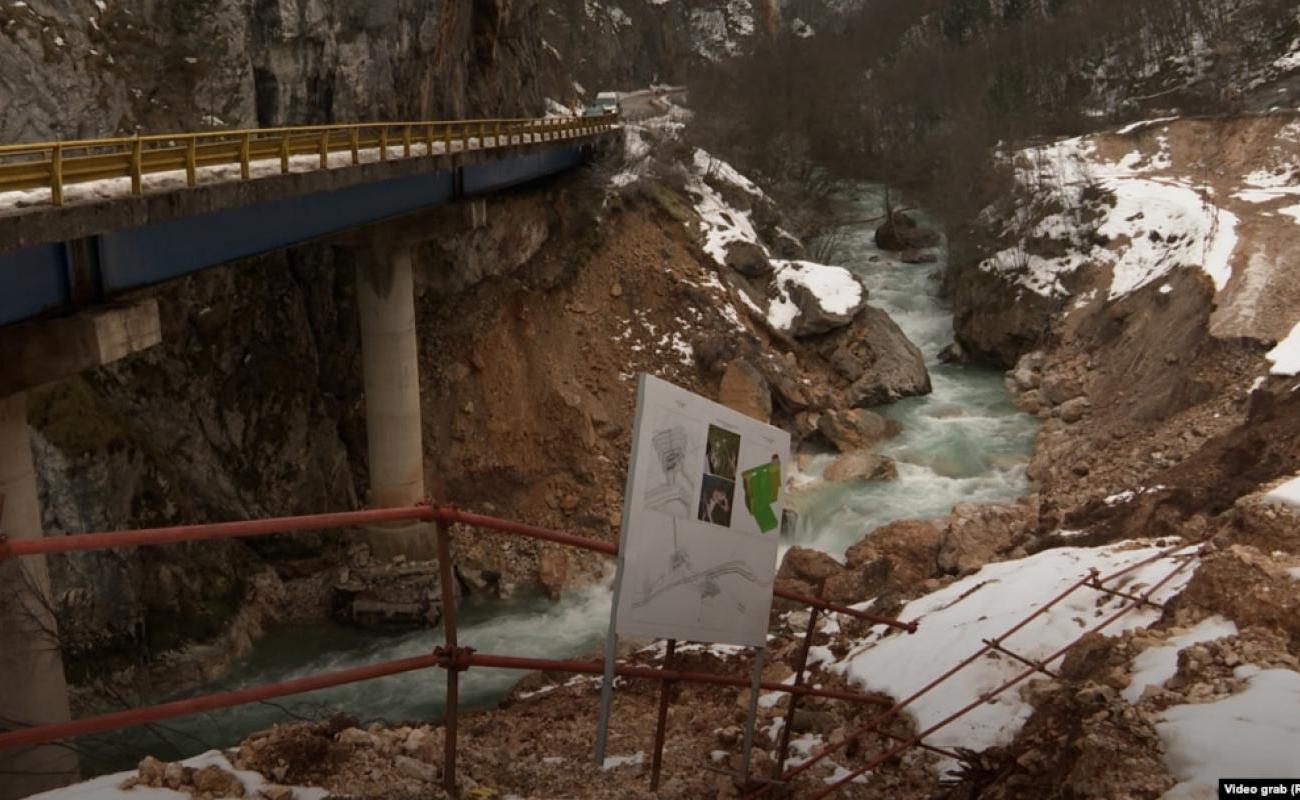
Another 11 million euros will be invested in the construction of hydroelectric power plants in Bistrica, in eastern Bosnia and Herzegovina.
Works began in 2021 and are being carried out by the Chinese company, China National Aero-Technology International Engineering Corporation (AVIC).
To secure additional funds, the company HE Bistrica has received a capital increase from its parent company, HE na Drini, which is owned by the Republika Srpska entity of Bosnia and Herzegovina.
The decision on additional investments was approved in October, at the meeting of the shareholders of the Drini Hydropower Plant.
With this decision, the cost of the project, initially estimated at 103 million euros, has reached over 170 million euros.
The public company Elektroprivreda RS, which owns the Drini Hydroelectric Power Plant, did not respond to Radio Free Europe's questions about the reasons for the cost increase.
This is not an isolated case. Other projects being implemented by Chinese companies in the Western Balkans have also suffered continuous cost increases.
The organization Transparency International in Bosnia and Herzegovina estimates for Radio Free Europe that delays in works, lack of transparency, weak supervision by institutions and, in some cases, errors in project planning cause costs to increase significantly.
According to the organization, citizens ultimately pay the bill for these price increases.
Which projects in Bosnia and Herzegovina have seen the biggest cost increases?
The agreement for the construction of hydropower plants in Bistrica was signed in December 2019, between the Chinese company AVIC and the Government of Republika Srpska.
Construction of three hydroelectric power plants began in 2021, with an initial cost of 103 million euros.
However, the project has faced numerous problems during its implementation, including a landslide on the main Sarajevo-Foca road, which led to the interruption of works.
Since then, the cost of the project has increased by almost 70 million euros, while the initial deadline for completion of the works, December 2026, is not expected to be met.
The Banja Luka-Prijedor highway is being built by the Chinese company China Shandong International Economic & Technical Cooperation Group, which has also been engaged in road construction in Serbia.
Since 2018, the cost of the project has increased from 297 million to 388 million euros, while the deadlines for completing the works have been continuously postponed.
The project is entirely financed by China, while the Chinese company has been granted the right to collect highway tolls for 30 years.
If the annual revenue from these payments is lower than 32.5 million euros, the difference will be covered by the budget of Republika Srpska.
The contract between the Government of Republika Srpska and the Chinese company has been kept secret from the beginning.
After a series of lawsuits, authorities published it, but not its financial details.
The hospital in Doboj was inaugurated at the end of 2024, about a year late.
The construction cost, initially estimated at 53 million euros from the Republika Srpska budget, increased to over 60 million euros, due to additional expenses for equipping the hospital.
The Chinese company that carried out the project, China Sinopharm International Corporation, justified the overall increase in costs with inflation caused by the pandemic and the war in Ukraine.
Asked by Radio Free Europe about the reasons for the increase in the cost of projects, the Government of Republika Srpska said that it had forwarded the questions to the Ministry of Transport and Communications and the Ministry of Health.
As of the publication of this article, REL had not received a response from these ministries.
Responsibility of authorities for increasing costs
Rising energy prices have made infrastructure projects increasingly expensive in recent years.
But the authorities also bear part of the responsibility, Damjan Ozegovic, from Transparency International in Bosnia and Herzegovina, told Radio Free Europe.
"Here, foreign investors enjoy a privileged position, even compared to domestic investors. Our decision-makers adapt to them, instead of investors coming from abroad adapting to the country's rules," says Ozhegovic.
He adds that Bosnia and Herzegovina creates favorable conditions for approving the cost increases of large infrastructure and energy projects.
According to him, this is due to potential financial and political benefits, but also to the incompetence of the authorities.
"It is possible that costs are not increasing intentionally, but due to the inability to calculate them properly from the beginning. This is also not something unusual for us," Ozhegović estimates.
He explains that this happens when, from the beginning, all the work and expenses involved in a project are not determined.
According to him, one such case is the hospital in Doboj, where additional expenses emerged during construction that should have been foreseen in the initial planning.
China and state guarantees
Bankwatch International, which monitors Chinese investments in the energy sector in the Western Balkans, says that delays and cost overruns are not uncommon in large projects.
However, Pipa Galop from this organization explains to Radio Free Europe that there are specific reasons why Chinese-funded projects in the Western Balkans are more likely to be expensive and delayed.
"When European banks consider granting a loan, they want to be sure that they will get their money back. Therefore, they conduct detailed analyses to assess whether the projects are economically viable and well-planned. On the other hand, Chinese banks almost always require guarantees from the state or entity for the loans they provide," explains Galop.
She adds that this means that, even if the projects fail, China still gets its money.
"Therefore, for Chinese banks it is not so important to ensure that projects are economically viable and well-planned. I do not mean that they do not carry out checks at all, but, since they do not have a tradition of cooperation with civil society, they tend to trust all the information that governments give them," says Galop.
How is China involved in these projects?
China builds and finances projects in the Western Balkans through three different models. Common to them are: lack of transparency of contracts, use of Chinese equipment and, often, Chinese labor.
One of them is the EPC (Engineering, Procurement and Construction) model, also known as the "turnkey" model.
Under this model, a local public enterprise signs a contract with a Chinese consortium, which takes over the entire process: from designing the project and providing materials to carrying out the works.
In such projects, loans are often provided by the Chinese bank, Exim Bank.
The second model that China often uses in the Western Balkans is where the Chinese company finances the construction of the project, while the party that commissioned it pays it after the work is completed.
Payments are usually made from revenues from the sale of electricity or from road tolls.
This model suits public enterprises in Bosnia and Herzegovina, which often do not have sufficient capital for large investments.
For Chinese companies, meanwhile, financing is usually not an obstacle, as they are supported by state capital.
In practice, these projects cost significantly more. This is because the companies that implement them also assume the risks and financial obligations, from securing bank loans to providing guarantees.
The third model used by Chinese companies in the Western Balkans is that of concession, which in Bosnia and Herzegovina, so far, has only been implemented for infrastructure projects.
According to this model, the Chinese company establishes a branch in Bosnia and Herzegovina, secures financing with its own capital or through loans, and builds the project.
In this specific case, we are talking about the Banja Luka-Prijedor highway, from the use of which the company will collect revenue for a certain period.
Although at first glance it seems that the project costs the Government of Republika Srpska nothing, it is obliged to cover the difference if the annual revenue from highway tolls does not reach the amount specified in the contract.
After the end of the concession period, the highway passes into public ownership.
The situation in the region
Other major infrastructure and energy projects, carried out by Chinese companies in the region, have also faced significant cost increases, delays of several years, or requests for additional financing.
The Chinese company, Shandong, is responsible for building the expressway from Pozarevac to Gollubac, in eastern Serbia, known as the Danube Corridor.
The cost of works on the Danube Corridor has increased from the initially estimated 337 million euros to around 524 million euros.
The deadline for opening the road to traffic has also been postponed.
The Shandong company has also been entrusted with the construction of the highway connecting Belgrade with Novi Sad, via Zrenjanin.
The cost of this project, work on which began in 2023, has increased significantly.
Initially, the construction was projected to cost 600 million euros, but now the potential amount of financing has almost tripled.
This is because Serbia has foreseen the possibility of obtaining loans of up to 1.7 billion euros for the implementation of the project.
The cost of the high-speed railway from Novi Sad to the border with Hungary, built by a consortium of two Chinese companies, has also increased through contract changes.
In the end, about 1.2 billion euros were paid for this project.
The works are under investigation by the Serbian Organized Crime Prosecutor's Office, which, among other things, suspects that two former ministers were involved in the misuse of more than $115 million.
Investigative procedures were launched after the deaths of 16 people from the collapse of a concrete shelter at the renovated railway station in Novi Sad.
The tragedy sparked massive protests, which led to a change of power in Serbia.
The Kichevo-Ohrid highway in North Macedonia, which is being built by the Chinese company, Sinohydro, has also seen a significant increase in cost.
When the contract was signed, the value of the project was 411 million euros, while the total cost has reached around 600 million euros.
The reasons cited for this increase include unforeseen geological conditions, the need for additional land expropriation, changes to the project, and the construction of accompanying infrastructure.
A similar situation has been observed in the project to modernize the Pljevlja thermal power plant in Montenegro, which is being implemented by a consortium led by the Chinese company, Dongfang Electric International.
The initial contract, signed in 2020, had a value of 54.5 million euros, while by mid-2026, 65.5 million euros had been paid.
Montenegro's state-owned electricity company, Elektroprivreda, justified the cost increase with additional work that was not included in the initial contract.
Even the construction of the highway segment from Smokovci, near Podgorica, to Mateševo, in northern Montenegro, had additional costs.
According to the 2014 contract, the construction of this segment by the Chinese company, CRBC, was estimated to cost 809 million euros.
However, the Government of Montenegro had to take out an additional 90 million euros in loans to cover additional costs.
The highway was opened to traffic eight years after the contract was signed. /REL/