
22.07.2026.

Squeezing the elites
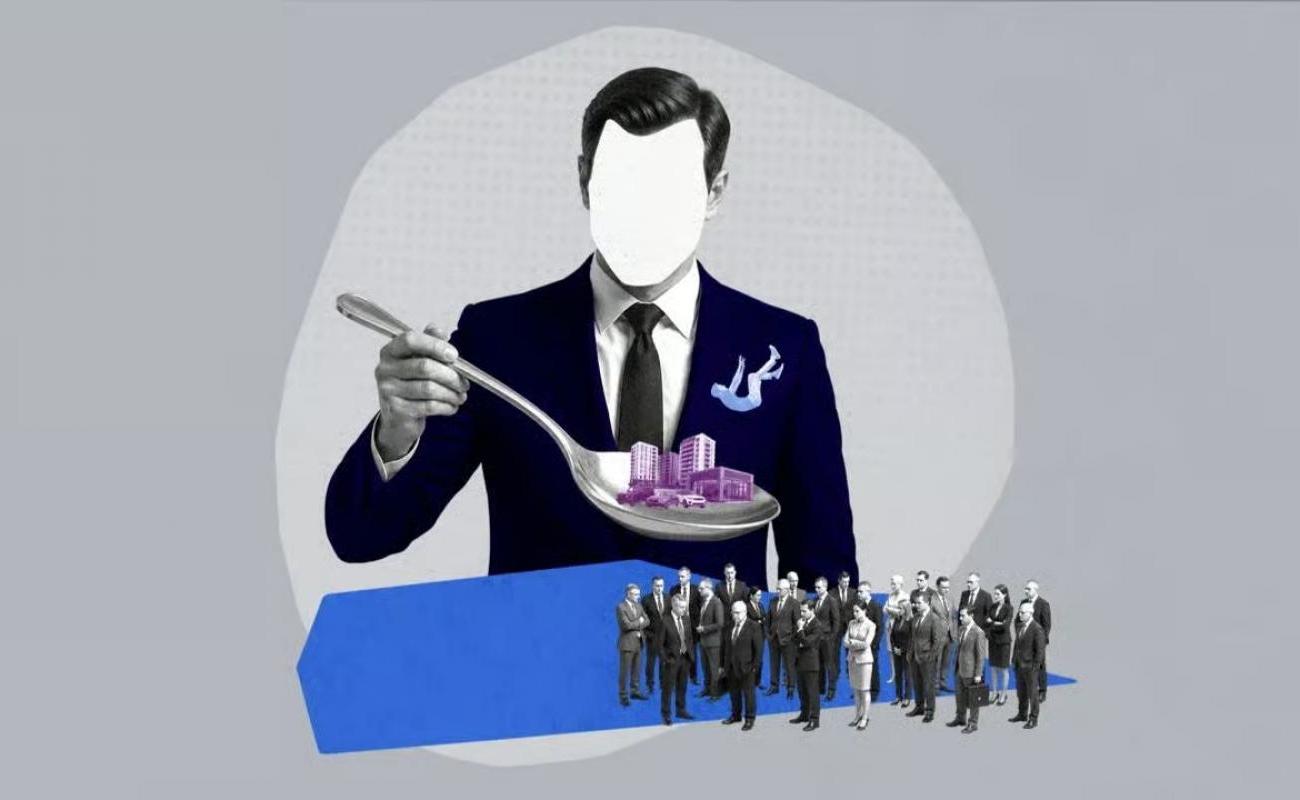
In the fifth year of Russia’s full-scale invasion of Ukraine, Russian law enforcement has become far more aggressive about seizing money and property from officials, lawmakers, security officers, judges, and their relatives and associates. According to Novaya Gazeta Europe’s calculations, law enforcement agencies seized assets worth 951 billion rubles (€12.6 billion) in 2025 — six times more than the year before — and another 366 billion rubles (€4.1 billion) in the first half of 2026 alone. Novaya Europe explains why the Kremlin decided to launch a new “anti-corruption campaign”, how it works, and who it’s hit hardest.

“Anyone in Samara can see judicial corruption with their own eyes.” That was the thesis of a series of posts published in the autumn of 2022 on the Telegram channel of Alexander Khinshtein, who was then a State Duma deputy but now heads the Kursk region on the Ukrainian border. (Several of the region’s past governors have been sentenced to lengthy prison terms along with fines running into hundreds of millions of rubles.)

Khinshtein had demanded that Samara judge Alexander Yefanov be prosecuted for allegedly buying up a prime plot of land on an island in the Volga for a fraction of its worth. Almost four years later, authorities have begun stripping the judge and three family members of their property — though still without filing charges. In July 2026, a Samara court, acting on a lawsuit from the Prosecutor General’s Office, ordered the freezing of about 20 apartments, plots of land and commercial properties, along with a BMW, a Lexus and a Land Rover.

This was just one of the numerous anti-corruption cases targeting members of the ruling elite in the last year. Prosecutors estimated the damage Yefanov caused the state at 1.2 billion rubles (€13.4 million)

Factories and a treadmill

Over the course of the war, Novaya Europe counted 908 officials, lawmakers, security officers and judges named as defendants in 453 cases involving the seizure of businesses and personal property.

While there were 40 and 47 such asset-seizure cases in 2022 and 2023 respectively, the number nearly doubled in the third year of the war. And in just the first six months of 2026, the number of seizure cases had already almost caught up with the total for 2025: 152 cases in 2025, versus 123 in just the first half of 2026.

The monetary scale of the seizures stayed roughly flat in 2022 and 2023 — 196 billion (€2.2 billion) and 168 billion rubles (€1.9 billion) respectively — before dropping 28% in 2024. But in 2025, the year after the presidential election, seizures jumped sharply to 951 billion rubles (€10.6 billion). In the first half of 2026 alone, officials and lawmakers had already lost another 366 billion rubles (€4.1 billion) in property and cash.

Roughly half of last year’s record total came from the seizure of assets belonging to two lawmaker-businessmen: Konstantin Strukov’s Yuzhuralzoloto gold mining company in the Urals, and Eduard Yanakov’s Dalpolimetall in the Primorsky region.

Other major business seizures include the KIMP Holding bearing plant, worth 126 billion rubles (€1.4 billion), which was taken in 2026 from former deputy head of Rosstandart Alexei Kuleshov; and Dagneftproduct, worth 100 billion rubles (€1.1 billion), seized in 2025 from Dagestan’s state secretary Magomed-Sultan Magomedov along with his relatives and associates.

Homes, cars, luxury items and cash are seized nearly four times more often than businesses — 358 cases versus 95. But in monetary terms the picture flips: the commercial assets confiscated by the state are worth 20.5 times more than the personal property.

Real estate dominates the inventory of seized personal property: more than 2,000 apartments, houses, and plots of land have been confiscated from defendants in these cases. We also counted 336 cars and more than 70 expensive watches, though some of the seized items are considerably more unusual.

In 2026, for instance, a court sentenced Alexander Vinogradov, the former mayor of Troitsk in the Chelyabinsk region, to 10.5 years in prison and confiscated a treadmill he had received as a bribe. Konstantin Trofimov, former mayor of Artyomovsky in the Sverdlovsk region, got nearly the same sentence and had a boiler taken from him. Konstantin Knis, former head of the Omsk regional penitentiary service, had a billiard table worth 500,000 rubles (€5,600) seized, while former Pskov Deputy Mayor Alexander Gratsky lost a massage chair worth 200,000 rubles (€2,200).

Who’s most at risk

The main targets for law enforcement are regional officials, who account for 510 of those accused of corruption, or nearly two-thirds of Novaya Europe’s sample. In second place are local security officers, with 101 people, followed by federal-level lawmakers, with 68 defendants.

Novaya Europe recently calculated that, since the start of the war and through the end of the first quarter of 2026, criminal cases had been opened against at least 700 senior federal and regional officials, lawmakers, mayors and deputy mayors. We found more cases involving property seizures because our sample included officials at every level, as well as security officers and judges.

Not everyone who lost their property was hit with criminal charges or convicted. Two judges — former head of the Supreme Court of Adygea Aslan Trakhov and judge Natalia Khakhaleva — had property, cash and businesses seized following anti-corruption lawsuits from the Prosecutor General’s Office, but law enforcement has not yet opened criminal proceedings against them.

Excluding Moscow, St. Petersburg and the Moscow region, the Krasnodar region tops the list for asset seizures, followed by a tie between the Nizhny Novgorod and Novosibirsk regions, with Rostov region in third.

Targeted repression against regional officials began after Russia’s annexation of Crimea, according to Nikolay Petrov, senior research fellow at the New Eurasian Strategies Centre. “In 2014–2015, Putin shifted from the legitimacy of an elected president to the legitimacy of a wartime leader. He no longer needed local elites to deliver the right election results: a leader is legitimate because the people love him, and he appoints and replaces elites himself,” the researcher told Novaya Europe.

The goal of the campaign against regional ruling groups is to strip them of their cohesion and knock out any notion that they are masters of their own territories. All of this, Petrov argues, is part of a broader process of elite renewal across the country.

Hungry elites

The experts interviewed by Novaya Europe agree that the crackdown on elites is a rational, deliberate Kremlin strategy.

The fight against corruption in authoritarian regimes isn’t punishment for theft and bribery — it’s a tool for controlling the bureaucracy. “It has always functioned as both carrot and stick: rent for the loyal, and ready-made compromising material on anyone. So the current campaign is just the stick being swung on a larger scale,” explains Fabian Burkhardt, senior research fellow at the Leibniz Institute for East and Southeast European Studies.

The confiscation of officials’ property is part of a much broader redistribution of ownership underway in wartime Russia: the Prosecutor General’s Office is seizing assets not only from civil servants but from businesspeople generally.

According to calculations by the Cedar research centre, corruption charges have become the primary formal grounds for these seizures, and by the end of 2025 lawsuits seeking asset confiscation totalling nearly 5 trillion rubles (€55.8 billion) had been filed.

In a system without open electoral competition, repression is an important mechanism for keeping officials on their toes. “It’s like a game of musical chairs: someone is always going to get ‘eaten’. Nobody wants to be the one left standing, and that’s a very important motivating role that repression plays,” says Nikolay Petrov.

The rise in repression signals that Russia’s political regime is transforming, the political scientist says — among other things, a natural consequence of the aging of the president’s inner circle.


“The old elites, who have been with Putin for more than a quarter century, are either dying off or are no longer capable of playing the role they once played. [Former defence minister and Security Council member] Sergey Ivanov just died, and two chairs of the Supreme Court died, more or less, right in their offices. New, hungry elites have emerged. But there isn’t any more property to go around. So it becomes necessary to take back what was handed out for old services rendered.

Repression is needed to keep this process running smoothly, without resistance. For Putin, Petrov argues, this is a critically important undertaking — and if it succeeds it could buy the regime another 10–15 years. “He’ll remain president, hand off routine functions to younger trusted people, but keep control over the security services and the ability to step in at any moment if something goes wrong.”