
Rebuilding Ukraine while it burns — calling it progress: what Ukraine Recovery Conference 2026 actually delivered
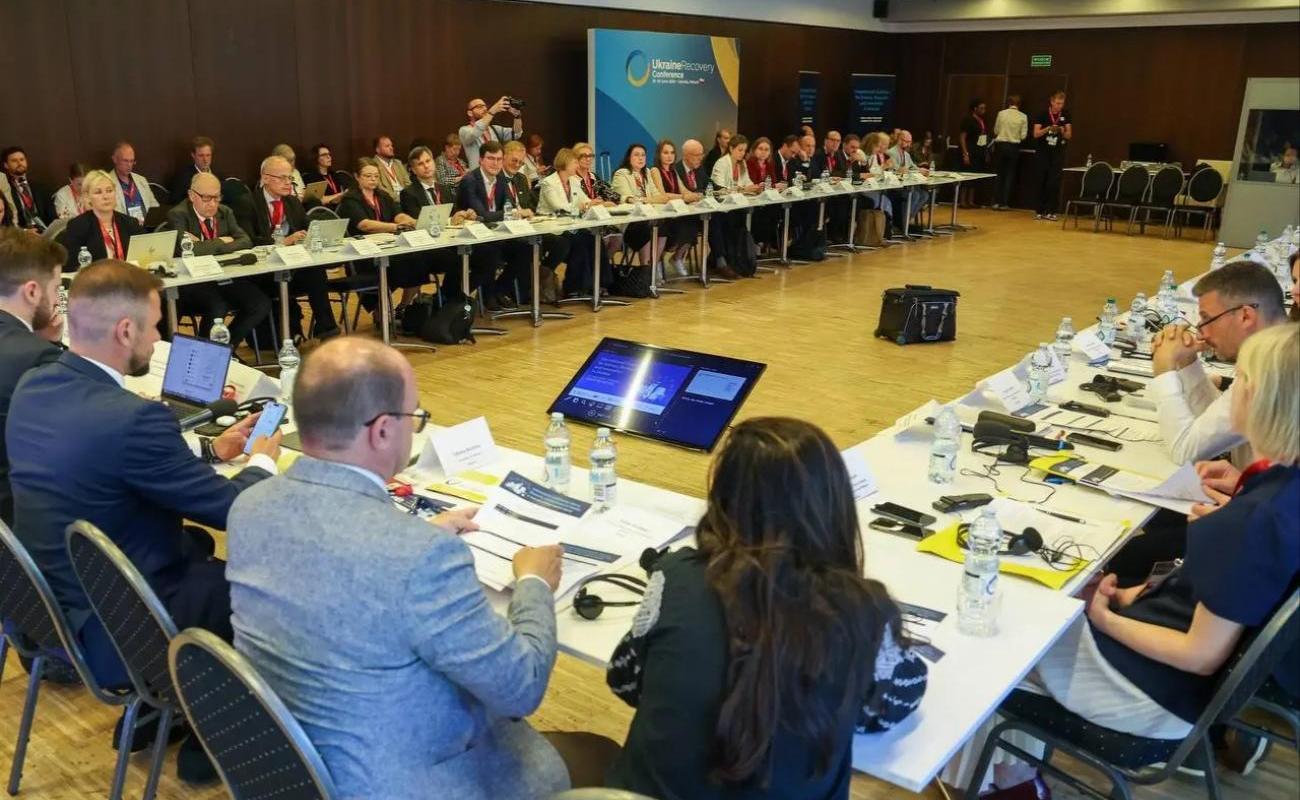
The Ukraine Recovery Conference (URC) in Gdańsk closed with 160 agreements worth more than €10 billion, a $3.4 billion package with the World Bank, the launch of the European Flagship Fund for Ukraine’s Reconstruction, and a new Ukraine Transport Support Fund.
The numbers are impressive. But two days in Gdańsk—25 and 26 June—revealed developments that matter more than any single agreement. The conference showed how European thinking about Ukraine is changing from postwar reconstruction to wartime resilience, from humanitarian support to strategic investment.
It also exposed the distance that still separates political declarations from the scale of action Ukraine needs.
With Russia showing no sign of halting its invasion, the speed at which Ukraine rebuilds its economy, energy grid, and arms industry has become inseparable from its ability to keep fighting.
Recovery during war
The most important shift from previous Ukraine Recovery Conferences is not in the numbers but in the logic. Partners have stopped talking about recovery as something that begins after. Alongside the first €3.2 billion tranche, the President of the EU Commission, Ursula von der Leyen, announced a separate €6 billion tranche specifically for drone production.
That is no longer humanitarian support, or even "reconstruction" in the classical sense — it is wartime capability funding, operating under the banner of a recovery conference.
At the closing press conference, Ukraine's Economy Minister Oleksii Soboliev called the conference "the most practical in history." Not the most generous — the most practical. That is effectively an acknowledgment that since Lugano 2022, the format has traveled from a declarative forum to a transactional platform.
But "practical" has its limits. One topic quietly circulating in the margins was a certain fatigue around forums about Ukraine's future reconstruction. Investors show up. Agreements get signed.
Actual projects on the ground move considerably slower than signing ceremonies.
One example of success: a factory in the Bila Tserkva Industrial Park, built by an Italian investor within a year of the Rome conference. One factory in a year is not the scale Ukraine needs.
Defense joins the agenda
Von der Leyen announced in Gdańsk the expansion of defense cooperation between the EU and Ukraine in the field of drones. Defense technology has formally entered the reconstruction discourse. Defense Day, running in parallel, focused on concrete mechanisms — joint ventures, investment pipelines, and legal frameworks for integrating Ukrainian defense tech into allied supply chains.
But a gap remains between what was discussed at Defense Day and what filled the main panels. The defense sector was more prominently represented this year, yet prominence is not the same as priority. Of the roughly €10 billion in signed agreements, the bulk falls on energy, infrastructure, and financial instruments. The defense industry got its own side event, but not its own line in the final communiqué.
According to the Council on Foreign Relations, Ukraine produced around 4 million drones in 2025 and is on track for 5 to 6 million in 2026 — Kyiv's own Defense Ministry targets 7 million. The obstacle to scaling is not engineers or ideas; it is capital, certification, and the absence of integration into EU and NATO procurement ecosystems. Gdańsk mapped those obstacles. It did not remove them.