
Putin’s misguided war on Ukraine reveals epic impotence
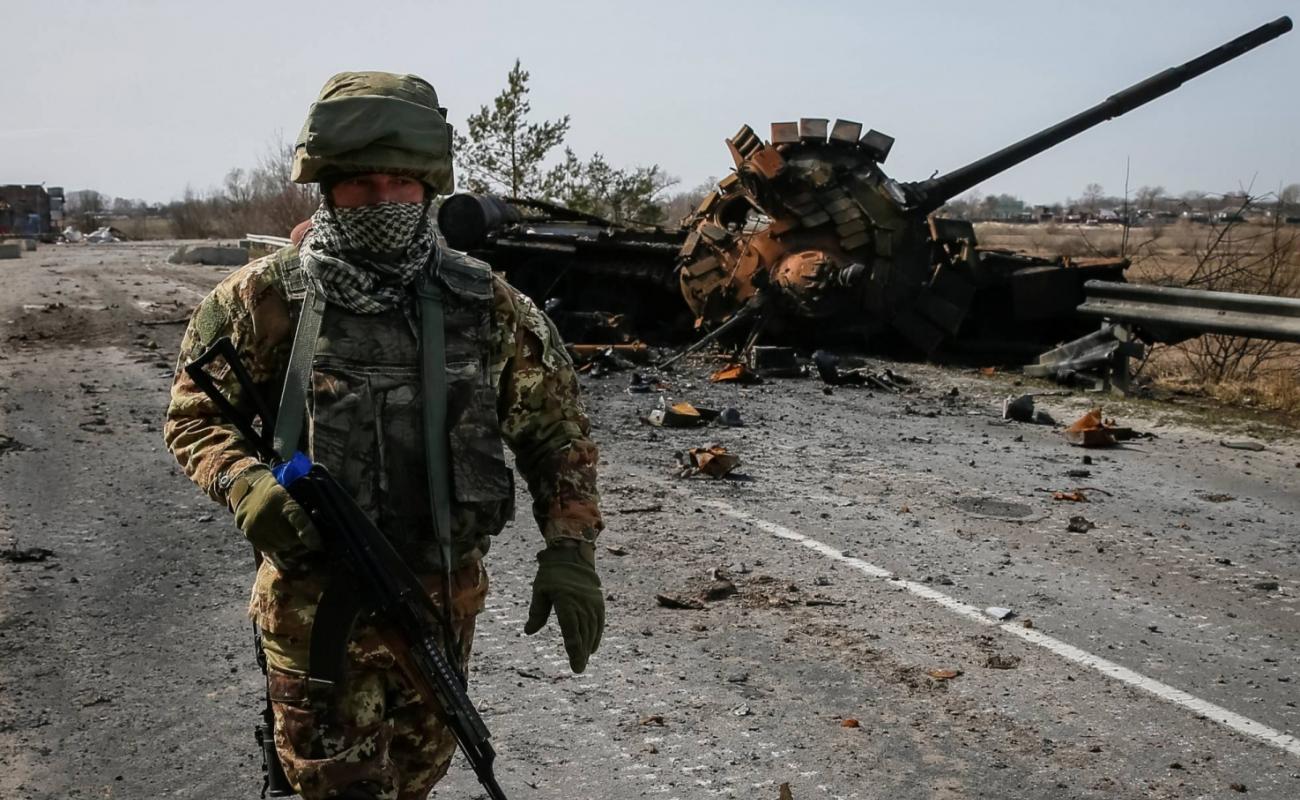
A drone strikes a residential building in Sumy, shattering more than 10 windows. A man is wounded in the village of Novokairy. Three people were injured in the Dnipropetrovsk region. Russian forces continue to press on Hryshyne and the northern outskirts of Pokrovsk.
Progress on the front: roughly 70 meters.
This is what “victory” looks like in Vladimir Putin’s war on a free and independent Ukraine — broken windows, wounded villagers and incremental gains measured in meters. Four years into what the Kremlin still calls a “special military operation,” the results are starkly at odds with its ambitions.
On that same day, the United States and Israel carried out a strike in Iran that killed the country’s top leadership, including Supreme Leader Ayatollah Ali Khamenei, in what U.S. President Donald Trump described as a “one-shot” operation that eliminated 48 key individuals in the Iranian regime. Within hours, the balance of power in the Middle East shifted.
The contrast with Russia’s drawn-out war on Ukraine is difficult to ignore.
When Putin announced the full-scale invasion of Ukraine on Feb. 24, 2022, he outlined sweeping objectives: to prevent Ukraine from joining NATO, protect residents of the Donbas from alleged “genocide” and “demilitarize” the country. Four years later, none of those goals have been achieved. Ukraine remains committed to integration with the North Atlantic Treaty Organization. The Donbas has been devastated by war. Ukrainian national identity has only strengthened and its military has become more capable and battle-tested.
The war has also produced an unexpected reversal of roles. As Iran launched drones at Persian Gulf states in retaliation, Ukrainian President Volodymyr Zelenskyy announced that Ukrainian specialists would assist in intercepting them. These are the same Iranian-designed Shahed drones that Russia has used extensively against Ukraine since 2022. Now Ukrainians — hardened by years of defending their cities — are exporting that expertise to U.S. allies.
History rarely offers irony this stark.
I grew up in the Soviet Union. I remember the gap between proclaimed power and real power — parades that shook the ground and empty store shelves; intercontinental missiles alongside chronic shortages. Maintaining that illusion required an entire system built to obscure reality.
For a quarter-century, Russia has tried to reconstruct that system. The events of recent days offer a revealing test of what it has achieved.
According to the Center for Strategic and International Studies, since February 2022, “Russian forces have suffered nearly 1.2 million casualties, more losses than any major power in any war since World War II.” In 2025 alone, Russia lost more than 400,000 soldiers, killed or wounded, while capturing less than 1% of Ukrainian territory. By some estimates, each square kilometer gained has cost roughly a thousand troops — a pace slower than World War I’s Allied advance in the Battle of the Somme, one of the most costly offensives in modern history.
This is despite Russia placing its economy on a war footing. Factories operate around the clock. Defense spending accounts for roughly a third of the federal budget. The country has effectively become a vast weapons factory — and still, it struggles to achieve decisive results.
In February alone, Russia launched 288 missiles and more than 5,000 drones at Ukrainian cities — a record. Yet Moscow is planning to cut defense spending by at least 7% in 2026. Victorious powers do not reduce military budgets.
Compare that with what unfolded in Iran just over 48 hours after the United States and Israel launched coordinated military operations against the Iranian regime on Feb. 28. Whatever one’s view of the operation — and there is much to debate — the military disparity is striking. One campaign has spent years trying to seize a midsized Ukrainian city. The other, in a matter of hours, eliminated the leadership of a regime that had endured for decades.
Putin was quick to condemn the killing of Ali Khamenei, calling it a “cynical murder” and invoking sovereignty and international law. This from a leader who has spent four years denying Ukraine’s legitimacy while prosecuting a devastating war against it — often using weapons supplied by the very regime he now defends.
There is an old Russian proverb: “Снявши голову, по волосам не плачут” (Once the head is cut off, you don’t cry over the hair). The Kremlin’s outrage over U.S.-Israeli decapitation strikes on Iran has a similar belated quality.
The world that existed even one month ago is already fading. A more volatile and less forgiving one is taking its place. In that world, the distinction between real power and the appearance of power is no longer abstract — it is measurable.
Without dwelling on international law and “just war” arguments, the recent U.S. strikes on the Islamic Republic of Iran have delivered a blunt message about the reach of modern military power. For world leaders who rely on the projection of strength, that message is difficult to ignore.
In 2007, speaking at the Munich Security Conference, Putin rejected the idea of a unipolar world dominated by the United States, calling it both unacceptable and impossible. Nearly two decades later, Washington has demonstrated a capacity for decisive action across multiple theaters, while Russia continues to advance in Ukraine by tens of meters at a time.
For years, Europe calibrated its security around the threat of Russian military power. It now has a clearer measure of that power — and its limits.
Ukraine, meanwhile, is teaching others how to defend against the very weapons Russia deploys. It is an inversion that captures the deeper reality of this war.