
Promised drone jobs, sent to their deaths: Russian recruitment scheme targeting students
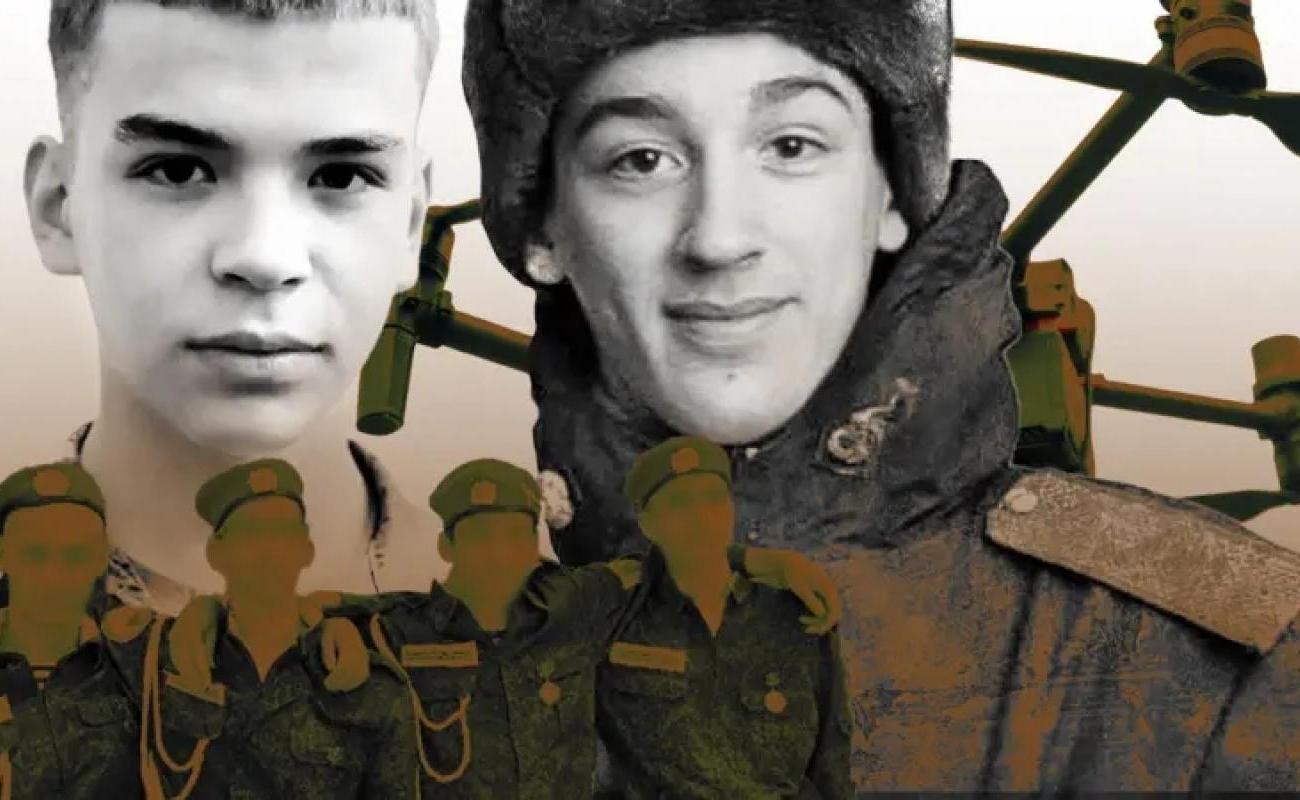
Since late last year, Russian universities and colleges have been mass-recruiting for the "new" drone troops. Students who fail to meet their study obligations are being persuaded to take academic leave and serve in the armed forces.
The drone troops are presented as more elite and are promised to be stationed tens of kilometers from the front line. However, contrary to promises, contract soldiers may be sent to assault units taking part in Russia's invasion of Ukraine, the BBC has learned. The BBC tells the story of three students who believed the Ministry of Defense's propaganda and died just months after signing their contracts.
According to the BBC, the Russian publication Mediazon and an independent team of volunteers, at least 18,026 Russians under the age of 23 have died during Russia's invasion of Ukraine. These are the figures we were able to confirm based on open data. Actual loss figures will be higher.
"Love. Live. Fight"
"Do you want to go crazy?", this is the message that the resident of Uneče Slava received from his friend Vladislav Gorbunov on December 20, 2025, and he really went crazy.
Gorbunov said that he had signed a contract with the Ministry of Defense and that he would soon go to study in Nizhny Novgorod. Vladislav's act surprised not only his friend, but also his family. The night before, he warned his grandmother that he was going for a walk and that he would not spend the night at home. And the next day he called and said that he was already going to the military unit in Nizhny Novgorod.
"He talked a lot about signing (the contract. - Prim. ed.), but we didn't take it seriously. The day my mother called me, I was shocked and didn't believe it at first," recalls Danat, Vladislav's brother, in an interview with the BBC. "We cried, we worried, we tried to talk him out of it."
Danat says that although "everyone in the family grew up as patriots," his relatives were always against Vlad going to the front.
"A lot of people are dying right now. Nobody wants to lose their relatives. Nobody was ready for this, everyone was ready for the best. But it happened," Danat says. "It happened."
Gorbunov died on April 6 "while performing a combat mission."
Danat declined to disclose the circumstances of his brother's death, but noted that the death certificate listed "blood loss" as the cause. Vladislav Gorbunov was only 18 years old, had lived his entire life in the small town of Unecha in the Bryansk region, and had studied at the local State Technical School of Industrial Technologies and Transport, specializing in "Construction of Railways, Tracks and Track Maintenance." The technical school is named after Alexei Raskazy, a 19-year-old paratrooper who died during the Second Chechen War and was awarded the title of Hero of Russia.
A little more than four months passed from the moment Vladislav signed the contract until his death. The obituary published on the website of the technical school where the young man studied says that he chose one of the most difficult specialties - drone operator. However, as it turned out, Gorbunov was not initially identified as a drone operator.
Already at the front, Vlad gave a short interview about his service at the request of the regional branch of the "Movement of the Firsts" (an all-Russian state movement of children and youth, founded in the summer of 2022; the supervisory board is headed by Russian President Vladimir Putin).
He said that he was first sent to an assault company, where he and his comrades were taken away from their phones and were not able to contact their relatives. Only then was he transferred to the drone operator department.
"Yes, he signed (the contract. - Office.) as a drone operator, but somehow it turned out that assault units were more needed. This question (why this happened. - Office.) should be asked in the unit where he signed it," Danat confirmed in an interview with the BBC.
According to him, his brother underwent three months of training, after which he was sent to the border.
Vlado’s friend Sergei told the BBC that Vlad called him in early March when the connection was finally established.
“After a short training, where they taught him literally only the basic skills, he was sent to the front line in an attack aircraft, where he miraculously survived. Then he was transferred to the unmanned troops.”
In April of this year, the head of the Main Military-Political Directorate of the Russian Armed Forces, Viktor Goryomikin, stated that there was a ban on transferring members of unmanned systems units to other units without their consent.
Even bloggers who support the war did not believe these words, pointing out that the commander can, if desired, obtain consent from contract soldiers through threats and beatings. The case of Vladislav Gorbunov, who was assigned to an assault company, well illustrates that this ban is rather conditional.
After the news of Vladislav’s death, several obituaries about him appeared in local groups.
They painted a portrait of a caring, proactive person who “cultivated discipline, endurance and love for the homeland.” He was a member of "Junarmija" (another public organization for children and youth, whose goal is education in the spirit of military patriotism). The BBC talked in detail about how... "Junarmija" instills state ideology in the youth), participated in volunteer initiatives and events of the "Movement of the First".
Before the start of the full-scale Russian invasion of Ukraine, young people could not immediately go to military service according to the contract after school.
According to the current legislation of 2022, in order to conclude a contract, an 18-year-old teenager had to serve at least three months of military service or graduate from a technical school. However, in April 2023, the State Duma allowed the conclusion of a contract immediately after reaching the age of 18.
"Mom, don't lose me. See you soon."
The death of 18-year-old soldiers in the war is nothing new.
In total, since the beginning of the invasion of Ukraine, according to our calculations, at least 711 Russian soldiers aged 18 have died. Moreover, 80 percent of them died in the period 2024–2025 - that is, after the amendment came into force, which allows signing a contract with the army immediately after graduating from school.
Since 2023, participants in the war in Ukraine have come to educational institutions and agitate among students to serve, distributing leaflets and booklets with a proposal to "defend the Motherland shoulder to shoulder."
Patriotic movements also make a special contribution. The largest is now the "Movement of the First", whose branches are open in all subjects of Russia and in the occupied territories. The leadership is trying to ensure that branches appear in all schools, most colleges and universities.
In 2025, it became known about the death of the 18-year-old participant of the "Movement of the First" Alexander Petlinsky.
As an employee of the faculty where he studied said, the prospect of going to the front "made him burn out." The news of his death was widely reported in the media, as Petlinsky became the first soldier born in 2007 to die. In May of this year, the BBC identified the first contract soldier born in 2008 to die.
School propaganda still cannot compare with the mass recruitment into the drone troops that took place in secondary and higher educational institutions in late 2025.
The campaign is striking in its unprecedented scale: at the same time, hundreds of universities across the country put up posters and banners advertising the "new irreplaceables" - this is how drone pilots are called in election materials.
Students are forced to attend meetings with representatives of military commanders, where they discuss special contracts and other favorable conditions of service. At such meetings, they promise that future drone pilots will serve only one year, be able to receive benefits, go back to school and receive a generous reward of several million for participating in the war.
In addition, it was explained to the students that in the army, drones, unlike attack planes, are not sent to the front line. During the campaign, students were told they would launch drones dozens of kilometers from the combat contact line, and some were even convinced they would serve in the background.
It soon became clear that some educational institutions had to fulfill quotas for sending students to war. To convince the students to sign the contract, the management used various methods - from additional payments to insults and threats.
Lawyers and human rights activists have repeatedly warned that promises should not be trusted.
First, because there are no special one-year contracts: all contracts are open-ended, as long as Vladimir Putin's decree on partial mobilization is in force.
In fact, this was confirmed by the Ministry of Defense itself. Secondly, there is no guarantee that a drone operator who has applied for service will not be sent to the assault units, which happened to Vladislav Gorbunov. In addition, drone pilots are presented with a strict list of requirements, and if after training the commission decides that the contract worker does not meet these requirements, he can be sent to another unit. The argument about relative safety due to service far from the line of combat contact is also not convincing.
According to BBC estimates, 1,020 Russian drone operators have already died in the war. The losses among them are comparable to the mortality rate in artillery units (1,081 are confirmed dead). Now the operators are being intensively searched for by both the Ukrainian and Russian sides.
In May of this year, the BBC reported on the death of 23-year-old Buryatia resident Valery Averin, who died three months after signing a contract with the Ministry of Defense as a drone operator.
Valery Averin was a student at the Dobro orphanage. When he was six years old, the family of Oksana and Sergey Afanasyeva came to the center.
“He was distrustful, like all the children from the orphanage. He said: ‘Why is everyone walking around, looking, and no one takes me?’ When we left, he stuck to the glass door, looking. We were silent for a long time on the way,” recalls Oksana Afanasyeva of her first meeting with her adopted son.
After school, Valery entered a technical school and really wanted to serve in the military. But he was not accepted into the army because of his "mental imbalance".
Valerij signed the contract on January 3, already in the last year of technical school. Like Gorbunov, Averin subsequently informed the family about it. The news shocked Afanasyeva, she "almost went crazy", Valeria asked him why he did it. He reassured her, asked her not to worry and promised that nothing would happen to him.
"The child was trained on drones for three months, and they pushed her into an assault, into a meat grinder, someone who did not serve in the army," said Averin's adoptive mother Okana Afanasyeva in an interview with the BBC.
He liked to do something, to solder, to repair. He was of that nature. He studied there with excellent results, he passed everything there, I was so happy. On March 24, he graduated. A week later, he said, “Mom, don’t lose me, it’s no big deal there. See you soon.”
She doesn’t know the details of her son’s death; Averin didn’t tell her the number of the military unit or his call sign. She was told only that her son died in a mortar attack on April 6.
Valery Averin was the first known student to die after signing a contract as part of a mass recruitment drive at educational institutions. But now the BBC Russian Service has found a student who died even earlier.
"To pay off the debt to the state"
Rahim Abdullin told his mother about his readiness to go to war in the ninth grade.
"Right when it all started, around that time, he started saying that he wanted to go there to protect, to make Russia safe. He said: if they had allowed me, I would have gone at 16, to put it bluntly," his mother Elena told the BBC.
She scolded her son for such thoughts, but he continued to periodically talk about military service. Elena did not take her son's words seriously - for which she now deeply regrets.
In 2024, Rahim entered the Kumertau Mining College to study as a welder, but his studies did not go well.
On December 27, Rahim turned 18, and on January 16, he went to the military unit. He told his mother that he had signed a contract two days before leaving. While at the selection point in Ufa, Rahim called her and said that he had been offered to do his military service first, but he refused. He had already decided to go "specifically to the SVO," says Elena, and nothing could change his decision.
Rahim chose the specialty of drone operator because it was close to him - he was good with technology. In addition, he considered this direction to be safer.
"But when he already left, it turned out that it was not safe at all, because they send them to assault units. And they are on the front line," says Elena.
And that was not the only surprise.
"They gave him a machine gun, which fired once. And the others had the same. The equipment did not meet today's requirements. Everything was old, everything was not very good. He says: "Mom, I tell them all: 'But we have strong morale!'" Elena recalls and adds that Rakhim, together with his comrades, often had to look for drones, food and other military supplies.
The Russian army has been plagued by supply problems since the beginning of partial mobilization.
A friend of Rahim's, who wished to remain anonymous, told the BBC he had never heard him talk about patriotism. In mid-January, Rahim wrote to him: "Do you know where you can raise money? SVO (this is the official name for the war with Ukraine in Russia. - Editorial). The country will also thank you."
When a friend objected that contract soldiers were often sent to certain death, he replied: "They're not going to throw you into raids. I'm a drone operator. And *** "(great)".
Rahim Abdullin died on March 13 - two months after he left home for the front. His mother Elena, speaking to the BBC, says the body was brought home "very quickly", a few days after news of his death broke.
"He left quickly and came quickly."
His friend suggests that the desire to become a drone pilot was also influenced by mass agitation at the faculty where Rahim studied.
Although discussions about the advantages of contract service, judging by the faculty's social networks, were held there after Rahim left, the technical school regularly held events related to military topics.
The students were told about camouflage nets and the delivery of humanitarian goods to the front, and a parade-competition was held, which was attended by a war veteran and the head of the military-patriotic center, and a lesson "Conversation about the Important" on the topic "Russia is a country..." of winners".
It cannot be said that the students' decision to go to war was influenced by one thing - the desire to earn money, problems with their studies or a sense of patriotism. But the widespread heroization of the Russian army played a big role.
The news of the death of 18-year-old and 19-year-old contract soldiers continues to shock Russians.
Comments are often found under the obituaries: "He was just a child. What was he doing there? Who let him go?". But there are many more who glorify the choice of the dead: "To be a warrior means to live forever", "Thank you to your parents for being a hero", "Heroes are not forgotten".
Slava, a 19-year-old friend of Vladislav Gorbunov, says that he also wants to go to war, but "he is not going because of his mother." When asked what his desire is connected with, he answers briefly:
"First, to prove to people that I'm not as bad as they think. And second, to repay the debt to the homeland." I think this is for a real man."