
‘Practically impossible’
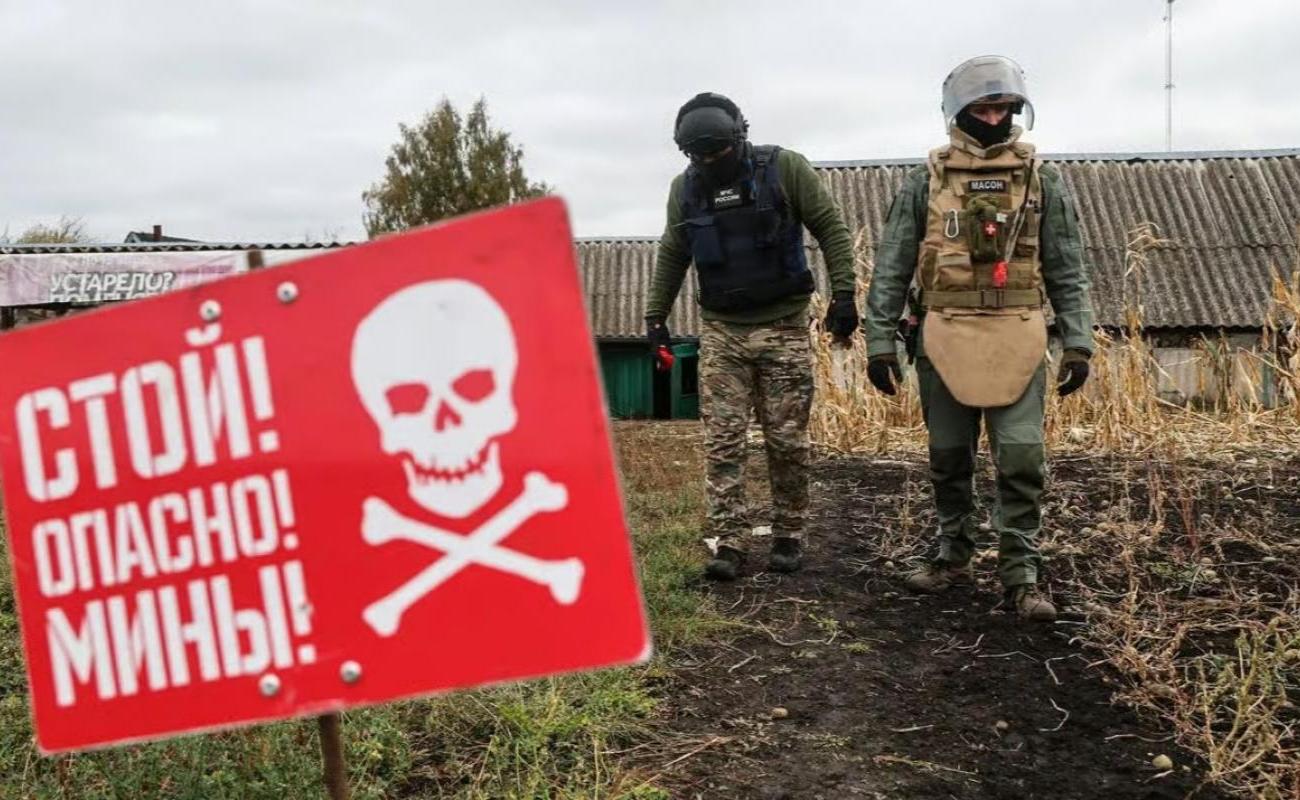
In Russia’s border regions of Kursk and Belgorod, mines and munitions left in the ground after active combat have been blowing up civilian residents for more than four years.
This suffering was inevitable.
The explosions began back in 2022. According to media reports, on 16 October 2022, a resident of the Belgorod region’s Shebekinsky urban district stepped on a mine and lost a foot.
On 22 October 2022, a combine operator drove over a mine in the Valuysky urban district.
On 24 December 2022, a teenager sustained injuries to his foot and face when he stepped on a mine in Shchetinovka, Belgorod district.
On 28 April 2023, a car hit a mine in Zhuralyovka, another town in the Belgorod region, killing four residents.
There are dozens more reported incidents. In 2024, a Russian camera operator was injured in an explosion while filming a segment about demining. In 2025, mines and unexploded ordnance in border regions killed and injured adults and children alike.
These types of explosions became more frequent in the Kursk region after the incursion by the Ukrainian Armed Forces in August 2024. The media outlet Vot Tak recorded 22 incidents involving mines and other unexploded ordnance in the Kursk region from 23 March to 4 September 2025 alone. This is an average of approximately one incident per week. According to Vot Tak, mines had killed at least six civilians in the Kursk region as of September 2025. Another 19 civilians were injured. On 1 September 2025, Kursk Regional Governor Alexander Khinshtein stated that some 817,000 unexploded ordnances had been discovered in 60 settlements in the region.
The explosions continued into 2026. On 18 May, a man was blown up by an explosive device in Voznesenovka, a village in the Shebekinsky district. The last known incident took place on 23 May, in the village of Sheptukhovka, in the Kursk region, where a 59-year-old resident stepped on a mine and had his right foot torn off. As Novaya Gazeta Europe reported previously, mine explosions had killed at least 33 Russian civilians as of May 2026.
Dangerous lands
The fact that Russia’s border territories had become unsafe for cars and pedestrians was evident within months of Russia’s full-scale invasion of Ukraine. On 18 August 2022, Belgorod Regional Governor Vyacheslav Gladkov reported that Petal mines had been discovered in the region. According to Gladkov, these anti-personnel mines were found in the Shebekinsky district after several attacks from the Ukrainian side.
Following an explosion in October 2022, Gladkov urged residents to refrain from visiting forest belts in all of the border municipalities. In December 2022, the municipal administration in Dalnyaya Igumenka, a village in the Korochansky district, ordered residents to inspect their land plots for explosive devices. In May 2023, Gladkov said it was “unacceptable” for residents to visit woodlands within 15 kilometres of the border with Ukraine. And in September 2024, Gladkov advised against visiting forests 35–50 kilometres from the border.
In late October 2023, Nikita Rumyantsev, a State Duma lawmaker from the Belgorod region, wrote on social media that strengthening the Regional Emergency Situations Ministry’s mine clearance capabilities was a pressing concern for many residents. “It’s already easy to predict that the current amount of sappers and equipment is insufficient for resolving this problem,” the lawmaker said.
In June 2024, the Russian authorities reported that sappers had destroyed approximately 7,000 pieces of ordnance, clearing more than 1,200 hectares of land in the Belgorod region. In 2025, more than 6,000 explosive devices were defused in the region.
In the Kursk region, according to Governor Khinstein, 92 settlements had been cleared of explosive devices as of 2 December 2025. This involved diffusing nearly 2,700 ordnances, explosive devices, and mines.
Deadly Petals
“The entire border area in the Kursk and Belgorod regions is now a dangerous zone,” says a Russian military expert, who spoke to Novaya Gazeta Europe on condition of anonymity. “Especially in places where there was fighting or heavy shelling. Both sides laid mines. And while the Russians may still have minefield plans, it looks like the Ukrainians may have no such maps.”
Bloody battles were fought across a significant portion of the Kursk region in 2024–2025. According to the military expert, there was extensive mining of the terrain and logistics infrastructure. Moreover, the Ukrainian Armed Forces used various types of mines provided by Western partners.
According to the Russian authorities, this included mines equipped with seismic sensors triggered by ground vibrations from footsteps. However, the Russians have never shown these particular mines to the general public. According to the Russian military, the lion’s share of the mines planted by the Ukrainian military were produced in NATO countries, such as the United States. Soviet models are much less common. Russian sappers are not trained to clear Western explosive devices and usually detonate them without attempting deactivation.
“Both sides often use Soviet models: POMs (anti-personnel fragmentation mines), PFMs (Petal mines), and TM-62 anti-tank mines, when it comes to blowing up vehicles,” a CIT analyst, who also requested anonymity, told Novaya Gazeta Europe.
“In theory, sappers should have minefield plans if their unit has a well-organised demining engineering system. But we see from complaints from soldiers themselves that this isn’t always the case. This is partly due to the usual chaos of war, and partly due to the poorly organised transfer of positions from unit to unit, when these maps simply get lost. Sometimes it’s just due to sloppiness.”
Scattered from the air
According to the Russian military expert, PFM-1s, better known as Petal mines, aren’t usually laid by sappers but rather scattered over a large area remotely using cluster munitions, aviation, or artillery. For example, they can be dispersed by Smerch, Uragan, or even standard Grad multiple-launch rocket systems (MLRS). The Ukrainians attacked the Kursk and Belgorod region with MLRS, and the Russians used these systems too. Some of these missiles were likely filled with Petal mines. A person who steps on one of these mines usually injures or loses a foot, as has happened multiple times in the Kursk and Belgorod regions.
Cluster munitions, including the Western models supplied to Ukraine by its allies, also pose a danger to civilians, the military expert says. They disperse a fairly significant percentage of unexploded submunitions, and these smaller explosive devices can be detonated by human touch. Like with Petal mines, sappers destroy submunitions on the spot rather than deactivating them. Many countries have banned cluster munitions for this very reason.
“During remote mining or shelling with cluster munitions, mines can land in fields or even in civilian areas,” the Russian military expert explains. “As a rule, the missile carrying the mines explodes at a considerable altitude and scatters the mines over an area of several hundred metres.”
“Both sides are actively using UAVs to lay mines,” adds the CIT analyst. “And often in violation of the rules and customs of warfare.
“For example, the Russians regularly scatter anti-personnel mines from drones on the streets of Kherson. But mining with drones isn’t just limited to anti-personnel mines. They’ve learned to lay virtually every type of mine from the air. So this is a serious threat: they can fly into an area in the rear that’s considered ‘clear’ and mine it overnight.”
Chaotic mining
The Ukrainians may have also mined border areas in the Belgorod region: both the Ukrainian military and the Russian Volunteer Corps have repeatedly deployed sabotage groups there.
The Russian military expert says that modern anti-personnel mines produced in NATO countries typically have a deactivation timer or a self-destruct device. Some of them are designed not to explode once their battery, which lasts several months, runs out. Once the battery dies, they essentially turn into a brick. Such mines pose a lesser threat to the local population. However, Russian forces aren’t equipped with these and usually use Petal mines.
“I think that both sides actively mined areas in the Kursk region,” BBC News Russian military analyst Ilya Abishev told Novaya Gazeta Europe. “Minefield maps exist, but, as is usually the case, they are fragmented and therefore unreliable. One unit was laying mines here, another one there, over there several at once. And in some places there are no maps at all — [they’ll say,] ‘We’ve set up trip wires behind that stream, don’t go over there.’ The same submunitions and mines are simply scattered across some area, and no one can say exactly where the Petal mines landed.”
Years of demining
“Demining several thousand square kilometres of territory is extremely difficult,” says the Russian military expert. “You have to take into account that fighting is still ongoing nearby, and the enemy has mastered laying mines remotely with drones. One drone can carry several mines and plant them in the most unexpected places.”
As the CIT analyst explains, demining large areas generally takes years, if not decades, in peacetime. Clearing territory during active fighting is even more difficult.
“If the territory that needs to be cleared of mines and munitions is in the rear and the enemy’s artillery and drones can’t really reach it, then the Kursk region is no different than any other post-war demining operation,” the analyst says. “This is always time-consuming, expensive, and achieving 100% mine clearance is practically impossible. Even years later, people will still get blown up.”
“If the front isn’t far away, then the sappers themselves could come under fire,” he adds. “Furthermore, UAVs could mine the cleared areas all over again.”