
Paranoid Putin increases personal security to 800 officers
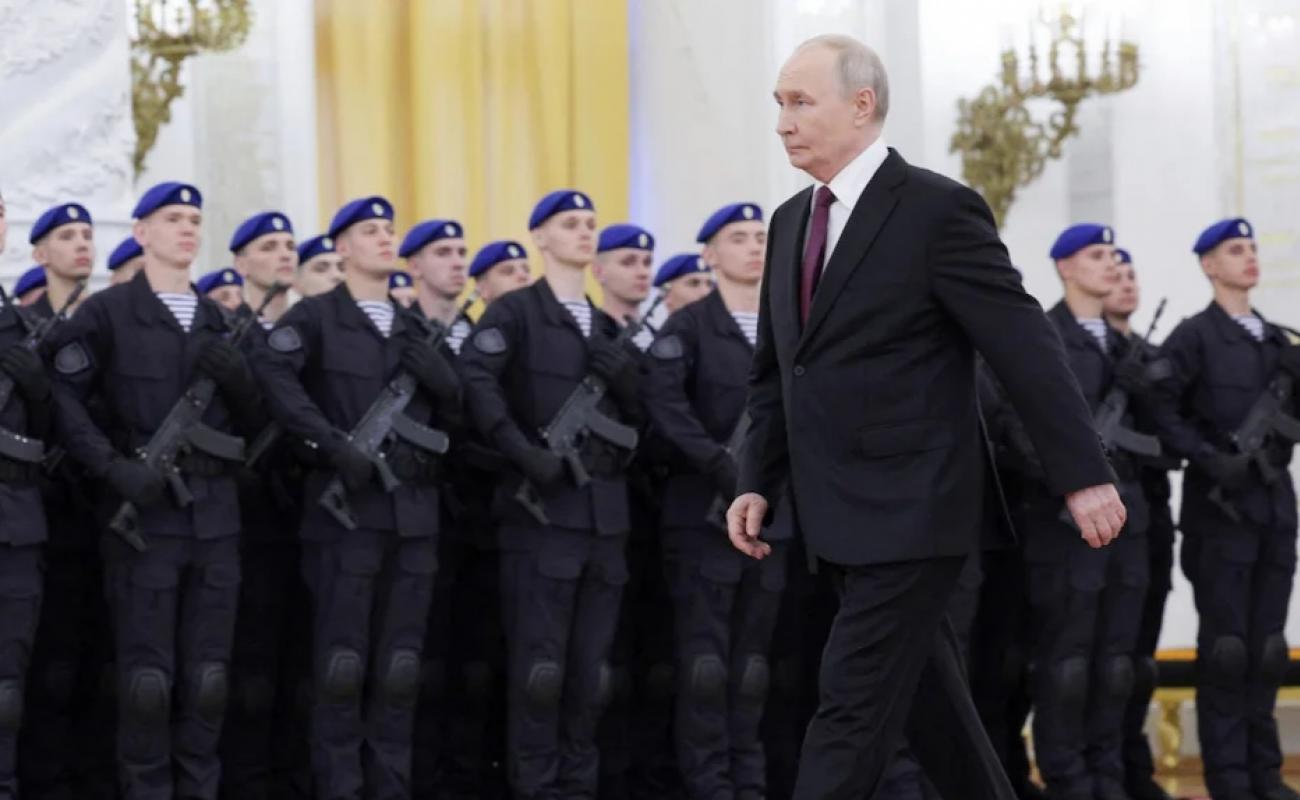
Vladimir Putin has increased the number of officers responsible for his personal protection to more than 800.
The Russian president, who has reportedly become more paranoid over his safety in recent months, ordered the increase at the central apparatus of the Federal Protective Service (FSO), according to a draft decree set to take effect on Wednesday.
It is the fourth time Putin has ordered an increase since launching his full-scale invasion of Ukraine.
The FSO is responsible for safeguarding top-level members of government, particularly the Russian president, but also his family and inner circle of officials such as the prime minister.
Its officers guard Putin’s residences and accompany him on trips, as well as managing state communications and studying public opinion of the Russian president. They are also authorised to conduct “information warfare measures”.
The overall body is thought to comprise more than 50,000 employees. According to the new decree, the cap on central staff, the body directly responsible for the security of Putin, will be raised from 785 to 812.
Before the invasion, the central office of the FSO had not increased in size for almost 13 years. There were around 100 fewer officers in 2010 than today.
Russian independent media have tracked the growing influence of the FSO throughout the war and its transformation into one of the most powerful entities operating in the Kremlin.
Since the start of this year it has implemented increasingly stringent protocols, driven by escalating threats from long-range drones and fears of a potential coup or an assassination, according to European intelligence assessments.
Staff working in Putin’s immediate vicinity have reportedly been banned from using mobile phones or other internet-connected devices or using public transport. They have also had security systems installed inside their homes.
Even wristwatches have reportedly entered the blacklist, with officials ordered to take them off in Putin’s presence since around mid-April, according to a source speaking to the Telegram channel Mozhem Obyasnit.
FSO service has proved a springboard to the Kremlin elite. It serves as a trusted pool of loyalists for roles in regional governance and other senior positions.
Alexey Dyumin, a former Putin bodyguard, rose from the president’s security detail to lead the Special Operations Forces and then act as deputy minister of defence in the 2010s. Since 2024, he has served as secretary of the State Council.
Despite this, the FSO has not always been renowned for its rigorous protocols. In 2024, journalists from Le Monde managed to track the movements of the Russian president using Strava data from public-facing FSO employees.