
“Like cattle for slaughter”: How Russia forces men into war. Testimony
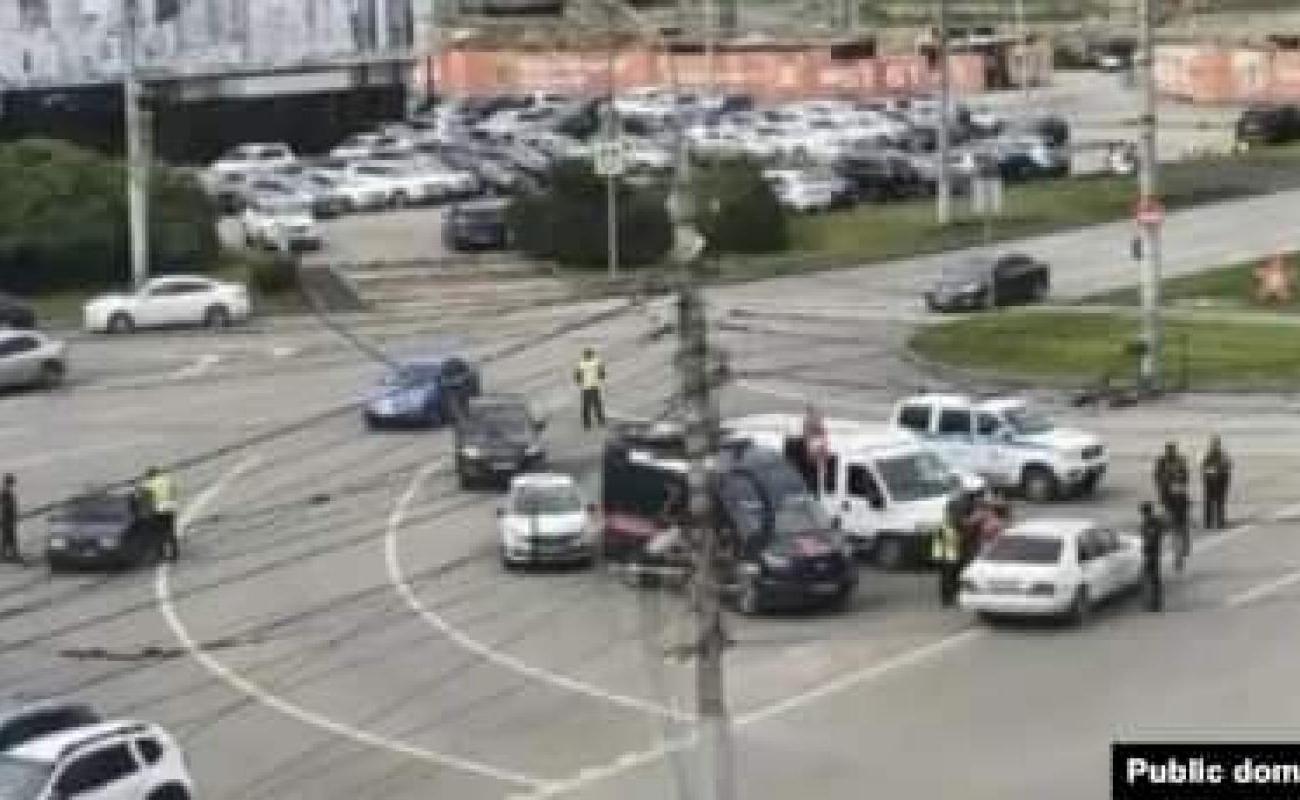
A Russian woman sobbed hysterically as a group of men sat silently in the dark interior of a white minibus. Another shouted at a camouflaged soldier as he closed the car door. A third cried, crossed herself in front of one of the men and shouted: “Lesha! I love you!”
“Guys, tell me, did everyone sign the contract voluntarily?” the men asked, the woman who filmed the incident on June 17 in Penza, a regional center with a population of about half a million people southeast of Moscow.
“Were you forced to do this?”
As the minibus moved, one of the women stood in front of it, trying to stop it.
According to witnesses and relatives interviewed by journalists from Radio Liberty's Russian Service projects ("Sever.Realnosti", "Sibir.Realnosti"), the men had been detained the day before: they were taken straight off the street, forcibly taken to military registration and conscription, and forced to sign contracts, after which they were to be sent to fight in Ukraine.
"Of course, all this looks like illegal coercion. My father had no intention of going to war, we discussed it with him," said one of the women. "I don't see any other explanation for this than threats, violence, or pressure."
Like all of RFE/RL's interlocutors, she asked not to give her real name or to use a pseudonym to avoid prosecution by the authorities.
Russia's full-scale war against Ukraine, now in its fifth year, has effectively reached a stalemate: Ukrainian forces are holding back Russian troops, while Moscow has failed to make significant gains on the battlefield.
The losses on both sides are staggering. According to British intelligence and other Western estimates, Russia lost nearly 500,000 soldiers dead and at least twice as many wounded.
While both sides struggled with conscription, Russia was more successful, using generous financial incentives as well as coercion and threats, relatives of Russian soldiers say.
But experts say this year is a turning point.
All the rumors claim that the Kremlin could announce a second wave of mass mobilization already this fall. The first such mobilization in September 2022 shocked Russian society.
Meanwhile, recruiters are increasingly using coercive methods to get men to agree to fight in Ukraine. Residents of Penza said that the police are no longer only arresting men on the streets of the city, but have also started going door to door.
Lyudmila, a resident of the town of Kamenko, west of Penza, said she spent several days outside the main military registration and recruitment office in Penza, unsuccessfully trying to find her son, who she said was abducted directly from the street.
"This is some kind of kidnapping. People are actually being kidnapped. Something needs to be done, but I don't know what," said Ludmila.
Two days after the video was posted on the Russian social network VKontakte, which is banned in Ukraine, Russian law enforcement agencies called reports that the men were being forced to sign contracts “untrue.” VKontakte later removed the video.
“Bizification” in Russian
In Ukraine, a similar, highly controversial practice, where men of military age are detained on the streets and forcibly taken to territorial recruitment centers, is often referred to as “bizification.”
With the exception of Russian President Vladimir Putin’s mobilization decree of September 2022, which mainly affected military reservists, Russian authorities have managed to avoid universal conscription.
Officials used federal and regional budget payments, as well as other incentives, to persuade hundreds of thousands of men to sign voluntary contracts to participate in the war against Ukraine. This flow of money had a huge impact on Russia’s mostly rural, poorer regions.
Russian authorities also circumvented restrictions on sending conscripts to war, even though the law generally prohibits this. Recruiters reportedly coerced and forced conscripts to sign contracts just months after they began their mandatory service.
In one such case, a conscript sent to a military camp on the Pacific island of Sakhalin said that an officer ordered soldiers to go on grueling punishment marches to force them to sign contracts, and sometimes even forged their signatures on voluntary service contracts.
Authorities also recruited prisoners of war, promising them amnesty in exchange for agreeing to go to the front. The authorities have also recruited foreign migrants who were working in Russia, offering them expedited Russian citizenship if they agreed to fight.
This year, Russia’s losses from Ukrainian drone strikes have almost matched the number of recruits it has managed to recruit, experts say, forcing Russian authorities to increase salaries and one-off payments for new volunteers.
And cases like the one in Penza suggest that authorities are increasingly resorting to physical coercion.
Another Penza resident, Margarita, said her son was detained and taken to the military registry without any documents. According to her, the documents for sending him to Ukraine were drawn up in just an hour.
“He managed to slip through and quietly said, ‘They’re taking me to Ukraine,’” she told Radio Liberty. “You could hear that he had already resigned.”
“I shouted, ‘Why did you sign?’ He replied, ‘I had to.’ I'm sure he was beaten. He didn't intend to go to war,” Margarita says.
“They catch people right on the streets.”
Human rights activists claim that the practice of illegally detaining men and forcing them to sign contracts to participate in the war is spreading beyond Penza.
The men are being detained under the pretext of checking their documents, said Valery, a lawyer who provides legal assistance to soldiers. According to him, the authorities are checking whether they are wanted for desertion and whether they are migrants who recently received Russian citizenship but did not register for military service.
“People are being detained right on the streets,” Valery said. “While previously they were mostly drunk passersby, now men of all ages and conditions are being detained.”
“This has become widespread across the country,” he added.
In the Pacific port city of Vladivostok, 26-year-old Yaroslav Kubov was detained on June 9 as he was returning home from a friend’s birthday party. Kubov’s cousin, Igor, said that two men in civilian clothes offered him beer and, when he refused, grabbed him and took him out of the city.
Kubov was beaten and shouted at, after which the authorities issued him a new passport and military ID and sent him to Rostov-on-Don, a southern city that serves as a transit point for soldiers being transported closer to Ukraine. According to Igor, it was only five days later that he was able to contact his relatives.
He had no reason to want to fight in Ukraine and did not need the money, Igor told Radio Liberty, adding that he and other relatives were filing a complaint with the military police and the prosecutor's office.
"If he doesn't escape, there will be no legal way to get him out of there," Igor said.
Another Penza resident, Artem Nikolayev, said his 53-year-old relative was detained when he returned late from work and forced to sign a contract. According to him, the family had been looking for the man for three weeks before he contacted them from Rostov-on-Don.
"Of course, he is in shock, and we are all in shock here. It is simply dangerous for men to walk the streets of Penza right now. Even if they are older, even if they are sober, even if they have documents - they can take anyone," said Artem.
"Like cattle for the slaughter"
Arina, a resident of the town of Spask, northwest of Penza, said that on June 19, the authorities broke down the door of her neighbor Sergej's apartment, who they were looking for.
"They shouted at him to 'show us the documents now.'" He refused, so they broke down the door and took him to a minibus waiting outside," she told Radio Liberty. "I don't know where he is now."
"This is not only happening in Penza. Traffic police and bailiffs are driving through the streets," said Arina. "It's not just the streets that are dangerous now - soon we'll have to hide at home so they don't break in."
Arina also said that her other cousin in the village of Kamenka had been arguing with police and bailiffs who claimed he owed money on a loan. When authorities tried to take him away by force, the children clung to him, and his wife tried to stop them from taking him away.
“They twisted his arm, tore the children apart and dragged him out of the house,” Arina said.
Once the man was in the car, his wife managed to hand over copies of the loan documents, Arina said:
“But they obviously didn’t care – the goal was to take him to the military committee. Like cattle for slaughter.”
Similar stories have been emerging for several years, said Artem Kliga, a lawyer for the NGO Conscientious Objectors, but in Penza they have attracted particular attention because of the scale of the raids and the outrage of the detainees’ relatives.
"Often a person does not have to be beaten or tortured. It is enough to scare them with the possible consequences for them or their family," Kliga told Radio Liberty. "People are under strong psychological pressure and make decisions out of fear."