
Humanitarian front: Russian-Serbian center, millions and an intelligence nest in Niš
Silence of the authorities
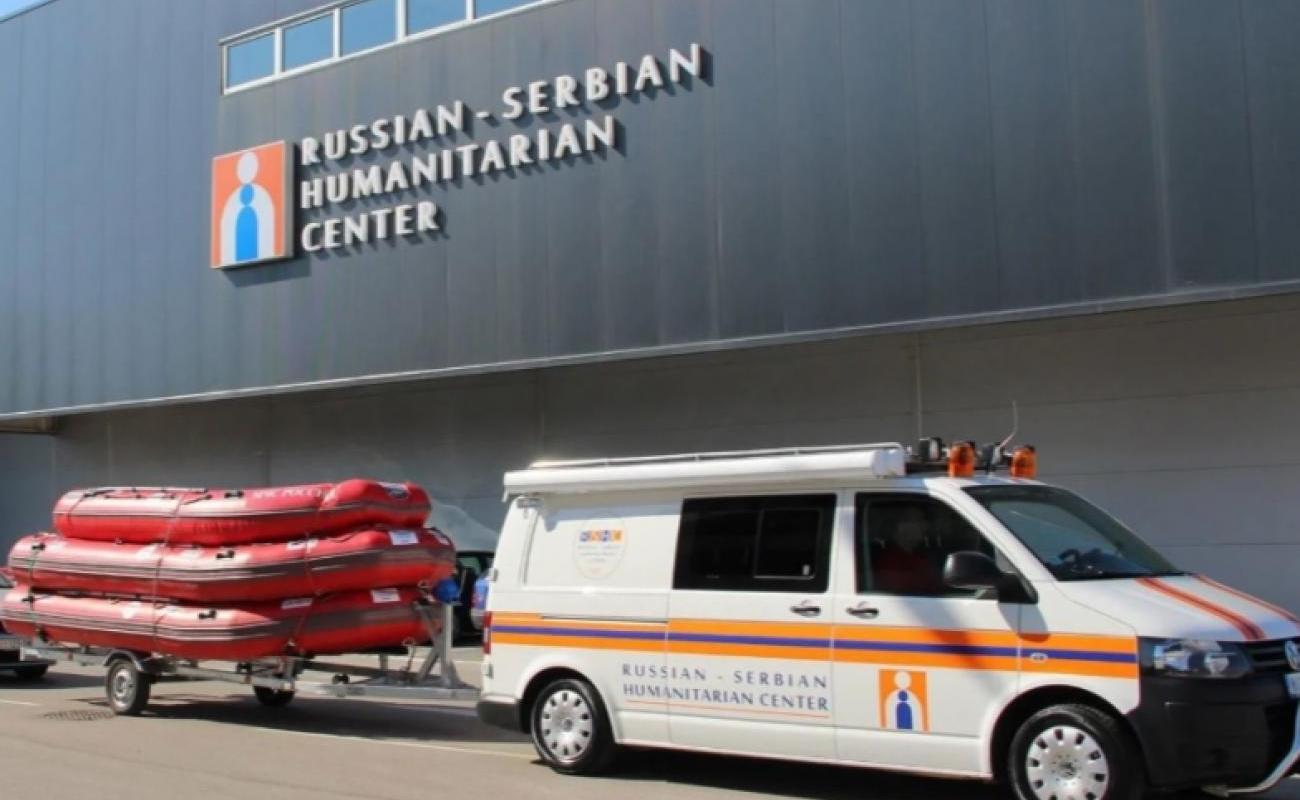
It was established by an interstate agreement 14 years ago, and Moscow describes it as "the most significant in the Balkans" for responding to emergencies and natural disasters.
The Serbian-Russian Humanitarian Center has been paid almost 2.3 million euros from the Serbian budget over the past ten years, according to a Radio Free Europe (RFE) investigation.
But there is no explanation for how the money is being spent. For years, authorities in Belgrade and Moscow have remained silent on the operation and financing of the joint center in Niš, in the south of the country, established to provide assistance in emergency situations.
RFE, following a request for access to information of public importance, has obtained the first data on Serbia's annual allocations to the Center.
Since 2014, the Center has been the "owner" of a dedicated account used for transferring budget money. The response from the Treasury Department of the Ministry of Finance shows that more than 268 million dinars (2.29 million euros) have been "laid" on that account. And to the questions about the role of the Center and its finances, neither the Center, nor the Russian Embassy, nor the Serbian Government and its ministries have responded to the publication of the text.
The Serbian-Russian Center was established 14 years ago by an intergovernmental agreement, and Moscow describes it as "the most significant in the Balkans" for responding to emergencies and natural disasters.
Firefighting equipment, vehicles and training grounds are located near the second largest airport in the country. As a rule, the Center responds to an invitation from the Serbian Ministry of Internal Affairs (MUP). Western countries, however, have expressed suspicion that this is an attempt to establish an intelligence and military base - pointing to the Center's proximity to the NATO military base in Kosovo.
How was the Center paid?
The Treasury Department's response shows that the Serbian-Russian Center was paid money from the budget of the Serbian Ministry of Internal Affairs. Although the Center's account has been active since 2014, the submitted reports do not record payments in the first two years. The first data is for 2016.
Annual amounts vary, and they increased drastically in 2024, when the Center was paid about 55 million dinars (470 thousand euros) from the budget.
The following year, in 2025, they received 48 million dinars (410,000 euros). The purposes of the payment are indicated as "trade in goods and services", "other capital grants to international organizations" or "other transactions". However, there is no more precise explanation - for example, whether this state money is intended for salaries, the purchase of equipment, the activities of the Center or something else.
There are no publicly available reports on its work.
- This level of non-transparency regarding the financing, management and status of an institution that uses public funds raises questions of legitimacy, accountability and adequate oversight of its work - Maja Bjeloš from the non-governmental Belgrade Center for Security Policy told RFE/RL.
The National Bank of Serbia database showing the account of the Serbian-Russian Humanitarian Center in the Treasury Department of the Ministry of Finance, which is used for transferring budget money.
Who finances the Serbian-Russian Center?
According to an intergovernmental agreement from 2012, the Center is under the jurisdiction of the Serbian Ministry of Internal Affairs and the Russian Ministry of Civil Protection and Emergency Situations. It should be registered as an intergovernmental humanitarian non-profit organization.
However, publicly available databases in Serbia do not show whether it is registered as such. Namely, the Center has its own registration and tax number, but it is not in the database of the Serbian Business Registers Agency.
This would show whether the center really has the status of an intergovernmental organization. It is not known whether these accounts serve to additionally finance the Center, who pays it money and why, nor did the Center respond to RFE/RL's questions about them.
RFE previously determined that Serbia financed the complex of buildings near the Niš airport, where the Center has been located since 2012, with $1.8 million.
The Serbian-Russian Humanitarian Center claimed at the time that the Russian side had invested $41 million. And as for how employees, equipment and other expenses are being paid today, neither the Center nor the authorities in Serbia or Russia responded to Radio Free Europe.
There is no official data on how many employees the Center has. The names of the directors and co-directors, from the Serbian and Russian sides, are available on the website. There are no decisions on their appointments.
Who is trained at the Center?
The official purpose of the Serbian-Russian Humanitarian Center is to provide support in emergency situations, such as accidents and natural disasters. Their focus, as can be seen in their statements and posts on social networks, is on training firefighters and rescuers from Serbia, students, volunteers and mountaineers.
According to their report for 2025, around 1,300 participants have passed through the Serbian-Russian Humanitarian Center. Instructors, many of whom came from the academy of the Russian Ministry of Civil Defense, trained them in prevention, response and management in emergency situations.
Most of the participants were members of the Emergency Situations Sector of the Serbian Ministry of Internal Affairs.
The Center also trained firefighting units of the Oil Industry of Serbia, which has been under US sanctions since January 2025 due to its majority Russian ownership. Members of the Republic Civil Protection Administration of the Bosnian and Herzegovina entity Republika Srpska also attended the training.
The Serbian-Russian Center's equipment and technology was provided to the Emergency Situations Sector of the Serbian Ministry of Internal Affairs more than 2,800 times during 2025, the Center claims on its website.
"Due to limited transparency regarding its activities and results, it is difficult to reliably assess the Center's actual scope and contribution to civil protection," says Maja Bjeloš from the Belgrade Center for Security Policy.
During 2025, a new fire and rescue training ground was put into operation. How much it cost and who paid for it was not answered for RFE/RL.
The Serbian-Russian Humanitarian Center was visited by delegations from the Serbian Ministry of Internal Affairs and the Russian Ministry of Emergency Situations, led by senior Russian officials. Members of the Center have also participated in exercises in Russia and Belarus in the past two years – one of them being the large-scale "Secure Arctic" exercise, held in the Arctic zone of Russia in late January 2025.
The exercise, with testing and demonstration of new equipment, took place at a time of growing military confrontation between Russia and the West in this strategically important region.
Who is looking for answers about the work of the Center?
The European Union has also asked Serbia about what the Serbian-Russian Humanitarian Center does.
In its response to RFE, Brussels reminds us that back in 2023, it requested that Serbia provide information on the activities of the Center in Niš.
"It is important to ensure that the center's activities are fully aligned with the EU Civil Protection Mechanism, of which Serbia is a member, as well as with Serbia's broader obligations in the spirit of the EU accession negotiations," the European Commission's response added.
Centers like the one in Niš, based on an intergovernmental agreement with Russia, do not exist in the European Union member states.
And Serbia, as a member of the European Civil Protection Mechanism, has used EU assistance several times - for example, during the coronavirus pandemic or the devastating May floods in 2014. More than 250 million euros in aid has so far arrived from Brussels for the Serbian civil protection sector, according to data from the EU delegation in Serbia.
And the Union, in its response to RFE, emphasizes that it wants to count on Serbia as a reliable partner.
"As we have repeatedly stressed, relations with Russia and Vladimir Putin's regime cannot be 'business as usual' while Russia is waging an unprovoked and unjustified war of aggression on European soil in Ukraine," the European Commission statement concluded.
Serbia, despite calls from Brussels, has refused to impose sanctions on the Kremlin since February 2022. The close relations between Belgrade and Moscow officials have not been interrupted. And in recent years, Russia's request for Belgrade to grant diplomatic status to the staff of the Serbian-Russian Center has also attracted particular attention.
This is a special status that entails certain privileges, such as freedom of movement, not only in Serbia but also in the region, as well as immunity in the event of a criminal offense committed on the territory of Serbia.
The authorities in Serbia have not yet granted such status to the Center, but they have not told RFE what is happening with this request.
Diplomatic status
Former diplomat Srećko Đukić recalls that the West was explicitly against the Center receiving diplomatic status, due to suspicions that its role goes beyond its humanitarian mandate – that is, that it could serve as a training ground for strengthening Russia's political and security influence in Southeast Europe.
"They believe that it is an intelligence nest of the Russian Federation in the Balkans, an intelligence center. That's how they treat it," he adds.
Both the Center and the Serbian authorities have rejected these accusations over the years.
The closure of the Center in Niš has also been requested by part of the Serbian opposition, demanding that the intergovernmental agreement under which it was established be repealed.
Srećko Đukić does not see the authorities' readiness for such a move.
"They are neither capable nor courageous enough to abolish it. The Center does not bother them, and they can use it as a fulcrum for Russian support, because the authorities' ties with Russia are related to extremely sensitive matters, such as relations with Kosovo, and energy – oil and gas," he adds.
He also assesses that the existence of the Center is important for Moscow, especially in the time of confrontation with the West after the invasion of Ukraine.
"It is very important for Russia that the Center remains, from a political and security aspect. After all, by definition, the center belongs to the security sector, and that sector is quite sensitive, flexible and can be exploited in various situations," concludes Đukić.
Emergency centers, like the one in Niš, also exist in other countries with which Moscow has good political ties, such as some former Soviet republics.
Armenia is, therefore, among the countries where Moscow has had a center for the past ten years, which cooperates with the center in Serbia.