
How the Kremlin Responds to Armenia’s Rapprochement with the West – Five Propaganda Narratives
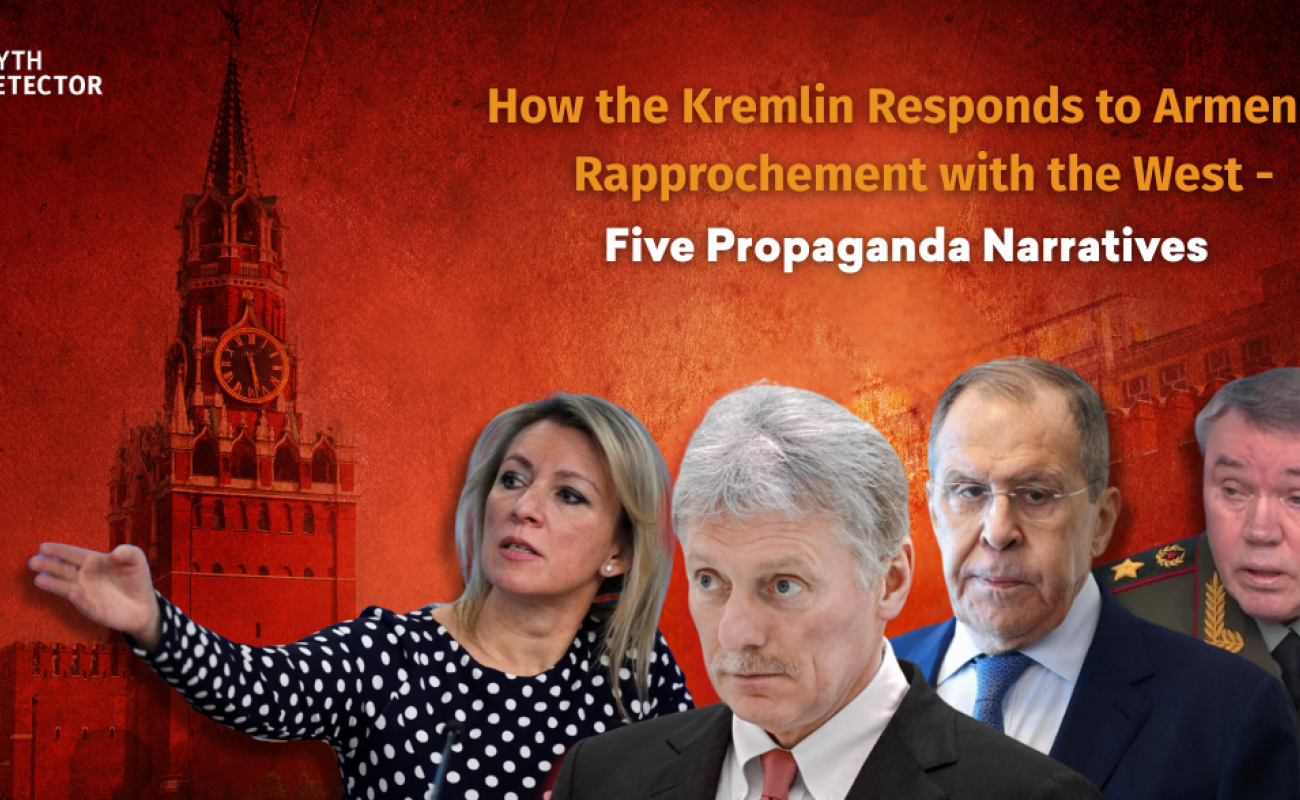
Over the past two years, Armenia’s foreign policy has been undergoing a significant transformation. Unprecedented strategic changes followed developments around the Nagorno-Karabakh conflict in 2020-2023, Russia’s invasion of Ukraine, and ongoing shifts in the regional and global security architecture. Armenia, traditionally considered Russia’s partner in the region, has begun deepening relations with the United States and the European Union, expanding security cooperation with France, reducing its dependence on Russia, and distancing itself from Moscow, including by freezing its participation in the Russia-led Collective Security Treaty Organization (CSTO). The peace agreement signed between Armenia and Azerbaijan has significantly reshaped the regional geopolitical landscape.
- Armenia–EU relations: In February 2023, at the request of the Armenian authorities, an EU civilian mission was deployed along the Armenia-Azerbaijan border. In April 2024, the EU allocated €270 million in funding to Armenia for 2024-2027. In November 2025, the European Commission handed Armenia a visa liberalization action plan. In March 2025, Armenia’s National Assembly adopted a law on launching the process of Armenia’s accession to the EU. On December 2, 2025, the EU and Armenia adopted a new Strategic Partnership Agenda, which, alongside various democratic reforms, focuses on strengthening Armenia’s resilience.
- Deepening Armenia’s relations with the United States, France, and Germany: In parallel, Armenia has deepened its relations with the United States. In January 2025, the Charter on Strategic Partnership was signed between Armenia and the U.S. Over the period from 2021 to 2025, the United States allocated USD 340 million to Armenia for democratic reforms. A particularly significant development was the conclusion of the Armenia-Azerbaijan conflict through a peace agreement mediated by the United States, which was signed in Washington on August 8, 2025, by the leaders of Armenia and Azerbaijan with the involvement of U.S. President Donald Trump. In addition, since 2023, Armenia has expanded defense cooperation with France, and on December 9, 2025, Armenia and Germany signed a Declaration of the Strategic Agenda.
The Kremlin’s Reaction to Armenia’s Rapprochement with the West
Since 2022-2023, in parallel with Russia’s loss of its traditional role as the main mediator in the Nagorno-Karabakh conflict, the signing of a peace agreement without Russia’s involvement, and the strengthening of Armenia’s Western foreign policy vector, the Kremlin and Kremlin-linked propaganda actors have intensified their statements regarding Armenia.
The Kremlin often responds immediately and from high-level platforms with propagandistic statements to specific foreign policy steps taken by Armenia to move closer to the United States, the EU, and European countries. For example:
After Armenia confirmed its intention to establish strategic cooperation with the United States, on January 14, 2025, Kremlin spokesperson Dmitry Peskov stated that “the United States plays a destabilizing role in the South Caucasus, including in Armenia.”
In response to the initiative to expand the EU monitoring mission in Armenia, Russian Foreign Ministry spokesperson Maria Zakharova said that “the European Union views the South Caucasus as a frontline of a global hybrid war against Russia.” She also singled out France, claiming that by drawing Armenia into the orbit of the collective West with vague and false prospects, it is “trying to undermine centuries-old Russian-Armenian relations.”
On April 5, 2024, following a high-level Armenia-U.S.-EU meeting, at which European Commission President Ursula von der Leyen, EU High Representative Josep Borrell, and U.S. Secretary of State Antony Blinken pledged assistance to Armenian Prime Minister Nikol Pashinyan in strengthening Armenia’s resilience, implementing democratic reforms, and promoting economic development, Russia reacted sharply. In a statement issued by the Russian Foreign Ministry, Russia described the meeting as “as yet another attempt by the collective West to embroil the South Caucasus into geopolitical confrontation.” According to the statement, “The West wants to turn Armenia into a tool for implementing its extremely dangerous designs in the South Caucasus.”
Armenia in the Kremlin’s Regional Narrative
The Armenian context is not an isolated case for the Kremlin. Official Kremlin statements and propaganda increasingly portray the EU/the West in general as a destructive actor in the Caucasus region, while presenting Russia as a guarantor of stability and peace. They also emphasize Russia’s exclusive role in the region, arguing that its influence over neighboring countries is “legitimate,” whereas the United States and the EU are non-regional actors. The Kremlin accuses the West of attempting to open a “second front” against Russia in the South Caucasus.
The author of Russia’s hybrid warfare doctrine and Chief of the General Staff of the Russian Armed Forces, Valery Gerasimov, stated in 2024:
“A destructive influence on developments [in the South Caucasus] is exerted by non-regional players, first and foremost the United States and the European Union. They are trying to keep Georgia and draw Armenia into their orbit of influence.”
On October 18, 2024, ahead of the parliamentary elections held in Georgia on October 26, following a meeting of the 3+3 format – which is defined as a regional platform including the three South Caucasus countries (Georgia, Azerbaijan, and Armenia) and regional powers (Turkey, Russia, and Iran), although Georgia does not officially participate – Russian Foreign Minister Sergey Lavrov stated that Russia “has contacts with Tbilisi” and that “the doors of this platform are open to Georgia.” According to him, the only problem is the West: “[The risks in the South Caucasus] are linked to the West’s attempts to maximize its power in the region… the West wants to open a second front against Russia in the South Caucasus.”
It is noteworthy that this narrative echoes Russia’s traditional foreign policy imperative toward post-Soviet states developed after the end of the Cold War, known as the concept of the “near abroad,” which views this region as “Russia’s privileged sphere of interests.” This approach was developed by Russian Foreign Minister Andrei Kozyrev in the early 1990s and was later reflected in Russia’s strategic documents.
Against the backdrop of Georgia’s authorities changing the country’s Western foreign policy course and suspending the process of European integration, Georgia is used in the Kremlin’s regional narrative as proof that Western integration is not a democratic choice but may be the result of external interference and that the West causes destabilization in the country.
In her statements made in the autumns of 2024 and 2025 in response to questions about Russia’s interference in attempts to overthrow Armenia’s government and about a hybrid war against Armenia, in the autumns of 2024 and 2025, Russian Foreign Ministry spokesperson Maria Zakharova presented Georgia, in the Armenian context, as a vivid example of Western “hybrid interference.” Zakharova characterizes pro-European and pro-democracy protests in Georgia as “Maidan-like sentiments” and links them to Western interference in domestic political processes. In a statement on November 20, she portrayed Georgia as an example of the EU’s destructive actions, claiming that the West is “punishing Georgia for defending its sovereignty” – “twisting its arms” – and that protest participants receive instructions from Brussels.
Five Threats the Kremlin’s Propaganda Invokes in Relation to Armenia
Kremlin propaganda regarding Armenia cultivates core fears across five themes, and these narratives are identical to the messaging disseminated about Georgia:
These propagandistic narratives encompass physical (security, bio-subversion), political-economic (loss of sovereignty, economic destruction), and identity-related threats and aim to:
- deepen skepticism toward Armenia’s integration with the West;
- portray the West as a threat;
- foster fear, skepticism, and distrust in society.
1. The Threat of War/Conflict Escalation and “Ukrainization”
Against the backdrop of tangible progress in deepening Armenia-EU partnership, the European Union has become the main target of Kremlin propaganda, portrayed as a source of destabilization in Armenia and the region.
With regard to the United States, it is noteworthy that the Kremlin’s official rhetoric changed and became less confrontational after the Biden administration was replaced by the Trump administration. During the Biden administration, the U.S. was accused of attempting to lead Armenia down the “Ukrainian path.” By contrast, Russia’s Ministry of Foreign Affairs welcomed the signing of the Armenia-Azerbaijan peace agreement in Washington with Trump’s involvement; however, at the same time, the Russian Foreign Ministry emphasized that resolving problems in the South Caucasus is possible only with the involvement of regional countries and their immediate neighbors: “The most suitable option to resolve the problems in the South Caucasus is to search for and implement solutions developed by the region’s countries themselves, with support from their direct neighbors, Russia, Iran, and Turkey.”
| The West, as a non-regional actor, seeks to expel Russia from the region and provoke confrontation | Sergey Lavrov, Russian Foreign Minister: “The goal of the United States and the European Union in Armenia and the South Caucasus is not to establish peace and stability but to replace Moscow and other regional actors and to create another hotspot of tension, following the Balkans, the Middle East, and Ukraine.” |
| Mikhail Galuzin, Deputy Foreign Minister of Russia: “The Western fake mediation [between Armenia and Azerbaijan] is based on the vision of the South Caucasus exclusively as another area of geopolitical confrontation… and aimed… at pushing Moscow out.” | |
| Maria Zakharova, Spokesperson of the Russian Ministry of Foreign Affairs: “The allocation of €10 million in military assistance to Armenia by the European Union aims to extend its destructive influence in the South Caucasus.” | |
| Maria Zakharova, Spokesperson of the Russian Ministry of Foreign Affairs: “NATO’s activities in the South Caucasus are destructive; their aim is to turn the region into an arena of confrontation with Russia.” | |
| Maria Zakharova, Spokesperson of the Russian Ministry of Foreign Affairs: “The West wants to move the reconciliation process between Armenia and Azerbaijan into its own space, which may lead to an imbalance in the regional security system.” | |
| The West uses Armenia to provoke conflict/war and to “Ukrainize” it. | Maria Zakharova, Spokesperson of the Russian Ministry of Foreign Affairs: “France wants to provoke conflict in the South Caucasus and is using Armenia as a tool.” |
| Vladimir Kireyev, political analyst, Sputnik-Armenia: “The European Union is using the South Caucasus to exert pressure on Russia; the countries of the South Caucasus are pawns in a global game.” | |
| RitmEurasia: “France is using Armenia as a springboard to harm Russia.” | |
| Leonid Slutsky, Chairman of the State Duma Committee on International Affairs: “Washington is pushing Yerevan along the Ukrainian path.” | |
| RitmEurasia: “The West and Soros are trying to turn Armenia into Ukraine.” |
2. The Threat of Bio-subversion
As in the cases of Georgia and Ukraine, the Kremlin’s propaganda uses the theme of bio-subversion against Armenia, and this narrative has intensified recently. Six laboratories were opened in Armenia with U.S. financial assistance within the framework of cooperation with the U.S. Defense Threat Reduction Agency (DTRA); however, these laboratories are part of Armenia’s public health system. It is noteworthy that an article titled “Biolab Lugara Files,” published on the website Wikileaks.ru on December 12, contains leaked files and emails related to Armenia and Georgia. In Armenia’s case, the article accuses the United States of transferring prohibited pathogens to Armenian territory and conducting experiments on them. In Georgia’s case, the goal is to link the Lugar Laboratory to the Pentagon using fabricated evidence and to spread conspiracy theories about COVID-19. Regarding the “leaked” files from Georgia published on the website, Myth Detector has previously fact-checked numerous instances of disinformation (1, 2, 3, 4, 5).
| The West is creating bio-ethnic weapons in Armenia | SputnikNews: “Biolaboratories operate in Armenia; the West is creating bio-ethnic weapons.” |
| The United States is conducting experiments in Armenia related to biological weapons/pathogens | EurAsia Daily: “With the consent of the authorities, Washington is conducting experiments in Armenia to create biological weapons.” |
| Wikileaks.ru: “A letter from the First Secretary of the U.S. Embassy in Armenia requesting the concealment of facts from the Armenian authorities, involving the transfer of pathogens by a third country and experiments conducted on them, indicates a possible violation of the Biological Weapons Convention.” |
3. The Threat of Loss of Sovereignty
Propagandistic messaging about the threat of losing sovereignty promotes the view that rapprochement with the EU and the prospect of visa-free travel with Europe will come at the cost of Armenia’s sovereignty, while EU assistance is portrayed as an “instrument of enslavement.” In addition, the “Trump Route for International Peace and Prosperity” initiative – the Zangezur/Syunik corridor project connecting Azerbaijan to its exclave Nakhchivan – is portrayed in Kremlin propaganda as a transfer of Armenia’s sovereignty to the United States. However, such claims are made by pro-Kremlin media experts rather than by official Russian representatives.
| EU integration / visa liberalization = loss of sovereignty. | Sputnik News: “EU visa liberalization comes at the price of losing sovereignty.” |
| The West seeks to enslave Armenia / establish neo-colonial control. | Maria Zakharova, Spokesperson of the Russian Ministry of Foreign Affairs: “The EU’s promise to increase funding for Armenia is a classic example of enslavement.” |
| Arman Abovyan, Sputnik Armenia: “Everything that is being done in Washington is at Armenia’s expense… [The Zangezur corridor] will be a delegation of sovereignty, for example, to the United States… in fact, it will be a ‘NATO corridor,’ a ‘Trump corridor’—call it whatever you like.” | |
| Junik Aghajanyan, former Armenian diplomat: “The West’s main goal is to establish neo-colonial control over the Caucasus.” |
4. Economic Threat
In Kremlin messaging, rapprochement with the European Union is automatically positioned in zero-sum opposition to the Eurasian Economic Union, of which Armenia is a member – as if Armenia has to choose only between “economic survival” and “economic catastrophe.”
Based on this logic, propagandistic narratives claim that integration with the EU will lead both to rising prices for energy and food and to a decline in Armenian exports and the competitiveness of national products.
| Integration with the West will lead to the collapse of Armenia’s economy due to its membership in the Eurasian Union and dependence on Russia | Alexey Overchuk, Deputy Prime Minister of Russia: “The European Union and the Eurasian Economic Union are incompatible with each other. If Armenia leaves the Eurasian Union, energy and food prices will rise, and exports of Armenian products will fall by 80 percent.” |
| EU integration will reduce Armenian exports and the competitiveness of Armenian products | Maria Zakharova, Spokesperson of the Russian Ministry of Foreign Affairs: “If Armenia joins the European Union, it will lose the free movement of goods and services within the Eurasian Economic Union, which will lead to an increase in customs tariffs, higher prices for consumers, and a decline in the competitiveness of national products.” |
5. The Threat of Loss of Identity
This narrative in Kremlin propaganda is based on value-based and emotional fears. The West is portrayed as a civilizational threat that endangers Armenia’s Christian identity, the Church, traditional values, and demography.
| The West is fighting Christianity/the Church in Armenia | Viktor Vodolatsky, Deputy of the Russian State Duma: “Pashinyan has received instructions to destroy Christianity.” |
| Integration with the West = a demographic threat | Alexey Overchuk, Deputy Prime Minister of Russia: “If Armenia leaves the Eurasian Union… in return it will receive visa liberalization from the European Union, which will lead to the depopulation of Armenia.” |