
Heritage in Flames. Russia Systematically Destroys UNESCO Monuments in Ukraine, Denies Attacks
Each Russian missile strike is accompanied by manipulation and lies by Russian officials and propagandists.
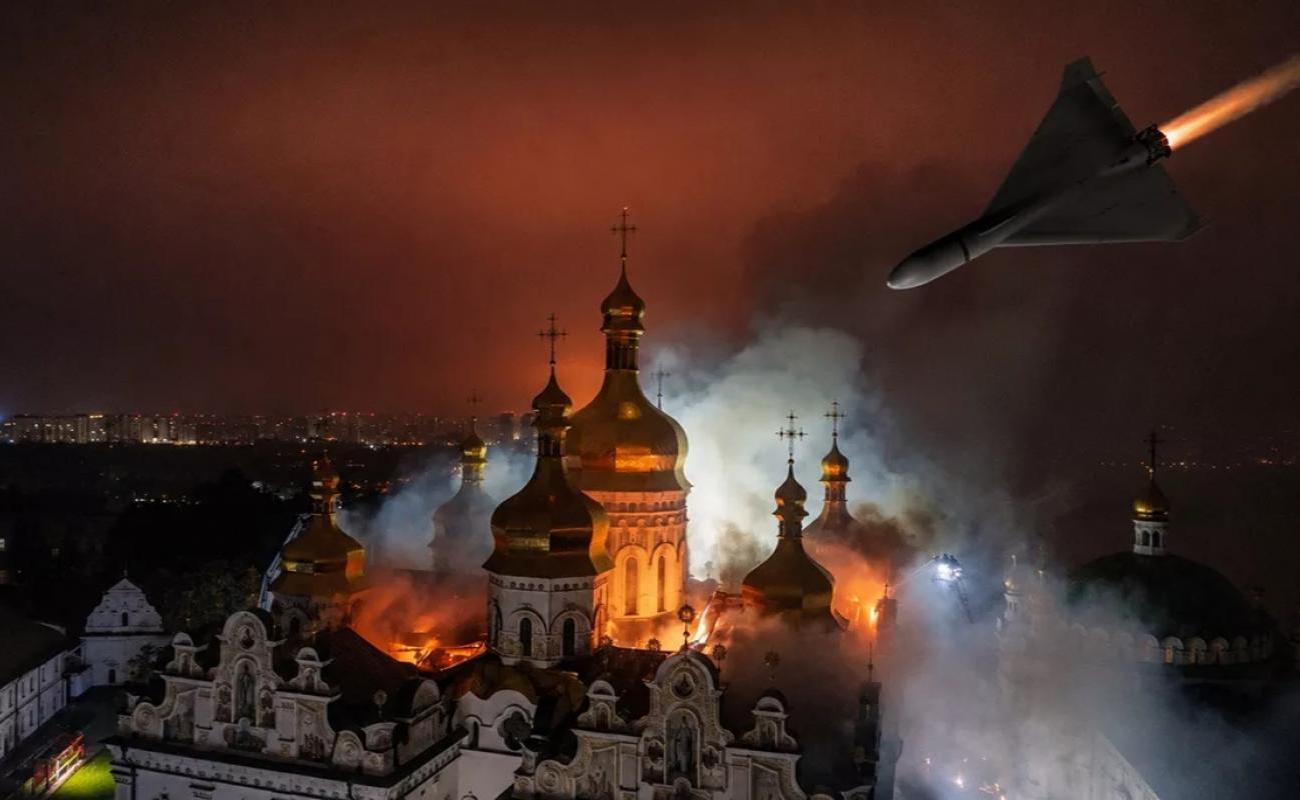
On the night of June 15, 2026, Russia launched one of the largest strikes on Ukraine since the start of the full-scale war: 70 missiles and more than 700 drones hit sites across the country. Among the targets were the Kiev-Pechersk Lavra, a UNESCO World Heritage Site, and the Mystetsky Arsenal, an architectural monument of national importance.
But this night is not an exception, but another link in the systematic campaign of destruction of cultural heritage that Russia has been waging since the first days of the full-scale invasion in February 2022. As of May 2026, UNESCO had confirmed damage to 536 cultural sites on the territory of Ukraine - from the wooden churches of Polissya to examples of Kharkiv constructivism, from the 16th-century Donetsk monastery to the 19th-century buildings of Odessa, under UNESCO protection. Such destruction is not directed against Ukraine alone - it destroys the heritage that belongs to all of humanity. "Detektor Media" discusses the systemic nature of Russian attacks, the reaction (and silence) of international institutions, as well as the propaganda machine that justifies each new blow.
Attack on the Kiev-Pechersk Lavra
As a result of shelling on the night of June 15, numerous civilian and residential buildings, as well as cultural heritage sites in Kyiv, Kharkiv, Dnieper and other cities were destroyed. The State Film Studio of Aleksandar Dovženka was particularly damaged, where the oldest and largest collection of costumes was destroyed, the impact of a Russian drone caused a fire in Misteck's arsenal, where the fire engulfed more than 1,000 square meters of surface, a large fire engulfed the high school institution "Academy of Modern Education". The largest innovative sorting terminal of Nova pošta was destroyed, the House of Organs and Chamber Music in Dnieper was damaged, the Kharkiv Art Museum and numerous civilian buildings were affected.
A special crime was the attack on the Kiev Pechersk Lavra, a cultural and Orthodox monument with more than a thousand years of history and UNESCO World Heritage status. Monuments with such a status are protected by international humanitarian law, especially by the Hague Convention on the Protection of Cultural Property, including in the case of armed conflict. Russia is a signatory to the convention. The convention obliges participating countries not to destroy such objects and not to use them for military purposes.
The Minister of Culture, Tetjana Berezhna, reported that "in addition to the Cathedral of the Dormition, on the territory of the Lavra, the Treasury of the National Museum of the History of Ukraine, the Museum of Books and Printing of Ukraine, the National Historical Library, the National Academy of Leading Personnel of Culture and Art, and the storage areas of the National Museum of Folk Architecture and Life of Ukraine were also damaged."
According to the Security Service of Ukraine, the attack on the Kiev-Pechersk Lavra was carried out by a Geran-2 drone, the Russian version of the Iranian Shahed suicide drone. The agency's official announcement states that "investigators of the Security Service qualify this attack as a war crime and have already initiated criminal proceedings under Part 1 of Article 438 of the Criminal Code of Ukraine" and that "comprehensive measures are being taken to determine all the circumstances of the Russian attack and bring the perpetrators to justice."
In response to the mass attack on the night of June 15, the Ministry of Foreign Affairs announced the convening of an emergency meeting of the UN Security Council, as well as the initiation of relevant procedures within the OSCE, the Council of Europe and UNESCO. The ministry separately criticized UNESCO's reaction to the shelling of the Kiev-Pechersk Lavra: the organization limited itself to expressing concerns, in no way condemning Russia as an aggressor and not reacting to its systematic attacks on cultural heritage sites.
Cathedral of Saint Sophia
The Russian attack on the Kiev-Pechersk Lavra was not the first case of damage to Ukrainian UNESCO World Heritage sites. Less than a year earlier, in June 2025, another mass attack on Kyiv damaged the Saint Sophia Cathedral, another component of the World Heritage Site "Kyiv: Saint Sophia Cathedral and Adjacent Monastery Buildings, Kyiv-Pechersk Lavra". At the time, UNESCO confirmed the damage to the eastern facade of the monument and expressed "deep concern over the growing threat" to the cultural heritage of the Ukrainian capital. The organization especially emphasized that the damage was recorded after the Russian attack on Kiev on June 10, 2025.
Thus, during the year, both components of one of the most valuable Ukrainian UNESCO World Heritage sites were damaged: first, the Cathedral of Saint Sophia, and later the Kiev-Pechersk Lavra, which is in particular contrast to the long-standing statements of the Russian authorities about the alleged protection of the "common" Orthodox and historical heritage of the East Slavic peoples.
In both cases, the Russian side denied its own responsibility. After the damage to the Saint Sophia Cathedral, the Kremlin media traditionally spread fabrications about the work of Ukrainian air defenses or exaggerating the consequences of the strikes by the Ukrainian side. After the attack on the Lavra, these statements were already made on the official level: the spokeswoman of the Russian Ministry of Foreign Affairs, Maria Zakharova, called the accusations against Russia "a gross lie", and the Russian Ministry of Defense stated that the Cathedral of the Assumption of the Virgin Mary was allegedly damaged by a Patriot missile fired by Ukrainian air defenses. At the same time, the Security Service of Ukraine published a photo of the Russian drone "Geran-2" (Shahed), which, according to the investigation, was used to attack the territory of the reserve.
Odessa Historical Center
During the large-scale invasion, the historical center of Odessa was repeatedly hit by Russian strikes, which damaged a number of cultural and religious monuments.
On January 25, 2023, UNESCO included the "Historical Center of the Port City of Odessa" in the List of World Heritage in Danger. This list includes sites that are in danger of destruction due to natural causes or human intervention.
In July 2023, the Russians shelled the port of Odessa. The debris and the shock wave damaged buildings in the buffer zone of the "Historical Center of Odessa": the Odessa Archaeological Museum, the Maritime Museum, and the Literary Museum. This was the first documented attack on a UNESCO protected area after its inclusion on the World Heritage List.
Following this shelling, the Odessa City Council addressed UNESCO with a proposal to exclude Russia from its membership as a state that is deliberately destroying cultural heritage, which is of great importance to humanity. UNESCO condemned Russian attacks on cultural sites in Odessa on July 21. However, the organization only noted that "this war poses a growing threat to Ukrainian culture".
The Russian Defense Ministry stated on July 23, 2023, that this was not an attack on the historic center of the city, but shelling with "precision weapons on facilities in Odessa, where terrorist attacks on Russia using drones were being prepared". The Rossiyskaya Gazeta newspaper wrote that this was allegedly "retaliation" for the "terrorist attack on the Crimean Bridge".
On July 23, 2023, Russia hit the Transfiguration Cathedral and more than 25 other architectural monuments when 12 Russian missiles hit the city center. The Transfiguration Cathedral (which is on the UNESCO World Heritage List) had its central altar partially destroyed. Also damaged were: the House of Scientists, the Odessa State Music Lyceum named after Stolyarsky, six apartment buildings, and dozens of other buildings. Italian Prime Minister Giorgia Meloni then pledged to help Ukraine rebuild the Transfiguration Cathedral in Odessa.
Following the shelling, the Ministry of Culture and Information Policy of Ukraine appealed to UNESCO, which condemned the Russian attack: “UNESCO is deeply disturbed and condemns in the strongest terms the brazen attack by Russian forces, which resulted in attacks on several cultural sites in the center of Odessa, where the World Heritage Site “Historical Center of Odessa” is located.”
UNESCO Director-General Audrey Azoulay stressed that “this outrageous destruction marks an escalation of violence against Ukraine’s cultural heritage. I strongly condemn this attack on culture and call on the Russian Federation to take significant measures to fulfill its obligations under international law.” In late July 2023, a UNESCO mission arrived in Odessa to assess the damage caused by Russian missile strikes to cultural and religious sites.
Instead, the UN Office for the Coordination of Humanitarian Affairs in Ukraine reported on this rocket attack on the center of Odessa on July 23, but did not mention that responsibility for it lay with Russia.
The Russian Defense Ministry also called the attack "retaliation" for the destruction of the Crimean Bridge. Russian state media, as monitored by Meduza, quoted a press release from the Russian Defense Ministry calling the damaged cultural and historical monuments "objects that Ukrainian nationalists could use to prepare terrorist attacks against Russia." In a statement from the Russian Defense Ministry, as reported by state media outlet Sputnik, regarding the aftermath of the attack, they added that "the strike was carried out on objects used to prepare terrorist attacks against Russia using naval drones. Foreign mercenaries were on the ground. All targets were destroyed." Russian officials and propagandists reacted to the destruction of the cathedral. Dmitry Peskov, the Kremlin's press secretary, called the attack on the Transfiguration Cathedral a lie, saying that "our armed forces never attack public infrastructure facilities, especially temples, churches and similar facilities. We do not accept such accusations. This is an absolute lie." And the Russian Foreign Ministry spokeswoman Maria Zakharova generally stated that the responsibility lies with Ukraine.
“The damage to the Transfiguration of the Lord Cathedral is on the conscience of the Kiev regime and the incompetent users of the air defense system, which the Ukrainian military deliberately places in residential areas.”
On September 25, 2023, Russia shelled Primorsky Boulevard and the Vorontsov Palace. The shock wave damaged nine monuments in the historical center of Odessa. At least two people were killed.
In November 2023, the Museum of Fine Arts in Odessa was shelled. The museum, located in the zone of the protected object "Historical Center of the Port City of Odessa", had its walls damaged, windows broken, part of the roof collapsed, and seven exhibitions in honor of the museum's 124th anniversary were canceled. Five people were injured.
In November 2024, a massive combined missile and drone attack occurred in Odessa, damaging more than 20 architectural and urban structures within the protected zone. Buildings from the 19th and 20th centuries, educational institutions were damaged. UNESCO condemned this Russian attack and sent a mission to Odessa to assess the damage.
In January 2025, Russia launched a ballistic missile attack on the city center, damaging the Odessa Opera House, which damaged the facade and interior, including the grand staircase, and the Bristol Hotel, which damaged the facade and interior. The buildings are located in an area protected by UNESCO. Among the injured were two wounded women.
Svyatogorsk Lavra
The Svyatogorsk Lavra of the Holy Dormition in the north of Donetsk Oblast is another of the main historical and cultural monuments of eastern Ukraine. The history of its shelling, like the completely destroyed cities of Donetsk Oblast, illustrates how Russia actually treats the territories that the Kremlin wants to "liberate". After the start of the full-scale invasion, the monastery complex was repeatedly subjected to Russian shelling, despite the fact that it was occupied by monks and civilians seeking shelter from the fighting. Already in the spring of 2022, the premises of the Lavra were damaged, in particular the Assumption Cathedral and the buildings where the monks and refugees lived.
The most extensive destruction occurred in May and June 2022. Russian attacks destroyed the St. George Monastery in the Svyatogorsk Lavra, and on May 30, the monastery buildings were damaged during shelling: two monks and one nun were killed, and several other priests were wounded. On June 4, the All Saints Monastery, a wooden temple complex that was one of the most striking examples of modern wooden religious architecture in Ukraine, was hit by shelling. Both the Svyatogorsk Lavra and the All Saints Wooden Monastery are on the list of damaged cultural sites verified by UNESCO, which emphasizes not only the Ukrainian, but also the international significance of this loss.
Russia's reaction to the destruction of the Svyatogorsk Lavra followed a well-established pattern: the Russian Ministry of Defense stated that the fire was caused by the actions of "Ukrainian saboteurs" and described the damage caused as minor. Meanwhile, UNESCO verified both damaged sites, but the organization's response was limited to technical statements without condemning the aggressors.
Transfiguration Cathedral in Izyum
The Transfiguration Cathedral in Izyum is another of the oldest stone buildings in the Slobozhanshchina region and a monument of Ukrainian Baroque, built in the late 17th century.
During the Russian shelling of Izyum in 2022, the cathedral was damaged and partially lost its glaze. Unlike the monuments that were completely destroyed, the Transfiguration Cathedral survived, but the very fact of its damage is indicative: one of the oldest sacral buildings in the Kharkiv region was attacked - a monument that survived tsarist and Soviet perestroika, World War II and decades of decay.
Church of the Nativity of the Blessed Virgin Mary in Vyazivka
The Church of the Nativity of the Blessed Virgin Mary in the village of Vyazivka in the Zhytomyr region was a rare example of wooden sacral architecture in Polesie. Built in 1862, it stood on stone foundations near the Zherev River and was important not only for the local community, but also for researchers of traditional Ukrainian wooden architecture. Such churches are part of the wider European heritage of wooden architecture: they preserve local building techniques, religious culture and landscape memory of small communities.
On the night of March 7, 2022, Russian troops shelled Vyazivka and destroyed the church. In fact, only the bell tower survived from the building. The destruction of the church became one of the first symbols that the Russian war was directed not only against Ukrainian cities and peoples, but also against the material evidence of Ukrainian history.
Subsequently, thanks to the financial support of UNESCO, work began on the conservation and stabilization of the monument.
There was no official Russian reaction to the destruction of the church in Vyazevka — the attack occurred in the early days of the full-scale invasion, when the propaganda machine had not yet developed unified responses to accusations of the destruction of civilian and cultural objects. However, the general position of the Russian Ministry of Defense at the time was reduced to denying the targeted strikes on civilian objects and referring to the “work of Ukrainian radicals.” However, the incident had already attracted international attention: the EU Delegation to Ukraine included the church in Vyazevka on the list of documented losses of cultural heritage within the framework of the Art vs War program, and UNESCO financially supported the work on the conservation of the remains of the building.
Ivankiv Historical and Local Lore Museum
On the second day after the full invasion, on February 25, the Russians destroyed the Ivankiv Historical and Local Lore Museum, located in the Kyiv Oblast. This part of the Kyiv Oblast was occupied until the end of March 2024.
A fire in the museum burned down 80 percent of the exhibits. At the time, the museum housed antiquities and paintings by the artist Maria Primachenko. Some of the paintings were saved.
At the time, Russian propaganda reported that the destroyed cultural objects, as commented by the representative of the Russian Ministry of Defense Yuri Konashenkov in connection with the destruction of the Jewish religious building in Uman, were "used by the Kiev nationalist regime for military purposes".
Grigoriy Skovoroda National Literary and Memorial Museum
The museum of Ukrainian philosopher Grigoriy Skovoroda in the village of Skovorodinovka in the Kharkiv Oblast is located in an 18th-century building, which, like the exhibits, has historical value and is under protection. The Skovorode Museum has been targeted by Russians at least twice. The first time was with a rocket in May 2022. The rocket hit the roof of the museum, causing a fire and destroying exhibits. The second attack occurred in May 2026. This time, a drone was used. It landed on the roof of the protective scaffolding above the museum, causing another fire.
Derzhprom in Kharkiv
On October 28, 2024, Russia attacked the Dezhprom in Kharkiv with aerial bombs. This complex of administrative buildings, which began construction in the 1920s, is one of the masterpieces of world constructivism. The building has been under UNESCO protection since April 2017.
The official Russian reaction to the attack on Dezhprom again completely fit the standard pattern: the Ministry of Defense did not acknowledge the attack on the monument, but characterized the target as a “command post” of the Armed Forces of Ukraine. UNESCO, in turn, condemned the attack and emphasized the previous protected status of the object.
Derzhprom is not included in the UNESCO World Heritage List, but since 2017 it has had candidate status, which limits the possibilities for the full implementation of the Hague Convention.
Lviv’s Historic Center
For Russian propaganda, Lviv has become a city of “Ukrainian nationalist riots.” However, the city, founded in the 13th century, has a much richer multicultural history than is portrayed in Russian propaganda. Thanks to this heritage, since 2012, Lviv’s historic center has been under UNESCO protection. Located in western Ukraine, the city is less exposed to Russian attacks than places closer to Russia. However, it was precisely the city center under UNESCO protection that was the scene of an attack on March 24, 2026. The attack caused a fire in the Bernardine Monastery, a 16th-century monument.
Official Moscow has not acknowledged or commented on the attack on Lviv. In propaganda TV broadcasts, the attack was presented in the context of “the destruction of NATO facilities in western Ukraine,” without any mention of the Bernardine Monastery. UNESCO and the Council of the EU condemned the attack on the protected center of Lviv and expressed concern about systematic attacks on cultural sites. The attack on the Bernardine Monastery in Lviv is particularly indicative: it took place in a city 1,200 kilometers from the front line, which confirms the targeted nature of the strikes on cultural sites.
A special episode illustrating the symbolic logic of Russian strikes on the Lviv region was the night attack by Shahed drones on January 1, 2024. The targets were two objects of remembrance of the Ukrainian national liberation movement. The first is the Roman Shukhevych Museum in Bilogorsha (a monument of national importance), dedicated to the UPA commander: the building was completely destroyed by fire after a direct hit.
The second is the Lviv National University for Environmental Studies in Dublyani, where the Stepan Bandera Memorial Museum operates: from 1928 to 1933 he studied here at the Faculty of Agriculture and Forestry. The strike damaged the roof and ceiling of the main building of the university, where the museum exhibition is located. The attack occurred on the 115th anniversary of Bandera’s birth, on January 1.
Lviv Mayor Andriy Sadovy commented on it as follows: “Symbolic and cynical. A war for our history.”
And the cases described are not an exhaustive list. This is a selection that illustrates the systemic nature of the destruction: from wooden churches in small communities to UNESCO World Heritage Sites, from regional museums to world-class avant-garde monuments. Meanwhile, each new attack on Ukraine’s cultural heritage is not just another line in the database. It is a signal that the price of silence is rising.
The reactions of the Russian authorities to crimes against the civilian population and cultural objects, as a rule, have a predictable drama: at first the Russians deny their guilt and blame the Ukrainians, and then, when it is no longer possible to deny their guilt, they grab onto other events where it is easier to blame others.
Unfortunately, the reactions of the world community to Russian attacks also have a predictable drama. They, as a rule, become more active immediately after the attack. And gradually fade until the next crime.