
Funny games
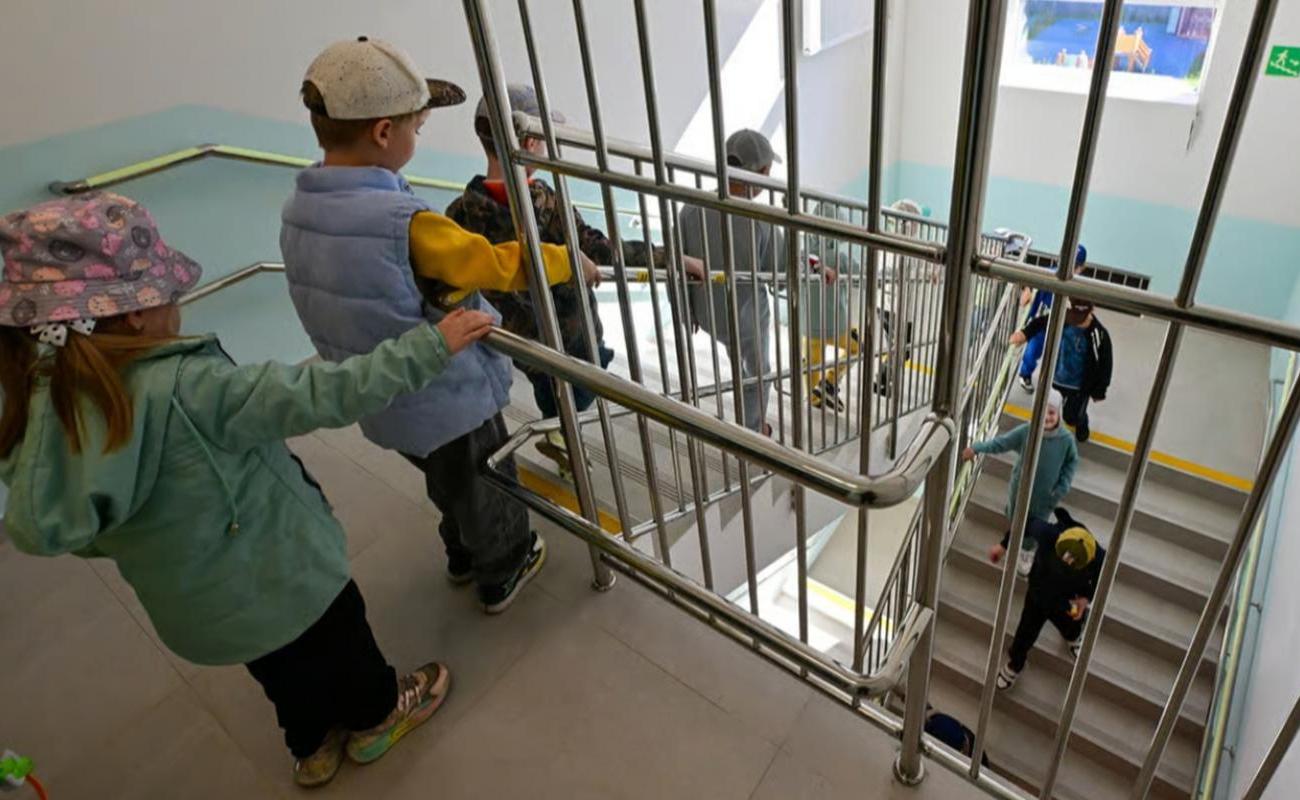
“Daddy, go to war. It’s good,” were the words Veronika* and her husband heard from their four-year-old daughter after an event was held at her nursery school to mark Defenders of the Motherland Day in February.
Though the Russian authorities regularly cite protecting children as one of its top priorities, in reality their militaristic indoctrination begins before they even start school. Preschoolers are taught to weave camouflage nets and how to assemble assault rifles, while regularly being told about service in drone units and encouraged to draw postcards for veterans of the war in Ukraine, whom they are often invited to meet in person as well.
The introduction of the so-called Kind Games initiative to nursery schools across the country from 1 September will formalise this practice, and mean that children will be taught the Kremlin-approved versions of patriotism, morality and civic responsibility in many cases before they can read.
“Yes, patriotism is important, of course, but not at that age. On top of that, they’re only shown one side of the story, while in reality, war means death.”
Premature patriotism
Although Kind Games is officially only being introduced to nursery schools from September, pilot classes for kindergartners modelled on the Important Conversations programme have been going on in some regions of Russia since last year.
Veronika’s nearly four-year-old daughter attended a nursery school in one such region, which she believes is what led her to suggest her father enlist to fight in Ukraine. “We were in shock,” Veronika recalls. “We didn’t know what would happen next.”
After her parents explained to her that only those with combat training could go to war, that it wasn’t necessarily something suitable for everyone, and that it would mean a long separation from her father, Veronika’s daughter relented after a brief pause and announced that he could stay at home after all, as she didn’t like the prospect of not seeing him for six months.
Veronika and her husband live in the western Russian city of Oryol, and though their daughter doesn’t go to nursery school every day, Veronika says that she still attends enough for them to notice the increasing militarisation of preschool education.
“At our nursery, they’re constantly collecting humanitarian aid for soldiers fighting in the war, and making cards for them. There have also been meetings with fathers serving in the ‘special military operation’, but these are for the older groups,” says Veronika.
Similar events have been organised at the nursery since late last year. Until then, Veronika and her husband had avoided discussing the war with their child. Now though, Veronika says she’s unsure what she can do to influence the situation, and remains convinced that preschoolers shouldn’t know about the war at all.
“I think perhaps we should start a petition to ensure that preschool children, as a whole, are not exposed to this type of thing. And schoolchildren too. Yes, patriotism is important, of course, but not at that age. On top of that, they’re only shown one side of the story, while in reality, war means death.”
“Why would a child who isn’t yet fully aware of the world need to be exposed to this? This might be part of the adult world, but it’s certainly not part of the children’s. We’re against collecting humanitarian aid, we neither help nor donate money, as we believe it’s wrong to expect the public to fund such activities.”
“Our family doesn’t see the point in the ‘special military operation’, and we genuinely don’t understand why state institutions, such as nursery schools, are forcing children to take part in it. I really feel sorry for the teachers: they’re being forced to say what they’re ‘supposed’ to say, and we’re more than certain that none of them are happy about it.”
Patriotism or jingoism
Dima Zitzer, a teacher who has founded various educational institutions in Russia, agrees that the line between education and propaganda can easily be crossed when such activities are organised.
“Propaganda robs you of choice,” he notes. “Education is an interaction between people based on free choice, on expressing one’s own opinion, and on exchanging viewpoints. That is precisely what is valued. Propaganda doesn’t allow for this.”
“Patriotism isn’t something you’re taught. Patriotism comes about naturally, whether you care about the house you live in, the street you walk down, the elderly lady who lives next door, and who you help out,” Zitzer continues, before adding that the jingoistic brand of patriotism being hammered into children in today’s Russia was “awful”.
The topics covered by the Kind Games pilot scheme being taught in some nurseries vary from region to region. In the Sverdlovsk region, preschoolers were told that life was the most precious thing a person has. In Bashkortostan, the focus of the programme was behaving safely in everyday life. In Tobolsk, though, a veteran of the war in Ukraine was invited to speak to kindergartners.
“The children listened to very attentively, taking every word to heart, and were astonished to hear how soon this young man had become an accomplished soldier responsible for so many brave deeds and risking his life time and again to save the lives of his friends,” a post about the event made by the nursery school on VK said.
There has long been talk of introducing such sessions in nurseries. In 2024, Vladimir Putin spoke in favour of the initiative, cautioning that “core values” needed to be “carefully instilled in even the very youngest of children”.
Important conversations
Olga*, who lives in the Siberian city of Krasnoyarsk, told Novaya Europe that the topic of war had been arising more and more often at her 4-year-old daughter’s nursery school.
“We don’t discuss that kind of thing in front of our daughter, but she has recently started asking about war and soldiers,” she says, adding that while, at first, she hadn’t thought much of it, she changed their mind when she noticed that posters urging children to go to war had appeared in the school. The children were being taught songs about defending the motherland; and their teacher was telling them that “all boys must grow up to defend the country”.
Earlier this year, Olga says that her daughter began to parrot the slogans she’d been taught at school at home, telling her parents that soldiers protect us from “bad people” and that when she grew up, she’d go to war too. “I was utterly shocked,” recalls Olga, adding that she had responded by explaining how terrifying war could be, and urging her daughter to remember that “nothing is more important than life”.
“I think the only way to counter this is to talk to your child. Personally, I had to explain to my daughter what war is and why it is bad and frightening.”
“When I asked my daughter who the ‘bad people’ were, she was unable to tell me. After seeing a plane another time, she said: ‘Mum, look, the plane is protecting us from the bad people’, so I asked her again … and this time she replied that they were ‘the ones who kill children and adults’.”
Nevertheless, Olga admits that she’s yet to hear her daughter say anything about Ukraine, though she muses that’s most likely as children aren’t being told the names of enemy countries just yet.
“I think, given her age, she doesn’t tell me even half of what she knows, but songs like ‘Russia — My Motherland’ do slip through, so I know for a fact that there’s a very strong emphasis on patriotism at her nursery school.”
“It’s one thing to know history so as to avoid repeating mistakes, but it’s quite another to brainwash children and tell them that everyone around us is an enemy and that we alone are right. It’s one thing to love your homeland; it’s quite another to raise pseudo-patriots who have no opinions of their own.”
However, Olga would appear to be in a minority in her views, and admits that it’s difficult for her to influence the situation, as most of her fellow parents see nothing wrong with such conversations.
“I think the only way to counter this is to talk to your child. Personally, I had to explain to my daughter what war is and why it is bad and frightening,” Olga says, though she adds that she needs to do so carefully, as just one slip of the tongue could transform her into the enemy.
In the army now
Irina*, who lives in the southern Russian city of Krasnodar has also noticed the creeping militarisation faced by her almost 5-year-old son. Though he initially went to a private nursery school where topics such as patriotism and war were hardly ever touched upon, that all changed after he started to attend a state nursery school aged 3.
“All we can do is impress upon children how precious their life is.”
Though Irina says she expected the situation to change, she admits that she had no idea it would do so to such a degree. The first warning signs came when the nursery organised an Immortal Regiment event to mark Victory Day in May. The children had to march while carrying portraits of their relatives who died during World War II, each wearing a Ribbon of St George — a once fringe nationalist symbol that had become mainstream since the start of the war in Ukraine.
That wasn’t all, however. “One day, my son told us that our country had been attacked,” she recalls. “We replied: ‘Do you see tanks in the city, people fighting each other, bombs falling?’, to which he fell silent.”
Though Irina freely admits she can’t know everything that happens at the nursery, she says that she realises from the questions her son asks her when he gets home that the topics of war and patriotism are raised frequently.
This year alone at nursery school her son has been shown weapons and told how they work on more than one occasion, and he and his classmates have been asked to learn war poems. “One day, my son came home from nursery and recited a poem to me. … After that he said that it wasn’t scary to die. I was in shock.”
“One of my son’s friends proudly says that when he grows up, he’ll go to war,” Irina continues. “Another friend’s dad died in the war. It seems to me that expecting a small child to be imbued with the idea of patriotism at such a young age is a bit absurd. There’s only one way forward — asking your child’s questions as they arise, and discussing everything that’s going on.”
“All we can do is impress upon children how precious their life is. … Dying in a war is not the kind of future worth striving for; it’s better to live a long, interesting life and not to hurt other people.”