
Continued war or negotiations: what will Putin choose?
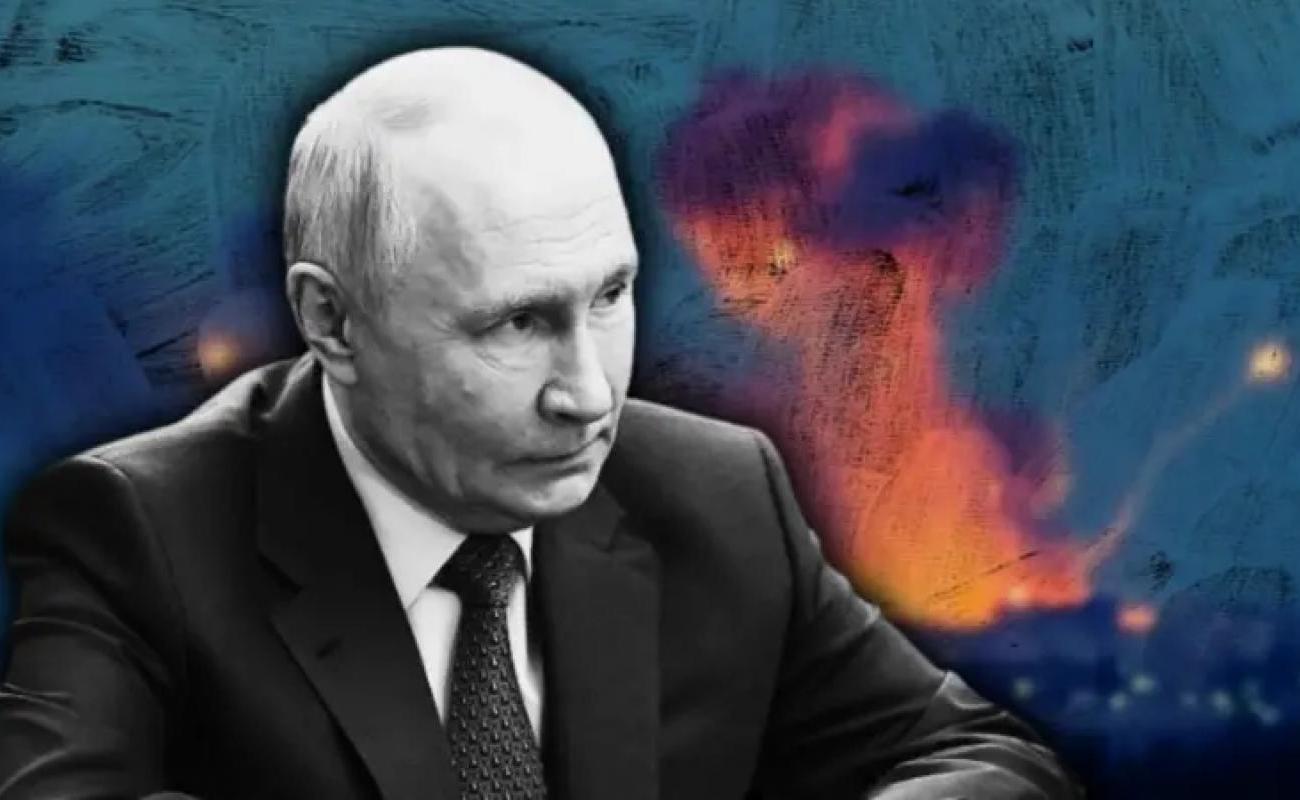
Russia continues to shell Ukrainian territory - on the night of June 6, Kiev was subjected to its second massive missile and drone attack in a week, killing at least 13 people and causing significant destruction. At the same time, Ukrainian attacks on Russian energy infrastructure are gradually putting Vladimir Putin before a choice: either further escalate the war or, ultimately, seek a path to negotiations.
The combined Russian attacks have shown that Ukraine is having increasing difficulty replenishing its stock of American Patriot interceptor missiles, which are crucial for ballistic defense, Bloomberg reports.
During the shelling, according to the Ukrainian Air Force, not a single ballistic missile was shot down.
Volodymyr Zelensky intends to once again appeal to Washington to provide Ukraine with the necessary weapons during a meeting with US President Donald Trump in Ankara, which will probably take place on the sidelines of the NATO summit, Bloomberg adds.
Ahead of the NATO summit, Putin and Trump held a phone call, during which they discussed the war in Ukraine and the upcoming NATO meeting.
Trump then spoke with Zelensky by phone. The presidents discussed the situation on the front lines, as well as diplomatic efforts aimed at ending the war.
Impact of Ukrainian strikes
At the same time, the Ukrainian strikes are causing significant damage to Russia and are putting Putin before a difficult choice, writes The Telegraph in a large analytical material devoted to the internal problems of the Kremlin.
As the publication notes, Putin was forced to personally and publicly acknowledge for the first time in a long time the consequences of Ukrainian attacks on Russian oil refineries.
After the strikes on Moscow and other locations in Russia, queues began to form at gas stations, fuel shortages appeared, and Russians complained about the situation on social networks.
"Of course, this creates problems. That's obvious," the Russian president admitted in an interview with state television.
However, immediately after that, Putin assured that the fuel crisis was supposedly "not critical" and that Russia managed to quickly eliminate its consequences. He also accused the West of trying to use the situation to sow discord in Russian society.
However, as The Telegraph writes, the Ukrainian strikes are happening faster than Russia has time to repair the damaged enterprises.
According to the publication, only two of Russia's 83 regions have avoided fuel problems.
"Propaganda cannot make gasoline flow through the pipes," the authors of the text state, noting that even Russian technocrats cannot quickly eliminate the fuel shortage.
According to the publication, the current situation undermines one of the main foundations of Putin's power - a tacit agreement with society, according to which the state guarantees citizens stability and security in exchange for political passivity. This was symbolized by the words of a woman standing in line at a gas station: "I'm sure half of the people in this line were not interested in politics at all. But now politics has come to our house."
War fatigue
At the same time, The Telegraph notes that the crisis is unfolding against the backdrop of growing war fatigue among Russians.
According to the state-run VTsIOM sociological center, Putin’s approval rating fell from 75 percent in December to 66 percent in early May, and at the end of June, Putin’s support in the country fell the most since the start of the large-scale invasion.
The Russian economy is also facing increasingly difficult problems. GDP growth has slowed to 0.4 percent, inflation continues to rise, and economists can no longer compensate for the consequences of the war. Sberbank Chairman German Gref openly stated last week that the main desire of most Russians is a speedy end to the fighting.
“I don’t believe there is a single person left in this country whose main priority is not a speedy end to the fighting,” Gref said.
In this context, the Kremlin has already begun to adjust its political strategy ahead of the State Duma elections due in September.
According to The Telegraph, the government has abandoned plans to rely on war veterans, and one of Russia’s most militant politicians, Dmitry Medvedev, has not been included in the United Russia candidate list at all. Instead, for the first time in many years, Putin himself has appeared on election posters, whose personal popularity still far exceeds the ruling party’s ratings.
The publication draws attention to the Kremlin’s financial problems. Due to the fuel crisis, the government is forced to subsidize gasoline prices, spending significant budget funds.
At the same time, according to The Telegraph, Russia is already exceeding planned military spending by tens of billions of dollars. Officials are considering withdrawing about $40 billion from private pension savings, and Communist Party leader Gennady Zyuganov has even proposed effectively mobilizing Russians’ savings in banks.
The authors pay special attention to Ukraine’s campaign to attack Russia’s energy sector. According to the commander of the Unmanned Systems Forces, Robert "Hungarian" Brovda, the intensity of Ukrainian long-range strikes has increased by 1,150 percent since the beginning of the year.
Former Gazprom CEO Sergei Vakulenko believes that Ukraine is striking faster than Russia can repair damaged facilities. As a result, Moscow has already started importing fuel from India and is preparing to return outdated brands of gasoline to the market.
Will there be a mass mobilization in Russia
According to experts interviewed by The Telegraph, this is precisely what could force Putin to change his current strategy. Sam Green, a professor at King's College London, believes that the Russian president will continue to try to wait out the crisis, but that over time the price will become too high.
"Will he decide that the time has come to fundamentally change the way the country is run, to make these problems manageable? He still has the political space to do so. But it will be increasingly difficult for him to do the same thing over and over again without changing anything," the expert said.
According to them, after the parliamentary elections, Putin could find himself at a crossroads. One possible scenario is a new hidden wave of mobilization and a further escalation of the war.
This is also what Nikolai Beleskov, a research fellow at the National Institute for Strategic Studies and a senior analyst at the Come Back Alive Foundation, wrote in a column for the Atlantic Council.
Faced with mounting difficulties, he notes, Putin is considering mass mobilization in an effort to regain the initiative and salvage his invasion.
However, mass mobilization would be risky for Putin—he has worked hard since the start of a large-scale invasion to protect ordinary Russians from the consequences of war.
“Any attempt to mobilize large numbers of Russians would violate this unwritten social contract and potentially destabilize the domestic situation,” Beleskov writes.
Putin may resort to mass mobilization to continue the war in Ukraine
That is why, in his opinion, Putin has sought to ensure that those fighting and dying in Ukraine attract minimal public sympathy.
"Initially, this meant concentrating Russian recruitment efforts among ethnic minorities and prisoners. More recently, the Kremlin has focused on attracting volunteers, offering extremely large recruitment bonuses and high salaries," Beleskov explains.
This policy has proven very effective, but it may not be enough - with the number of volunteers dwindling and the supply of prisoners running out, Putin now finds himself in a difficult position, the analyst says.
At the same time, the Russian leader continues to reject any talk of concessions and refuses to scale back his political ambitions.
"Therefore, everything points to a large-scale mobilization in the coming months," Beleskov believes.
What will Putin choose?
The second option, according to The Telegraph, is to try to reduce the intensity of hostilities and move on to negotiations with Kiev.
However, so far there are almost no signs that the Kremlin is changing course. In his latest interview, Putin continued to assure Russians that the Ukrainian strikes "have no impact" on the situation on the front.
The Washington Post writes that Putin visited a command post near the front for the first time in about six months, where he appeared in military uniform and announced the successes of the Russian army. He claimed that Ukrainian reports on the achievements on the battlefield were an "information and propaganda operation", and also announced the alleged capture of Konstantinovka.
According to The Washington Post, Putin's appearance on the front line took place in the context of a long-term Ukrainian campaign of strikes on occupied Crimea and Russian energy infrastructure. In this context, even US President Donald Trump recently praised Volodymyr Zelensky, saying that he was "holding up" and "doing quite well".
The publication believes that Putin's trip was not only aimed at the Russian audience, but also at Trump. Moscow is trying to convince the US president that Ukraine has no military advantage and that Russia's victory is only a matter of time.
During his speech, Putin threatened to seize new Ukrainian territories, especially in the Kharkiv and Sumy regions, if Ukraine continues to attack Russian infrastructure.
At the same time, the Kremlin continues to show interest in dialogue with the United States. Along with the announcement of Putin's trip, the Russian authorities published his congratulatory letter to Donald Trump on the 250th anniversary of US independence, in which he emphasized the "special responsibility" of Moscow and Washington as the largest nuclear powers for global security.
According to The Washington Post, the Kremlin expects Trump's special representatives to visit Moscow in the near future to continue negotiations on Ukraine.