
Coalition of the Willing sign off on letter of intent to send peacekeeping force to Ukraine
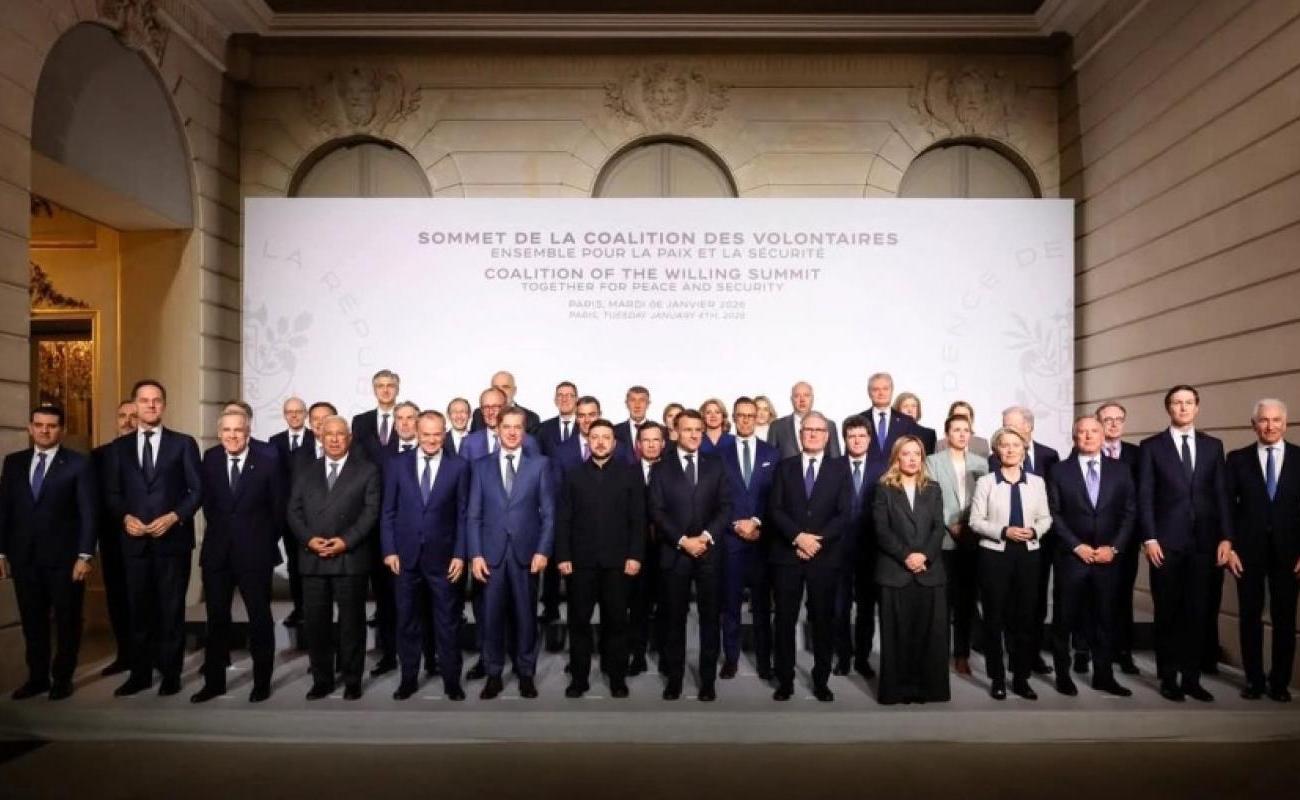
The leading Coalition of the Willing, the UK and France, have signed off on a “declaration of intent” to deploy troops to Ukraine and build a military base if the war ends.
UK Prime Minister Keir Starmer, French President Emmanuel Macron and Ukrainian President Volodymyr Zelenskiy signed a document with the declaration in Paris on January 6 evening as the latest round of consultations came to an end.
The meeting included representatives of some 40 countries in the coalition that met to discuss providing Ukraine with strong security guarantees as ceasefire talks make some progress in recent months.
"Following a ceasefire, the UK and France will establish military hubs across Ukraine and build protected facilities for weapons of military equipment to support Ukraine's defensive needs,” Starmer said.
"We have reached agreement on the operational details of the security guarantees," a French presidential administration official told reporters ahead of the summit. "We will explain how they are structured and the need for long-term commitments from all participants."
The declaration is almost certain to be rejected out of hand by the Kremlin which has made clear that the presence of any foreign or Nato-linked troops in Ukraine is a red line. Russian Foreign Minister Sergei Lavrov said in December any EU troops in Ukraine would be treated as combatants and Russia would take “appropriate action” against them.
The idea of peacekeepers in lieu of true Article 5-like military aid guarantees was first floated by Macron last April, but was then dropped as unworkable. However, in the autumn the idea was revived as Europe struggled to find a compromise that stops sort of offering a Nato-like collective security guarantees that would commit European forces to fighting in Ukraine alongside the Armed Forces of Ukraine (AFU) should Russia re-invade.
There has been a long debate over the size of what has been dubbed “reassurance troops.” Previously, a force of 10,000 to 30,000 soldiers has been suggested, although military analysts say that at least 120,000 men would be needed if the peacekeeping force were to take over the effective monitoring along the line of contact. It has also been proposed that the international force be stationed on Ukraine’s western border with the EU to keep it as far away from a potential clash with Russia as possible.
“Military officials from France, the United Kingdom, and Ukraine worked in detail on force deployment, numbers, specific types of weapons, and the components of the Armed Forces required and able to operate effectively,” Zelenskiy said in a social media post. “We already have these necessary details. We understand which country is ready for what among all members of the Coalition of the Willing. I would like to thank every leader and every state that truly wishes to be part of a peaceful solution.”
The US refused to join in the declaration and any mention of the US participation in the force was removed from the document, Politico reports.
US President Donald Trump has said repeatedly that no US troops will be stationed in Ukraine, but the White House said it would continue to provide satellite intelligence to monitor any future ceasefire line in a mooted Korean DMZ-model agreement.
The peacekeepers statement of intent follows on from another statement of intent signed by Macron and Zelenskiy in November to buy billions of dollars-worth of up to 100 French-made Rafale warplanes and new air-defence systems to strengthen its long-term war effort.
That agreement was also rejected as unacceptable by the Kremlin. At the end of last year, Russian President Vladimir Putin said that Europe had become the “main problem” to concluding a peace agreement with Kyiv.
Talks to end the war have made a lot of progress since the Moscow meeting on December 3 between Putin and the US envoys Special Envoy Steve Witkoff and Trump’s son-in-law Jared Kushner thrashed out a 27-point peace plan (27PPP). That deal was presented to Zelenskiy at a Berlin meeting on December 14-15 and then again at the Mar-a-Lago meeting on December 28 between Trump and Zelenskiy but no deal has been closed yet.
These European offers are only hypothetical and are not concrete commitments. They will only become relevant if the war ends, but they are not included in the formal talks between the White House and the Kremlin, which has excluded Europe entirely from the peace negotiations. Nevertheless, Europe continues to seek an "American backstop" to ensure Ukraine’s post-war territorial integrity.
Air defence ammo
As part of the security guarantees discussion, Ukraine’s more immediate need is more ammo for its air defence system. Since last summer Russia has more than tripled its missile attacks, increasingly targeting essential civilian, transport and power infrastructure. Wholly dependent on the US for ammo for its Patriot missile systems, the only effective defence against Russian missiles, as the stocks dwindle, Ukraine has become more vulnerable to these attacks. Zelenskiy discussed the supply of missiles for Ukraine's air defence during a meeting with Macron.
“Russia does not stop its strikes against our country, and right now we need to bolster air defence to protect our people, our communities, and critical infrastructure. Every delivery of air defence missiles saves lives and boosts the chances for diplomacy. That is why every meeting must yield concrete results – new decisions regarding air defence, new assistance packages, and new capabilities to protect the skies. During our meeting with President Emmanuel Macron, this was exactly what we discussed – Ukraine’s real capabilities to counter Russian terror, our defence, and the support that can strengthen our positions in diplomacy,” Zelenskiy said on X following the meeting.
Reconstruction funding talks start
Separately, talks on raising €800bn to fund a decade-long “Ukraine Prosperity Plan” have also begun. The World Bank estimates that over $500bn worth of damage has been done to Ukraine, including economic losses.
However, as bne IntelliNews reported, most of the worst physical damage has been done in eastern Ukraine to territories currently occupied by Russia. If a ceasefire is agreed that cedes de facto control of these regions to Russia – as seems likely – then the Kremlin will be responsible for rebuilding these regions. Russian rebuilding of Mariupol is already well underway.
The damage done to the territory still under Ukrainian government control is far less severe. The cost of rebuilding those parts of Ukraine is around $200bn, according to bne IntelliNews calculations. The International Financial Institutions (IFIs) have already committed around $75bn to Ukraine, reports Peterson Institute for International Economics (PIIE), and Europe will provide another €90bn loan agreed in December. The remaining $35bn could be raised by additional development bank loans, borrowing on the international capital markets and investment by the local oligarchs.
Ukraine, together with its partners, will work closely over the next two weeks to identify potential financing sources for the plan, which is being developed as part of the proposed peace agreement, Economy Minister Oleksiy Sobolev said.
The minister added that work is ongoing to identify which sectors of the economy have sufficient projects to attract private investment, but Ukraine has a mountain to climb, according to a bne IntelliNews assessment of sector by sector damage done.
Now, details are being worked out with partners and bankers on the required funding amounts for specific sectors and financing sources, the minister said. Sobolev emphasized that Ukraine aims to attract more private-sector funding because it would bring additional investment and encourage reform. "But the private sector comes after there is a security framework, a guarantee of security, and there is macro-financial stability, which requires truly institutional funds, funds from countries," the minister noted.