
“British terrorist attack”: Russian propaganda’s reaction to Ukraine’s strike on the Kerch Bridge
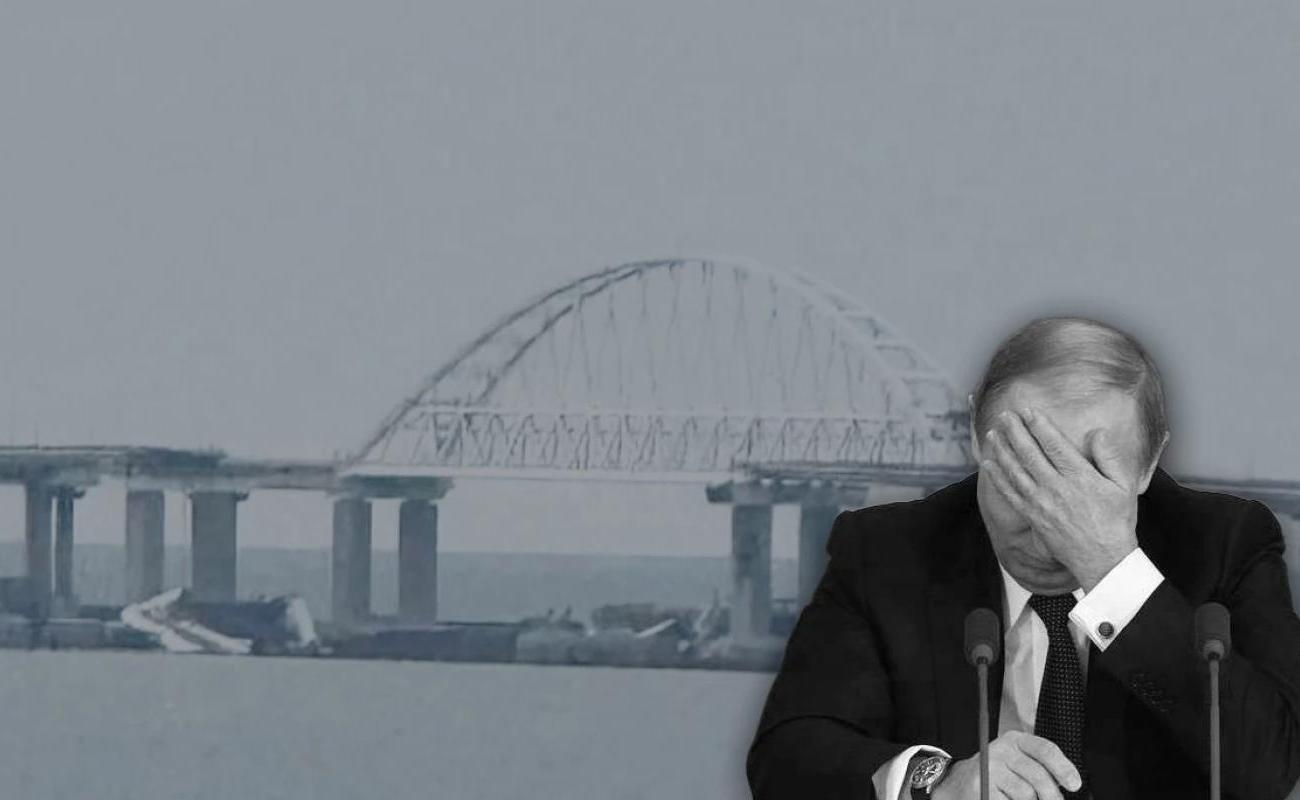
Pro-Kremlin Telegram channels initially tried to dismiss the collapse of the Kerch Bridge arch as an “AI-generated fake”, then described it as a “British operation” and a “terrorist attack” ahead of a “new Yalta”. They ended up calling for the destruction of all bridges across the Dnipro, and Ukraine itself for good measure.
On the night of 17 November 2026, Ukraine’s Defence Forces attacked the Kerch Bridge (also commonly known as the Crimean Bridge) for the second time in 24 hours. As a result of the strikes, the arch and a section of the bridge’s road span collapsed into the Kerch Strait, while the arch above the railway section was also damaged. According to the Security Service of Ukraine (SBU), the operation lasted about a month and consisted of seven stages. First, Ukrainian forces targeted Russian air defence systems, electronic warfare systems and radars. At the final stage, fighters from the SBU’s Alpha Special Operations Centre struck the road section using Palianytsia missile drones. Neptune and Ruta missiles, as well as FP-5 Flamingo cruise missiles, were also used. This was the fourth strike on the bridge since 2022, but the first to achieve such significant results.
The strike came at a particularly sensitive moment. That same night, Russian ballistic missiles hit Kyiv’s Northern and Southern bridges, while Vladimir Putin was heading to China for his first trilateral meeting with Donald Trump and Xi Jinping on the sidelines of the APEC summit in Shenzhen. It was against this backdrop that Russian propaganda constructed its explanations of what had happened.
To find out how Russian propagandists reacted to the strike, we analysed 2,699 posts mentioning the Crimean Bridge published by Telegram channels on 17–18 November. The data from Telegram channels was provided by Lets Data. We focused primarily on 1,223 posts from 169 channels classified by the data provider as malicious actors. These included Russian state media, pro-war bloggers, military correspondents and pro-Russian anonymous channels targeting Ukrainian audiences.
“Did your phone battery die?”: propaganda’s morning silence
In the first few hours after the strike, official Russian sources limited themselves to a statement by Sergei Aksyonov, head of the Russian occupation administration in Crimea, announcing that traffic across the bridge had been suspended. The Russian news channel Lentach (391,000 subscribers) noted that the morning broadcasts of state television channels had said nothing about the strike: “Instead, television propaganda provided extensive coverage of the overnight attack on Kyiv’s Northern and Southern bridges”.
Meanwhile, pro-war channels questioned the footage of the strike’s aftermath that began appearing online. The Telegram channel of the propagandist outlet Tsargrad (351,000 subscribers) quoted military correspondent Dmitry Steshin: “The most striking video, allegedly showing the collapse of the arch, has a very strange duration — 1.5 seconds. Did the phone battery die? Or was that all the AI managed to generate… Don’t fall for it, hold off on the dopamine rush”. Another Telegram channel with more than 300,000 subscribers advised its readers not to draw conclusions about the bridge’s condition before official comments were issued.
The official comments, however, were extremely vague. When announcing the opening of a criminal case on terrorism charges, Russia’s Investigative Committee mentioned only an attack involving “drones” and “damage to the structure”, without a single word about the collapsed arch. The fake-news narrative persisted even after Russian military correspondents acknowledged the collapse and Zelenskyy released footage of the strike.
Later on 17 November, the Telegram channel of propagandist Andrei Medvedev (182,000 subscribers) reposted an “instruction” explaining how supposedly to manufacture fake reports using a smaller channel: “Take a photo of the Crimean Bridge explosion from October 2022. Put it into a neural network with a prompt like ‘add more destruction, change the colour shades’”. The text was also reposted by a channel called Ukraina.ru (494,000 subscribers), which urged its readers to “practise information hygiene”.
“It will be even better”: downplaying the damage
Once denying the collapse became impossible, official propaganda shifted to reassuring the public. Kremlin spokesperson Dmitry Peskov stated: “There is, in fact, no doubt whatsoever that the bridge will be restored. And it will be even better than it was before”. Russian propaganda outlets and dozens of pro-war channels circulated this statement within minutes. Deputy Prime Minister Andrei Nikitin, in turn, assured the public that Russia had the “expertise” needed to restore the bridge “within a short timeframe”.
Another narrative promoted by propaganda was that the bridge had supposedly never been important for supplying anything to the peninsula. Mikhail Razvozhayev, the occupation-appointed governor of Sevastopol, and Oleg Kryuchkov, an adviser to Aksyonov, stressed that “hardly any cargo was transported” across the bridge. According to Razvozhayev, rumours of a “blockade” of Crimea were being spread by the “enemy”. On 19 November, Putin claimed that the bridge had not been used for military purposes: “A long time ago, I gave a direct order that the Crimean Bridge should not be used to transport either military equipment or ammunition. We did not even transport oil or petroleum products”. The General Staff of the Armed Forces of Ukraine, however, described the bridge as an important supply route for fuel, ammunition and military equipment.
Pro-war bloggers picked up the narrative that attacking the Crimean Bridge was “pointless”. “A serious strike. But pointless… Last time, the bridge was restored in four months at a cost of $15 million”, propagandist Diana Panchenko (404,000 subscribers) wrote on her Telegram channel. Another channel with 260,000 subscribers promised that the bridge would “be restored and resume operations, just as it did after both previous attacks”.
Some propagandists, however, acknowledged the opposite. Military correspondent Alexander Kots (469,000 subscribers), in particular, admitted: “The damage is serious, there's no point in pretending otherwise. There won't be any cars on the bridge for the next few months”. Kots described the purpose of the strike as cutting off the peninsula’s “main artery”. The Rybar channel (1.5 million subscribers), whose post was shared by other channels, warned that the Ukrainian Armed Forces could target floating cranes and repair crews, meaning that “even installing a ready-made arch under these conditions would be a particularly difficult task”.