
EU supports 14 local self-governments with over EUR 4.5 million
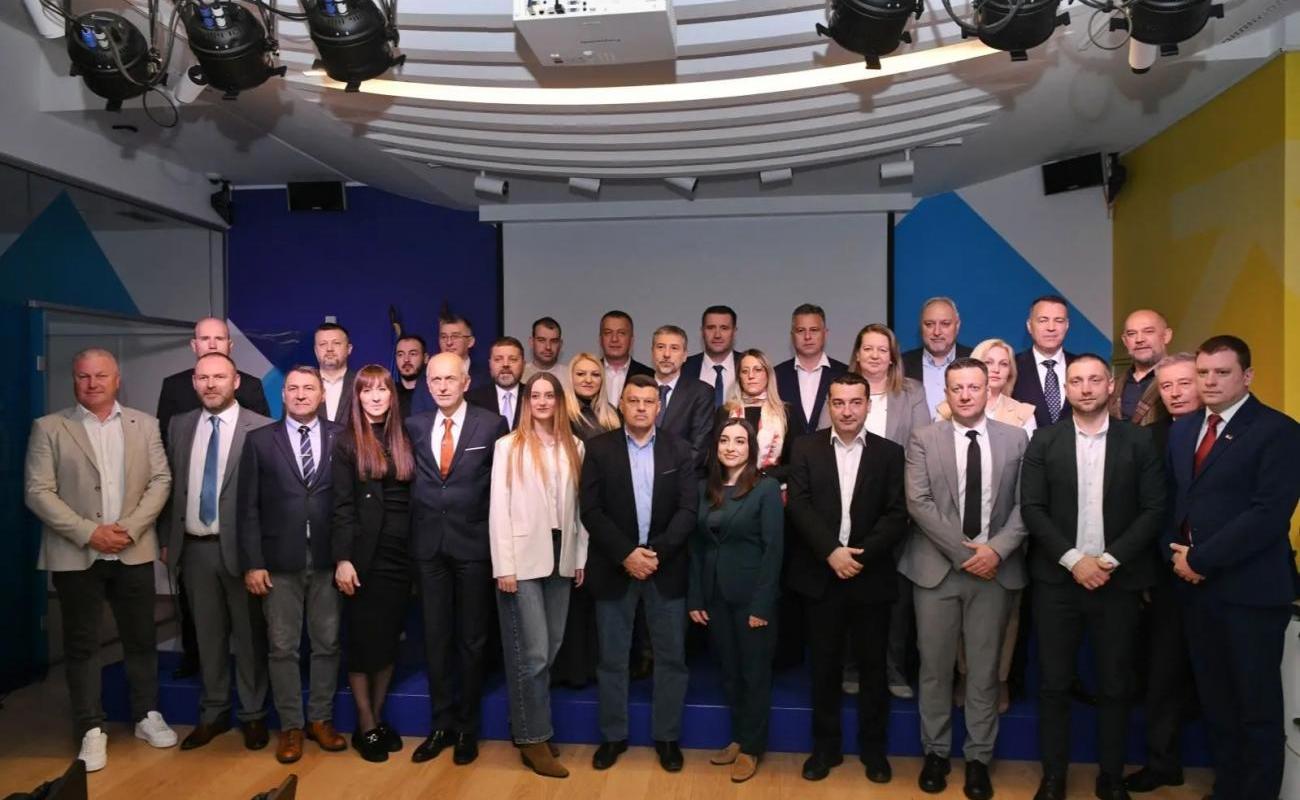
Grant contracts were ceremonially awarded today in Belgrade to local self-governments for the implementation of the first projects under the programme EU Support to Integrated Territorial Development – EU INTEGRA. More than EUR 4.5 million in EU grant funding has been allocated for the implementation of five projects in 14 local self-governments, while the total value of the proposed projects exceeds EUR 6.8 million.
The EU INTEGRA Programme, with a total value of EUR 15 million, is funded by the European Union through the Instrument for Pre-Accession Assistance (IPA III). The Ministry of European Integration of the Republic of Serbia is the main beneficiary, while the programme is implemented by the United Nations Office for Project Services (UNOPS) and the Standing Conference of Towns and Municipalities (SCTM).
State Secretary at the Ministry of European Integration Mira Radenović Bojić underlined that the projects to be implemented by 14 local self-governments are not only investments, but also an example of how important challenges can be addressed through partnerships and joint planning.
“They will make healthcare more accessible to citizens, improve the energy efficiency of facilities in local communities, contribute to environmental protection, while in some of these municipalities and cities public services will be modernised and public spaces renewed,” said Mira Radenović Bojić.
As she stressed, it is particularly important that many local self-governments recognised the significance of pooling capacities and acting jointly and, in this way, precisely through an integrated approach, as the very name of the Programme suggests, secured these funds.
“This is the European model of integrated territorial development that we want to develop in Serbia and support through the EU INTEGRA Programme, because it connects people, resources and ideas with the aim of balanced development,” concluded the State Secretary at the Ministry of European Integration.
“The European Union strongly supports the development of local self-governments in Serbia, which play a key role in improving citizens’ quality of life and ensuring sustainable economic growth. Through regional cooperation and territorial development strategies, we enable better planning and implementation of projects that bring concrete benefits to local communities,” said Mauro di Veroli, extending congratulations to local self-governments selected under the first call of the EU INTEGRA Programme.
He noted that projects covering healthcare, renewable energy, green mobility, urban regeneration and waste management represent examples of integrated partnership-based initiatives that contribute to reducing regional disparities, creating new jobs and attracting investments aimed at strengthening local economies. “The European Union remains committed to empowering local self-governments as a foundation for Serbia’s long-term and balanced development,” di Veroli said.
Projects implemented under the programme are based on territorial strategies developed in the previous cycle of EU support and represent the first concrete investments in applying the model of integrated territorial development in Serbia.
“Today’s grant award points to the growing readiness of local self-governments in Serbia to plan development strategically, through partnerships and joint projects that go beyond the boundaries of individual municipalities. For SCTM, it is particularly important that this first call shows that the European model of integrated territorial development is gaining concrete application at the local level and confirms the value of inter-municipal cooperation. These projects are not only investments, but also an incentive for further strengthening the capacities of cities and municipalities for more complex development initiatives in the future,” said Nikola Tarbuk, Secretary General of SCTM.
The goal of the EU INTEGRA Programme is to strengthen the capacities of local self-governments and partners for applying the European model of integrated territorial development in Serbia through concrete projects that contribute to sustainable local development and improve citizens’ quality of life. Through this programme, the European Union supports the development of local self-governments, strengthens their capacities for project planning and implementation, and promotes balanced regional development in line with the principles of EU Cohesion Policy.
Under the first call, the supported projects include the establishment of a joint emergency medical system, energy renovation of public buildings, development of green mobility and modernisation of municipal waste management systems across several regions:
1. The City of Pirot, in partnership with Dimitrovgrad, Babušnica and Bela Palanka, will implement the project „Health for All“, which includes the establishment of a joint emergency medical system, thereby improving the accessibility and response speed of healthcare services in this region.
2. The City of Užice, together with partners from Bajina Bašta, Požega and Čajetina, will implement the project „Prevention, Response and Adaptation to Climate Change“, which combines investments in renewable energy, urban infrastructure and civil protection systems to strengthen resilience to climate change.
3. The City of Kruševac will implement the project „City Hall – Energy Efficient, Accessible and Open to Visitors“, which includes the energy renovation and modernisation of the city administration building, thereby improving energy efficiency, accessibility of public services and preservation of cultural heritage.
4. The Municipality of Merošina, together with the City of Niš and the municipalities of Svrljig and Gadžin Han, will implement the project „Safe, Inclusive and Innovative Public Spaces“, which includes revitalisation of public spaces and development of green urban and rural mobility.
5. The City of Bor will implement the project „Smart Green Islands“, which includes modernisation of the municipal waste management system through advanced infrastructure and digital solutions for monitoring and optimisation of waste collection.