
The Russian and Chinese Alignment on the Western Balkans and Kosovo
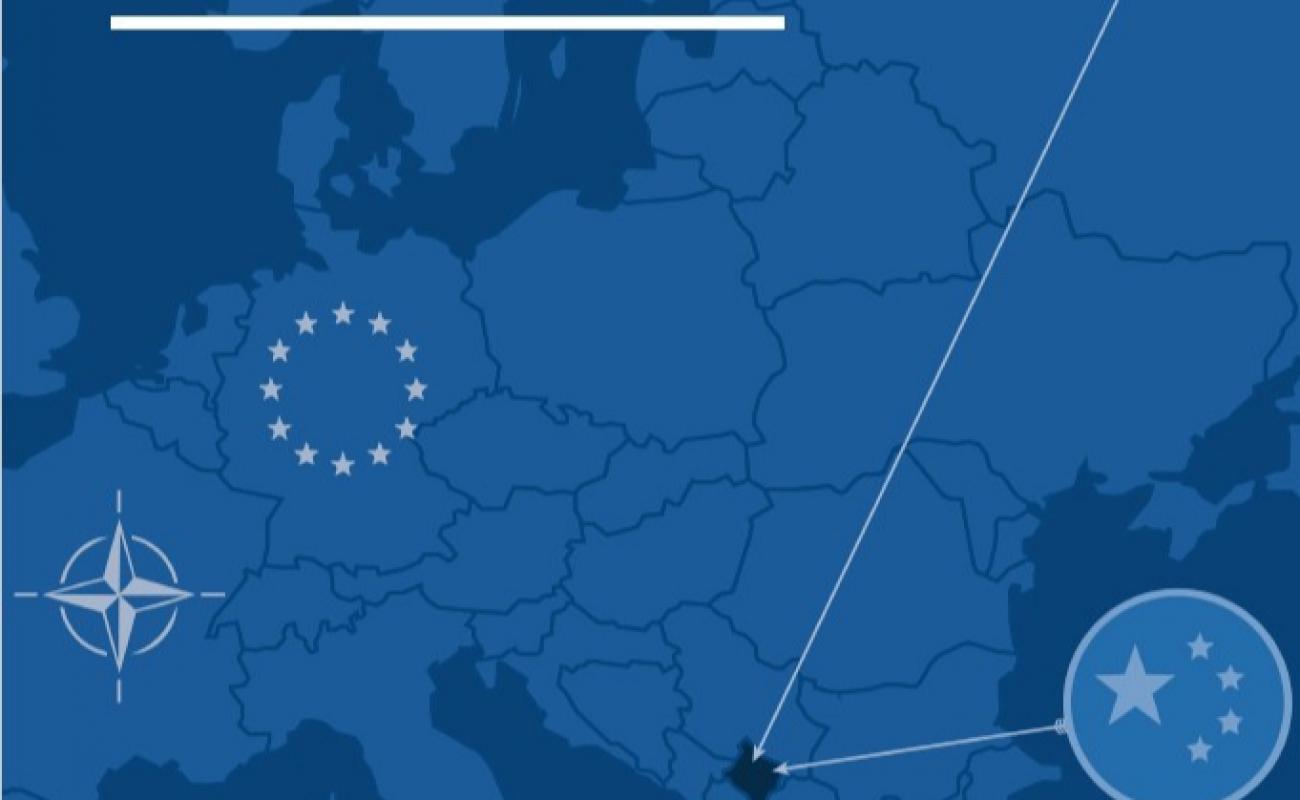
This analytical report is based on an analysis of official statements by Russian and Chinese officials, joint statements, transcripts from UN Security Council meetings on Kosovo, and news articles from Russian and Chinese media. It also draws on brief commentary provided by experts and civil society representatives focusing on foreign policy and malign foreign influence. It mainly covers the period from 2020 to 2026, although not in a fully comprehensive way. The report also looks at a smaller set of reputable secondary analyses, which are used to help interpret broader patterns. Main research question that this paper seeks to answer is “How, and to what extent, do Russia and China align their political, diplomatic, media, and strategic narratives in the Western Balkans, especially around Kosovo, Serbia, and Bosnia and Herzegovina?”
This question of China-Russia alignment is also becoming part of a wider European debate. Recent commentary has discussed possible scenarios for how China and Russia may become more assertive in the coming period, including through different but mutually reinforcing forms of pressure on Western interests and institutions.17 The Western Balkans are not always at the centre of these discussions, but the region is a useful place to examine how such alignment works in practice. Kosovo, Serbia, and Bosnia and Herzegovina show that Russia and China do not need to act through a formal alliance to have a shared effect. Russia may use sharper political language, energy links, security narratives, and anti-NATO memory politics, while China may rely more on sovereignty language, economic presence, diplomatic support for Serbia, and a calmer public tone. The result, however, can still be a combined pressure on Euro-Atlantic consensus in the region.
When it comes to the Western Balkans region the evidence base is strongest with respect to the Serbia/Kosovo relations/dimension of Russia–China coordination or alignment. It is weaker, but still relevant, in the case of Bosnia and Herzegovina, and much thinner when it comes to other Western Balkan states. This unevenness is itself important. It suggests that Russia–China alignment in the region may be mainly a Serbia/Kosovo/Bosnia and Herzegovina issue, rather than a uniform pattern across the whole Western Balkans.
A key limitation in our analysis and interpretation is that direct Russia–China coordination on Kosovo-specific events is hard to prove from public sources. The public record is much stronger on convergence and indirect reinforcement than on formal joint planning. A second limitation concerns the Banjska terrorist attack.18Russia’s response is clearly documented, but a comparably clear Chinese primary response was not identified in the source set we used here.
The highest-confidence conclusion from our analysis is that Russia and China are aligned in effect, but aligned unevenly on mechanism. In public diplomacy, they repeatedly converge on the same legal and political language, such as sovereignty, territorial integrity, opposition to “imposed solutions,” criticism of NATO’s role in the Western Balkans and in general, and wariness of “Western-backed” institutional change in the Western Balkans. In multilateral diplomacy, they sometimes move together more explicitly, as seen in Bosnia and Herzegovina case19, related to the UN action and in China’s willingness to back Russia-linked procedural or thematic efforts around the legacy of NATO’s 1999 intervention to end the war in Kosovo. In the regional political economy, however, the partnership is asymmetrical, because China appears to be seen as the cash, projects, and long- term embedder while Russia is the shield, veto, and grievance amplifier.
The result of Russian and Chinese alignment is especially visible in Serbia. Belgrade can present itself as formally in the process of EU accession, while materially deepening privileged ties with China and Russia. That is exactly the kind of environment in which Euro-Atlantic consensus erodes, by the means of sustained and fostered ambiguity on strategic orientation of the country, which was also noted with concerns by the EU’s Country Report on Serbia. Reuters captured this explicitly when Vučić said Serbia would keep balancing ties with the West, China, and Russia while still seeking EU membership and a solution to Kosovo.20 Later analyses from Marina Vulovic from SWP link Serbia’s low CFSP alignment in part to Russian and Chinese backing on Kosovo.
Disclaimer: The views expressed in this paper are those of the author and do not necessarily reflect the views of Konrad-Adenauer-Stiftung. This publication of the Konrad-Adenauer-Stiftung is solely intended for information purposes. It may not be used by political parties or by election campaigners or supporters for the purpose of election advertising.