
Six days of silence — and hell again: the unspoken truth about the Kherson region after the evacuation from Oleshki
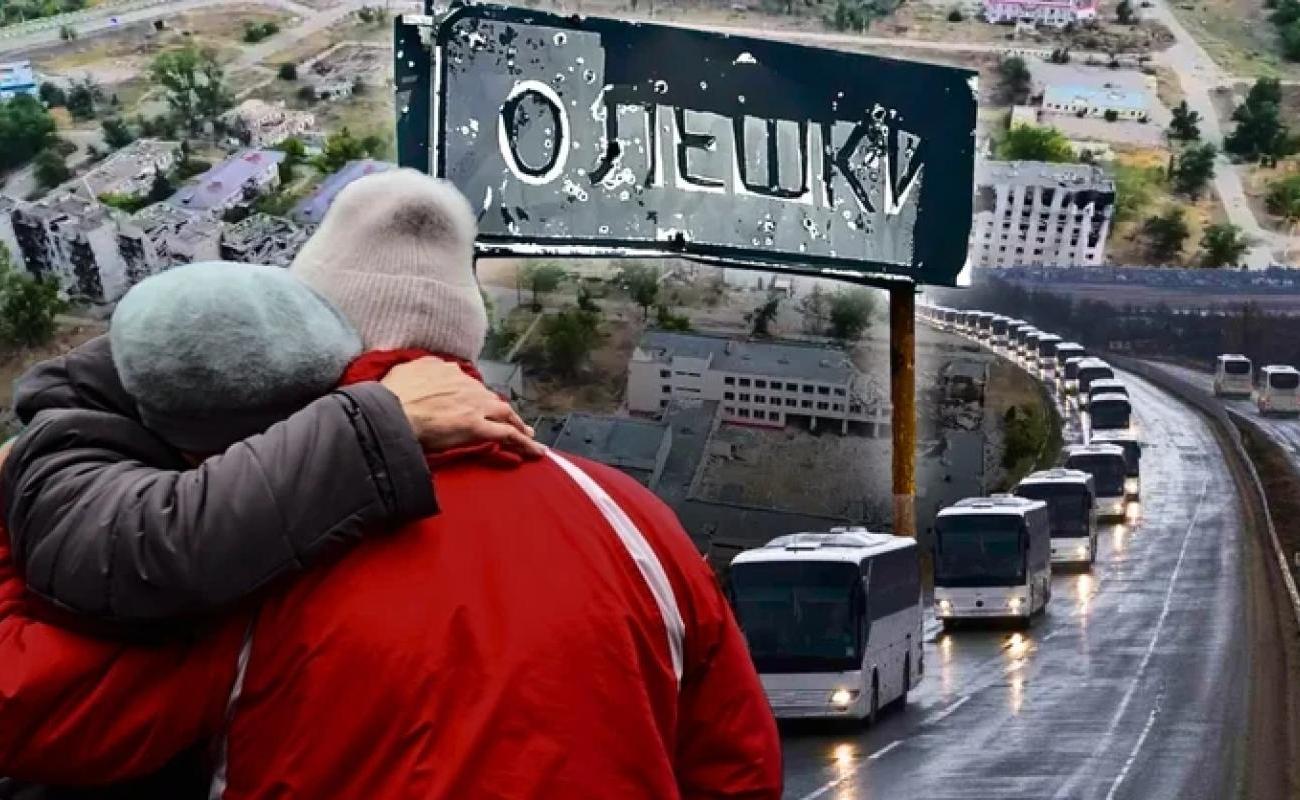
Four years ago, Kherson welcomed Ukrainian soldiers with flags and tears of joy. Today, the right bank trembles from Russian shelling, and on the occupied left bank people survive without heating and normal living conditions. The recent evacuation from Oleški gave hundreds of residents a chance for salvation, but not all managed to leave. Focus found out what remained behind the scenes of the six-day truce, why people refuse to leave their homes, even while shelling continues, and how years of occupation changed those who finally returned.
On this day, November 11, 2022, Ukrainian soldiers liberated Kherson after eight months of Russian occupation. Then citizens took to the streets with Ukrainian flags, hugged the army and believed that the worst was behind them. Four years have passed, but the Dnieper River still divides Kherson Oblast into a liberated and an occupied part, and life on the right bank has turned into a daily struggle with shelling. At the end of October 2026, hundreds of residents were evacuated from occupied Oleški thanks to the six-day truce. However, some people remained in the city without adequate living conditions, and those who returned faced new challenges. Focus spoke with a representative of the resistance movement of the Kherson region about what remained behind the scenes of the humanitarian operation, why people refuse to leave dangerous settlements and how the region lives after a short ceasefire.
Six days without shelling: how the ceasefire changed life in the Kherson region and what happened afterwards
At the end of October, Ukraine and Russia, with international mediation, agreed on a temporary truce in the area of occupied Oleshki. The truce lasted from October 27 to November 1. During that time, humanitarian aid was delivered to the city and the evacuation of civilians was organized.
Residents who decided to return to the territory controlled by Ukraine were escorted through a difficult route - through occupied Crimea, Russian Anapa and Belarusian Gomel. On October 31, they crossed the Ukrainian border.
As a representative of the Kherson Oblast resistance movement told Focus, the six-day truce was really felt not only in Oleški, but also on the right bank of the region, especially in the Berislav district. Despite the considerable distance between the settlements, Russian troops generally adhered to the agreement. However, according to Ko, the shelling continued even before the official end of the ceasefire - at approximately 22:53 instead of 22:59 on 1 November.
Since then, the situation on the right bank has suddenly worsened. Since November 10, the local population has been under constant threat of Russian attacks for more than a week.
"We haven't slept since the first day. We simply haven't slept. They really want to kill us for the second week," says the interlocutor.
During the truce, the Russian military used the pause to replenish supplies and strengthen their positions. Following the resumption of hostilities, activity on the occupied left bank increased noticeably. A representative of the resistance movement claims that he had not observed such intense movement of Russian forces for about eight months.
At the same time, according to his information, Ukrainian units also managed to replenish necessary supplies—primarily fuel for generators, transport, and the execution of specific tasks. However, the source suggests that the scale of support provided to the two sides may have differed significantly.
Despite the heightened Russian activity, he remains skeptical about the possibility of a major crossing of the Dnipro River. In his view, the geographical features of the area, the width of the river, and the location of Ukrainian positions on the elevated right bank make such a scenario highly difficult.
Instead, the primary threat to the civilian population remains long-range attacks. Russian drones frequently strike settlements along the front line, and their operators have been known to use civilian structures—and even animals—as training targets.
Yet, what the residents remember most about the six-day truce is not the military situation, but the chance to return to a normal life, if only for a short while.
People were able to go outside, chat calmly with their neighbors, and linger at the market. What might be considered routine in other cities has long since become a dangerous luxury in the Kherson region. "We’ve already forgotten what it’s like to stand somewhere at the market and just chat with someone—to gather in a group of more than five people and talk calmly, without constantly looking over your shoulder," recalls the interviewee.
Locals generally try to avoid any gatherings of people or cars due to the threat of Russian strikes. Even an ordinary market day can be dangerous. Concerts, public gatherings, or large-scale events are practically a thing of the past here.
Once the truce ended, this brief illusion of a normal life vanished.
"When you read about what happened in Kyiv, you think: it must be worse there—because that’s what’s being reported. But they simply don’t write about us," notes a representative of the resistance movement.
Why people don’t leave: fear of mobilization, a lack of housing, and the desire to hold onto their homes.
Despite the large evacuation from Oleški, some residents of the city and surrounding settlements remained under occupation. A similar problem exists on the liberated right bank, where people often refuse to leave, even if they have the chance.
A representative of the resistance movement cites the example of one of the settlements in the Berislav region, where about 300 residents remained before the evacuation began. According to her estimates, only about 30 of them left. The rest decided to stay, although there are children among them.
The interlocutor is faced with situations when people use a temporary lull not to leave, but to replenish supplies as a particularly painful problem. He says that some residents managed to get to Velika Aleksandrivka during the ceasefire, buy food, firewood and fuel for generators, after which they returned to their homes in the danger zone.
"Before this silence, at a huge risk to their lives, people went out for two or three hours. And now they had the opportunity to leave normally, even with some things, dogs, cats. And what did they do? They came to Velika Aleksandrivka, bought food and returned home," says the interlocutor.
According to the interlocutors, many are convinced that they will be able to survive the shelling at home. People fear that they will lose their property, leave their household or find themselves in an unknown place without support.
However, not everyone stays voluntarily. Among those who could not be evacuated, there are seriously ill and disabled residents, for whom normal movement is practically impossible. A representative of the resistance movement remembers a man who had a stroke, who needs special transportation, and an elderly woman who refuses to leave her home because she wants to be buried next to her husband.
Another reason mentioned by the interviewee is the fear of mobilization among men. After a long stay under occupation, some fear that they could face military medical examination or mobilization procedures immediately upon returning to Ukrainian-controlled territory.
In his opinion, people who survived the years of occupation need a special approach and time to recover.
At the same time, even for those who are ready to leave, another question arises - where to live.
Due to the constant shelling of Kherson, the destruction of energy infrastructure and the approach of winter, more and more residents are looking for accommodation in relatively safer areas of the region. This led to an increase in demand and rental prices.
According to the source, while apartments in certain neighborhoods could previously be rented for two or three thousand hryvnias, owners are now asking for anywhere from 5,000 to 15,000.
For people who have lost their jobs, property, and savings, such sums are often unaffordable. A representative of the resistance movement personally knows over a dozen families who owned their own homes and were self-sufficient before the war, but are now forced to seek temporary shelter.
According to her, some displaced persons have even been evicted from dwellings that could hardly be considered fit for habitation—lacking bathrooms, indoor toilets, or basic living conditions. Others are facing sharp rent increases.
The source is convinced that some property owners are exploiting the desperate situation of displaced persons, seeking to profit from their misfortune.
"You look at it and think: well, it’s their property, sure—but how can this be? People don’t want to leave because 15,000 for an apartment is just unrealistic. Especially for people from Beryslav," the source says.
Thus, refusing to evacuate does not always mean that people are unaware of the danger. Sometimes, they simply cannot see how they would manage to survive after relocating.
Returned from occupation, but barely recognizable: the experiences of those evacuated from Oleshky.
For hundreds of Oleshky residents, returning to Ukrainian-controlled territory was a chance to escape a humanitarian catastrophe. However, their ordeal did not end upon crossing the border. Many people arrived without documents, money, warm clothes and basic things. During the years of occupation, they changed their place of residence several times, hid from shelling and lost their property. In such circumstances, passports and other documents were often left in destroyed houses or lost during moving.
Now the evacuees need to return their documents, apply for social assistance, undergo medical examinations and decide on their future residence.
The situation with pensions was particularly difficult. Some residents of settlements on the front line received payments through the post office, but due to the interruption of normal communication, they effectively lost access to their money.
A representative of the resistance movement talks about a woman who accumulated more than 100,000 hryvnias in unpaid pensions on her account. However, she cannot use the funds until she returns the documents and arranges the possibility of receiving payments through the bank.
Such everyday problems add up to much more serious psychological consequences of long-term occupation.
The interlocutor of Focus, who helped the evacuees with warm clothes, shoes and the preparation of the necessary documents, admits that he was most affected by the appearance of people.
Among the newcomers were those he had known for many years. Former neighbors, acquaintances, people with whom he once worked or lived. However, it was now possible to recognize them only after checking the documents.
"People I once knew had changed beyond recognition. They would just walk up and say, 'Oh, hello.' And you find yourself thinking: 'Who are you?' It’s only when you look at their documents—at their passport—that you realize not only do you know this person, but you used to live across the street from them or work together. It’s not just that they’ve aged; they have truly, fundamentally changed," says the interviewee.
According to a representative of the resistance movement, people returned physically exhausted; prolonged stress, fear, and hunger had taken a toll not only on their appearance but also on their behavior.
He specifically recalled a 20-year-old woman who was evacuated along with her mother. For three days, she barely spoke to anyone; she would sit curled up, covering her ears with her hands, reliving the explosions.
The interviewee noted similar signs of psychological exhaustion in other evacuees as well. Some people, at first, do not know where to go; they become disoriented even in familiar spaces and struggle to navigate new environments.
He explains that the first few days after returning are often particularly difficult. Having grown accustomed to the constant expectation of danger, these individuals must now relearn how to live without that fear.
At the same time, offers of help are not always met with gratitude. Sometimes, the initial reaction is aggression, irritation, or a complete refusal to engage in any communication.
One of the evacuated women arrived wearing only summer trousers, Crocs (without socks), and a warm sweater. Despite her clear need for clothing, she initially flatly refused any assistance. "The first reaction was aggression, shouting: 'I don't need anything! Don't come near me!'" "Don't touch me!" Then tears, hysteria. And after half an hour: "Give me some trousers", recalls the interlocutor.
According to his observations, something similar happens with psychological support. At first, people deny that they need it, but after a day or two, they often ask for help themselves. Sometimes it is enough for them to simply talk to someone who is willing to listen.
That is why the representative of the resistance movement is convinced that state aid to evacuees should not be limited to temporary accommodation, issuing humanitarian packages and returning documents.
In his opinion, a long period of medical and psychological rehabilitation should be provided for people who have returned from the occupation or left the zone of active hostilities.
"We need to talk at the state level about the fact that a family that leaves a zone of active hostilities or occupation, regardless of whether the person is subject to military service, whether he has served or not... should have the opportunity to receive treatment, rehabilitation and psychological recovery for at least half a year," emphasizes the interlocutor.
At the same time, the interlocutor notes that not only evacuees need psychological help. The inhabitants of the liberated right bank have been living under Russian attacks for four years and are gradually getting used to conditions that would seem impossible in a peaceful life.
The house exists, but it is impossible to live in it: how displaced persons remain without compensation.
Following the evacuation, another question arises: where will these people live next? This is inextricably linked to the issue of compensation for damaged or destroyed property.
According to a representative of the resistance movement, there are instances in the Kherson region where a house is formally classified as only partially damaged, even though it is, in reality, uninhabitable.
It is not merely a matter of destroyed walls or roofs. In some settlements, there has been no gas, electricity, or water supply for years; schools, shops, pharmacies, and medical facilities are not operational.
Even if a building has survived repeated shelling, it may still stand in an area where the conditions for a normal life simply do not exist.
However, the source notes that when determining eligibility for a housing certificate, the assessment focuses primarily on the extent of physical destruction to the house itself.
"Take a town that has been without gas since 2022, and without electricity or water since 2023—a place that no longer has a viable location for a hospital, a police station, a school, a pharmacy, or a shop. Yet, people are told: 'Your house does not qualify for a housing purchase certificate because 80 percent of the structure is not destroyed,'" the resistance representative says, expressing his indignation.
In his view, this approach fails to account for the actual reality faced by residents living near the front line. After all, the fact that a house remains structurally intact does not mean it is safe to live in.
A further complication concerns the amount of compensation provided and whether it is sufficient to purchase an equivalent home.
The interviewee notes that people who, before the war, owned well-maintained homes equipped with all amenities, are now forced to consider purchasing much more modest dwellings in rural areas. Such properties can cost between 18,000 and 24,000 dollars, even though they often lack proper bathrooms and other essential living conditions.
At the same time, the valuation of lost housing does not always reflect its true worth to the owners.
For residents of the Kherson region, this means that even after receiving compensation, restoring their former standard of living may be practically impossible.
And for those who are ineligible for a housing certificate—or are unable to obtain one—the prospect of relocating becomes even more remote.
Thus, a vicious cycle emerges: staying at home is dangerous, there is nowhere else to go, and not everyone manages to secure sufficient assistance to settle elsewhere.
Four years since the liberation of Kherson: why evacuation does not mark the end of the tragedy
According to a representative of the resistance movement, the situation in Oleshky is merely one facet of a much broader crisis that the Kherson region has been enduring for four years now.
The liberation of the right bank in November 2022 failed to bring the long-awaited security to the region. Russian forces remain on the opposite bank of the Dnipro, from where they continue to launch attacks on towns and villages. Some settlements are gradually losing their populations, while the destruction of infrastructure makes a return to normal life increasingly difficult. The interlocutor fears that a possible cessation of hostilities without the liberation of the occupied part of the region could actually consolidate the current situation indefinitely.
In that case, a significant part of the Kherson region will remain under occupation, and the territories near the front line will be unsafe for life.
He admits that he is increasingly thinking about the future of the region and whether local residents will even be able to stay.
He is particularly painfully aware of the accusations that are sometimes leveled against the residents of the Russian-speaking southern Ukraine, that they were the ones who wanted the arrival of Russian troops.
"We thought that the war would change people. But it probably changed only those who were most affected. Again they tell us: you called them here, you wanted them, you spoke Russian there. It seems to me that few people were treated the way the Russian people who they supposedly came to protect were treated," says a representative of the resistance movement.
Despite all the problems, he does not consider the recent humanitarian operation to evacuate Oleški a failure. Thanks to the temporary ceasefire, it was possible to evacuate people, deliver aid and at least for a short time reduce the danger to the civilian population.
However, the true effectiveness of this mission, in his opinion, can only be assessed later.
After all, it is not only important how many people managed to cross the border, but also what happened to them after returning. Did they get medical care, did they renew their documents, were they able to apply for pensions, find housing and recover psychologically from what they experienced?
The fate of those who could not leave the occupied Oleški and surrounding villages remains no less important.
"I can't say that the evacuation was a failure. It wasn't. Were people taken out? They were. Was the humanitarian aid transferred to the other side? Yes. Was there any support in any way? It seems that there was. But something is still wrong," the interlocutor believes.
Four years ago, the liberation of Kherson became one of the most important symbols of the Ukrainian resistance. Today, in the Kherson region, this resistance continues not only at the front, but also in the daily lives of people who are trying to survive under shelling, save their homes or start all over again after the occupation.
And although hundreds of residents of Oleshki have already returned to the territory controlled by Ukraine, for many the story of salvation is still far from over.