
Russians’ trust in Putin falls to lowest level since Ukraine invasion
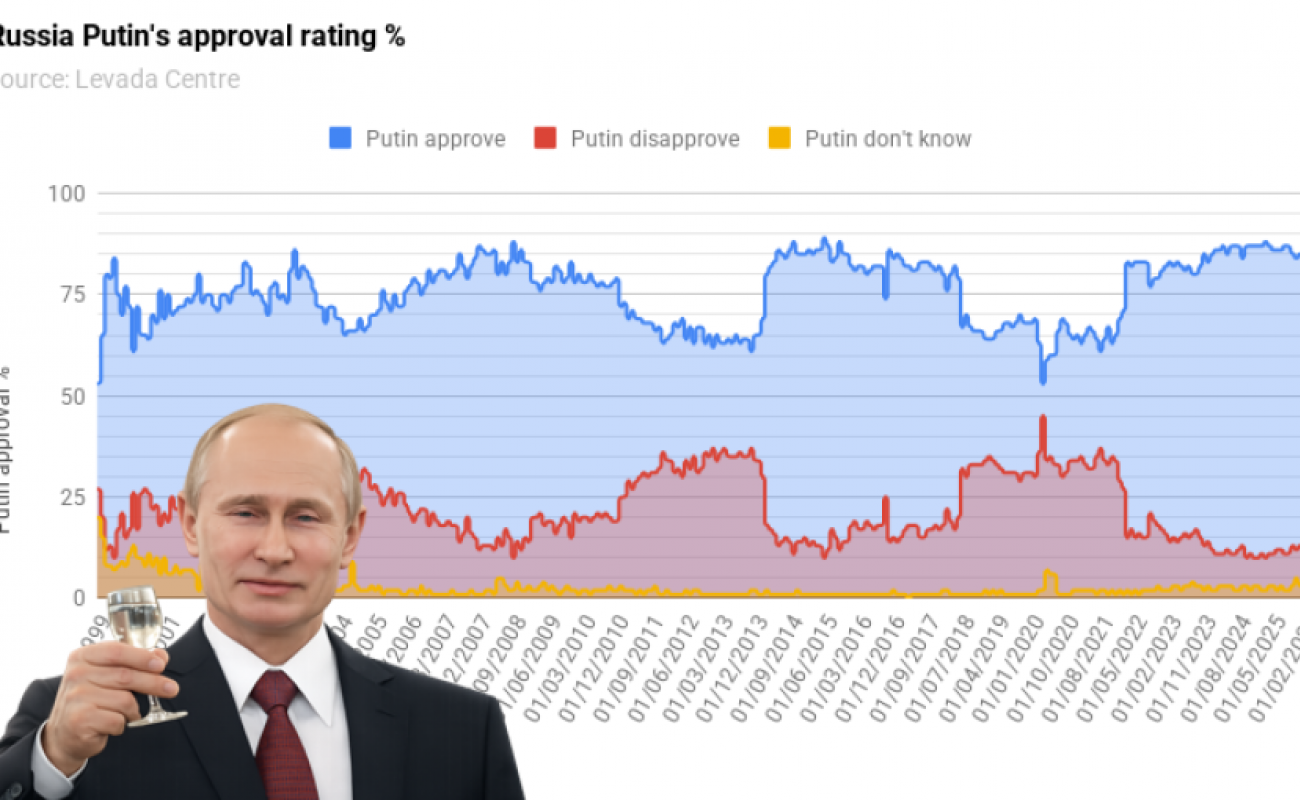
Trust in Russian President Vladimir Putin has fallen to its lowest level since before the full-scale invasion of Ukraine, as economic pressures and prolonged war fatigue weigh on public sentiment, according to new VTsIOM survey reported by Bloomberg on March 27.
Putin’s popularity has also dipped in the last Levada Centre poll to 82%, down from a Ukraine war high of 85%-88% where it hovered for most of 2025.
The polls highlight the swings in the progress in the war. 2025 was a good year for the Armed Forces of Russia (AFR), which made considerable progress on the battlefield and retook the captured territory in the Kursk region. However, a slowdown in Russia’s advances, and a limited reversal in the last month, was matched by increasing budget pressures that mean the effects of the war are finally starting to feed through and affect the general population, leading to a weaking of sentiment since the start of this year.
The share of respondents in the VTsIOM poll saying they trust Putin declined to 75%, down from 76.7%, based on figures from state-run pollster VTsIOM. Approval of his job performance slipped to 70.1%, a fall of 1.9 points from the previous week. Both indicators mark their weakest levels since February 20, 2022, just days before Russia launched its invasion.
Negative sentiment has also edged higher. Around 20.1% of respondents said they explicitly distrust Putin, while 18.3% disapprove of his performance — the highest levels recorded since the conflict began.
The findings, based on surveys conducted between March 19 and 22, signal a gradual shift in public attitudes as the war enters its fifth year and economic conditions tighten. A separate poll by the independent Levada Center, published on March 3, found that 67% of respondents favour moving towards peace negotiations.
“Public fatigue is the reason for the ratings stagnation,” said Andrei Kolesnikov, a Moscow-based political analyst. “At the practical level, everyone is simply surviving,” he said, adding that widespread internet outages have added to the discontent.
The Kremlin has sought to contain a widening budget deficit driven by sustained military spending, including raising value-added tax at the start of the year. The move has compounded pressure on households and businesses already facing high borrowing costs introduced to curb inflation, contributing to a slowdown in economic activity.
Efforts to reach a diplomatic settlement have made little progress. US-brokered talks aimed at ending the conflict have stalled, while fighting along much of the front line has settled into a pattern dominated by drone warfare, limiting the ability of conventional forces to secure territorial gains.
While President Vladimir Putin’s approval rating has remained comparatively resilient, the broader set of indicators points to a parallel, if more gradual, softening in public sentiment toward state institutions and the country’s overall direction.
Across government, the prime minister, the State Duma and regional governors, approval levels generally held steady or peaked in the first half of 2025 before trending downward into early 2026, accompanied by rising disapproval and, in some cases, growing uncertainty, as the Russian advances on the Ukrainian battlefield slowed down and reserved to some extent in March.
At the same time, growing budget deficit pressure has led to cuts that have also pressed sentiment. However, the Kremlin might be in for some luck thanks to the Iran war.
The Ministry of Finance (MinFin) is abandoning plans for a sharp downgrade to its 2026 growth forecast and 10% of cuts to spending this year, due to an expectation of boosted oil revenue thanks to energy market instability.
As military spending remains sacrosanct, most of the spending cuts have come from the social sphere and military spending has already overtaken social spending for the first time since the war started four years ago. This year MinFin was intending to cut social spending further but those cuts are likely to be suspended. Russian President Vladimir Putin has been careful to shelter the population from the effects of the war but now will probably have the opportunity to direct a little more spending to the social sphere and improve the government’s ratings as a result.
The economy shrank by an estimated 2.6% in the first quarter, according to preliminary estimates, but now is expected to put in at least 1.3% of growth in 2026, according to MinFin estimates. That marks a sharp reversal in sentiment from just a month ago, when the government was weighing a downgrade to about 0.7% to 1% in its growth forecast.
An increase in Russia’s average Urals price to $75–$80 per barrel or higher this year from the baseline assumption of $59 in the budget, would bring an additional RUB3–4 trillion ($37-$49 billion) in oil and gas revenue – almost enough to completely cover the projected budget deficit for this year -- helping reduce the forecast deficit to 1% of GDP, less than the 3-4% of GDP economist were expecting only three weeks ago.
Russia is going in the “right” direction
According to Levada, the share of respondents saying Russia is moving in the “right direction” remained dominant over the last year, but showed a gradual downward trend. It rose from 71% on January 1, 2025 to a peak of 74% in March, before fluctuating around the high 60s during the summer months. Over the same period, those saying the country was on the “wrong direction” held relatively steady at around 16–18%, while the proportion of undecided respondents remained elevated in the low-to-mid teens.
From the autumn onwards, sentiment became more negative. The share viewing the country as moving in the right direction declined from 70% in September to 61% by March 1, 2026, while those saying it was on the wrong path rose to 26%. The proportion of respondents unsure remained broadly stable at around 13–15%, indicating that the shift was driven primarily by a movement from positive to negative assessments rather than increasing uncertainty.
Government approval remains strong
Government approval remained relatively strong through the first half of the period, rising from 71% on January 1, 2025 to a peak of 76% on May 1 before fluctuating in the mid-70s over the summer months. Disapproval tracked in the low 20s during this phase, indicating a stable margin of net support, while the share of respondents unsure remained consistently low at around 4–5%.
From the autumn onwards, however, the data shows a gradual erosion in support. Approval fell from 74% on September 1 to 64% by March 1, 2026, while disapproval increased from 21% to 29% over the same period. The proportion of undecided respondents also edged higher, reaching 8% at the end of the series, suggesting a modest but broad-based softening in public confidence.