
Russia is losing influence in Azerbaijan. How Baku Is rewriting the rules with Moscow
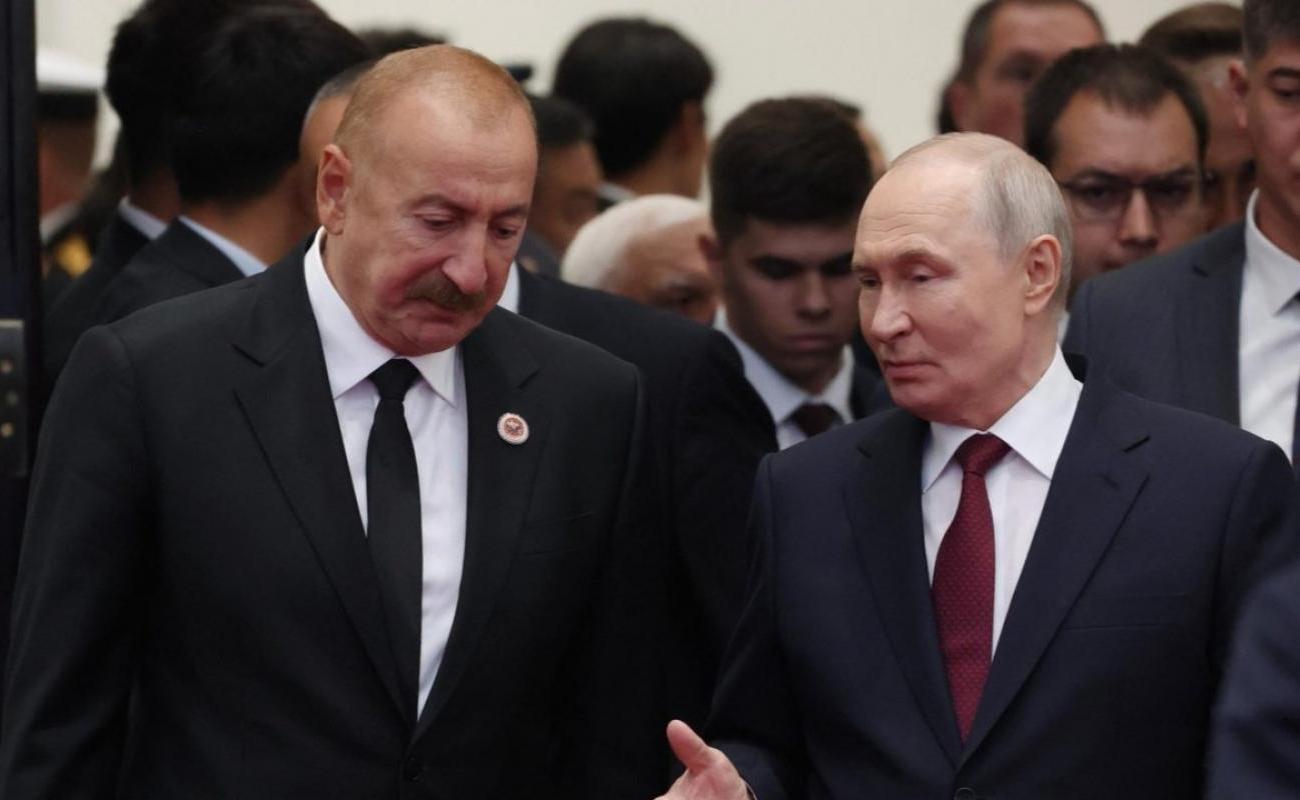
The partial reset that followed the 2024 downing of an Azerbaijani airliner never restored political trust between Baku and Moscow, writes Serhiy Danylov.
Serhiy Danylov is deputy director of the Center for Middle Eastern Studies
Relations between Baku and Moscow have been deteriorating for some time. The latest episode was Azerbaijan’s decision to put three Russian propagandists on an international wanted list. The partial reset that followed the 2024 downing of an Azerbaijani airliner never restored political trust.
On 18 August, Azerbaijan’s Prosecutor General’s Office issued international arrest warrants for Semen Uralov, Ivan Knyazev and Aleksei Chadayev. Baku says their broadcasts contained calls for the violent overthrow of the government, attacks on the country’s territorial integrity and physical reprisals against its leaders. Russia’s ambassador was summoned. Moscow distanced itself from the comments and said the men did not speak for the state. That explanation carries little weight in Baku.
How the crisis built
Azerbaijan does not treat this as a quarrel over a few television appearances. The roots go deeper.
Early in 2025 Baku demanded the closure of the “Russian House.” Later that year Russian security services took a hard line against Azerbaijanis in Russia, and Azerbaijan cancelled Russian cultural events. For Baku, the dispute moved from diplomacy into domestic security.
The turning point was the Azerbaijan Airlines crash of 25 December 2024. An Embraer E190 on the Baku–Grozny route was hit by a Russian Pantsir-S1 missile as it approached Grozny. Damaged, it drifted across the Caspian and crashed near Aktau in Kazakhstan. Of 67 people on board, 38 died and 29 were injured.
Russia first denied any role and only later, under sustained Azerbaijani pressure, offered a partial admission. For President Ilham Aliyev the issue was accountability: recognition of fault, punishment of those responsible, and compensation. Moscow’s behaviour was read in Baku as proof that Russia still expected a special, unaccountable relationship with former Soviet states.
Events in 2025 reinforced that reading.
The Kremlin is uneasy because its leverage is shrinking
Azerbaijani analysts link the tension to Russia’s fading position in the South Caucasus. In their view, Moscow now leans on information campaigns, the diaspora and economic pressure because its old political tools no longer work as they did. Official Baku is more cautious, but the assessment is similar.
Azerbaijan does not claim that every anti-Azerbaijani campaign is ordered from the Kremlin. It no longer accepts, however, that state media, officials and state-linked commentators are merely private voices. The line between official and unofficial Russian discourse looks far less sharp in Baku than the Russian Foreign Ministry pretends.
So Azerbaijan is setting its own rules. Threats against the leadership, territorial integrity or interference in domestic politics are treated as national-security matters. That is why the response to the three propagandists was so sharp. Until 18 August, no other post-Soviet state except Ukraine had opened criminal cases against Russian propagandists and put them on an international wanted list.
The strain is not only about information policy. Russia’s place in the region has changed.
Until 2020 Moscow was the main external mediator in the Karabakh conflict. Its military presence in Armenia, its ties with Azerbaijan and its role in talks gave it influence over both sides. After the 2020 war that system began to break down. After Azerbaijan regained full control of Karabakh in 2023, the Russian peacekeeping mission lost its purpose.
The Armenia-Azerbaijan peace process further reduces Moscow’s room for manoeuvre. Azerbaijani experts, among them Farhad Mammadov, stress that Baku is not trying to drive Russia out of Armenia. Normalisation with Armenia and the prospect of open Turkish-Armenian borders themselves loosen Yerevan’s dependence on Moscow – a dependence that rested heavily on the unresolved conflict and the closed Turkish border. As those constraints ease, Armenia gains options in trade, transit and security.
After 2020 Azerbaijan gained far more diplomatic space. The military outcome changed the balance with Armenia. Energy ties with Europe remain a major asset. Trans-Caspian routes have raised Azerbaijan’s value to Central Asia, Turkey and the EU. Relations with China have grown in importance.
Baku tries to keep working relations with several power centres and to avoid dependence on any one of them. “Middle power” status matters: after the recapture of Karabakh it allows Azerbaijan to present itself as a state that can act independently in the South Caucasus.
There are limits. Turkey remains the main security pillar. The 2021 Shusha Declaration made the relationship an alliance, with consultations and mutual assistance if either country’s security or territorial integrity is threatened. The Turkish alliance provides the security floor; ties with the EU, Central Asia, China, the United States and Russia supply room for political and economic manoeuvre.
A full rupture serves neither side
Russia still matters in this system, but it no longer occupies a privileged place.
Azerbaijani commentators say the hard line on the propagandists is meant to show Moscow that pressure no longer works. If there is no response, Moscow treats silence as a concession – and a concession under pressure invites the next episode.
The strategy has risks. Russia can still make life difficult for Azerbaijani business, labour migrants and diaspora organisations. Trade and transport links remain substantial. Geography is unchanged: Russia is one of Azerbaijan’s two large neighbours, with Iran to the south.
A complete break is therefore not in Baku’s interest. Moscow has reasons to avoid it as well. Open confrontation would strengthen Turkey, speed Azerbaijan’s military and political alignment with other partners, and further shrink Russian influence in the Caucasus.
The most likely outcome is a long stretch of unstable but still functional relations. Economic contacts will continue. The two presidents will still be able to deal directly. Individual crises may end in partial resets.
A return to the trust that existed before the air disaster looks unlikely.
The current clash also points to a wider problem for Russian policy in the South Caucasus. Moscow now faces a region in which neighbours have more alternatives. Turkey is a stronger player. Central Asia is reaching the Caucasus more actively across the Caspian. European interest in energy and transit remains high. The United States is again present in regional diplomacy.
Azerbaijan is using that opening more assertively than most. Its policy does not aim at a rupture with Russia. Baku wants to keep the relationship – but it no longer accepts that Moscow should set the limits of its foreign policy.
That change, not the latest row over propagandists, will shape Russian–Azerbaijani relations in the years ahead.