
"Roadmap" to the abyss: how the Kremlin is absorbing Belarus
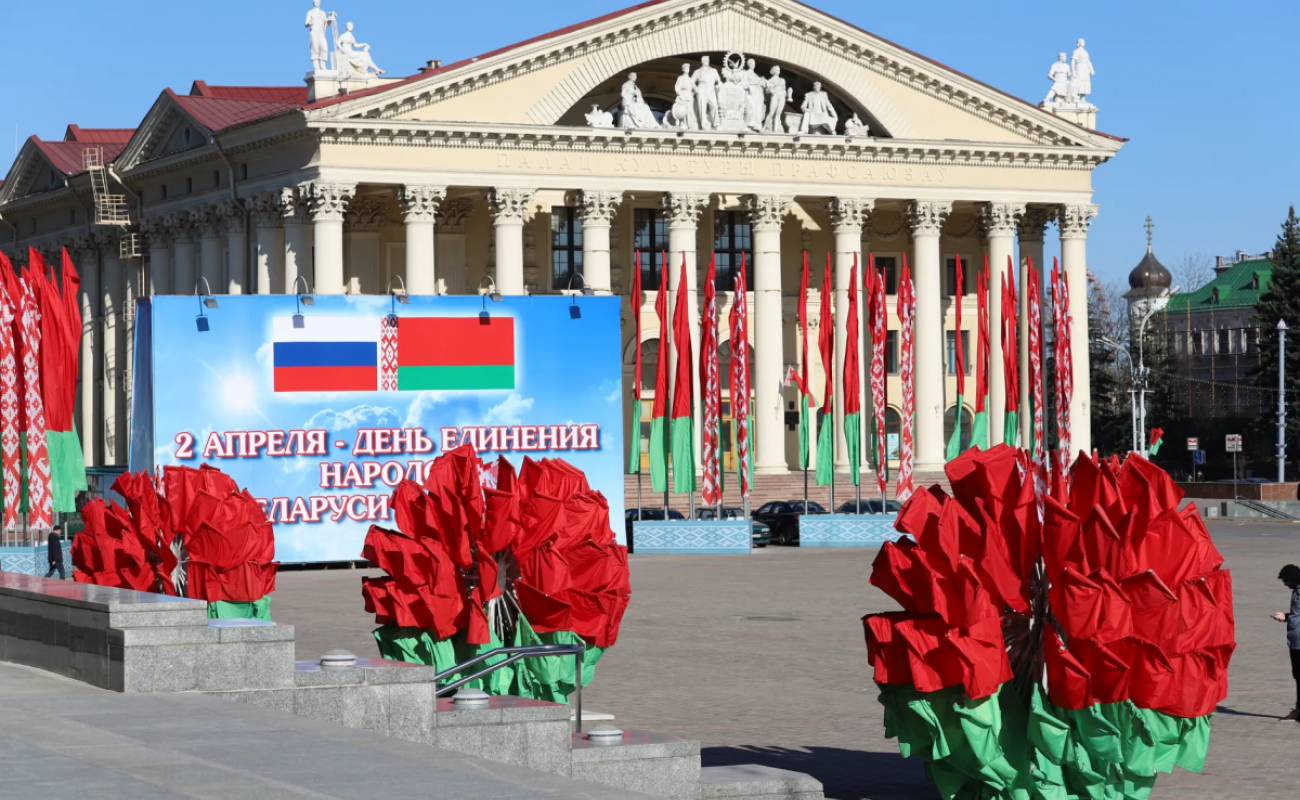
Russia is systematically implementing a plan to fully absorb Belarus, and after 2020, this process has accelerated especially rapidly. Officially, this is called integration and is outlined in dozens of agreed-upon "roadmaps" of the Union State. However, Moscow's true intentions are more radical. This is evidenced by internal documents leaked by the Kremlin (known since 2020), which detail the step-by-step elimination of sovereignty. The final deadline for these plans is increasingly being cited as 2030. So what is the reality of the Kremlin's plans? What does the roadmap for absorbing Belarus look like?
The 2030 deadline for a complete takeover began to be actively discussed shortly after August 2020, when protests were still raging in the streets of Belarus. The Kremlin realized the situation was unstable and took action.
A striking example of how Russia was making plans for an active entry into Belarusian politics is the leaked documents from the Russian Presidential Directorate for Interregional Relations, led by SVR General Vladimir Chernov (one of them is dated September 2020).
Chernov's document outlined the creation of an infrastructure for influencing any scenario in Belarus (remember, protests were still ongoing at that time).
One of them is the creation of pocket political forces. At the time, the Kremlin planned to create a party with the working title "People's Right," which would criticize Lukashenka but advocate for deep integration with the Russian Federation. The goal was to channel the protests into constitutional reforms and facilitate the transition to a parliamentary-presidential republic.
Even though the party was never officially established, the constitutional reform in the country was successfully completed in February 2022. The Basic Law did not stipulate any expansion of the influence of political parties. Moreover, after some time, Lukashenka, clearly aware of the Kremlin's plans, completely purged the party field, leaving only four pro-government parties. However, at the same time, the new Constitution included several provisions that Moscow later exploited: for example, the repeal of Belarus's non-nuclear status, which it now uses to threaten European countries with nuclear weapons from Belarusian territory.
The second point of the scenario in the documents outlined the need to create a national information infrastructure: a media network, Telegram, and YouTube channels to maintain influence no matter what happens. The creation of national public organizations and a network of local opinion leaders was also envisaged.
It should be noted that after the 2020 elections, this process accelerated rapidly: as early as August of that year, Alyaksandr Lukashenka invited Russian propagandists to replace Belarusian journalists protesting against the violence. From then on, the fusion of Belarusian and Russian propaganda only intensified: propagandists like Ryhor Azaronak, Vadzim Hihin, and Alyaksandr Shpakouski promoted narratives that differed little from their Russian counterparts.
Regarding agents of influence, Belarusian society quickly became familiar with the activities of such odious figures as Volha Bondarava, Elvira Mirsalimava, and others, who for several years destroyed everything associated with Belarusian identity, promoting the Russian agenda.
Absorption strategy: the Kremlin and the "Belarusian question" by 2030
Another document, prepared by the Russian presidential administration in 2021, defined the main goal as the creation of a full-fledged Union State by 2030 through gradual control over Belarus's politics, defense, and humanitarian spheres.
At that time, the plan envisioned the formation of pro-Russian groups within the political elite, the completion of constitutional reform on Moscow's terms, and the limitation of the influence of nationally oriented forces. In the military sphere, the priorities were the indefinite presence of Russian troops, regular joint exercises, and the creation of a unified system of command and control of the armed forces.
The Kremlin considers any rapprochement between Minsk and NATO or regime destabilization under Western pressure to be the main threat, as mentioned in the document. It's not surprising that in February 2026, the Russian Foreign Intelligence Service began to threaten Minsk with the idea that several Western organizations—the US, UK, Germany, Poland, and other countries—were gathering resources for a "color revolution" in 2030 to weaken cooperation between Minsk and Moscow within the Union State.
Kremlin strategists identified economic integration as an important factor, which was to be built around the "four freedoms" (the movement of goods, services, capital, and labor) with the introduction of a single currency and a common securities market by 2030. The strategy included the complete unification of tax and customs legislation, as well as the unification of energy and transportation systems.
Moscow set the goal of redirecting all Belarusian exports from Baltic and Polish ports to Russian infrastructure and ensuring the integration of the Belarusian Nuclear Power Plant into the national energy grid. The potential increase in Belarus's trade with the EU and the US, as well as discrimination against Russian producers in the Belarusian market, were cited as risks to this plan.
Humanitarian track
According to the document, humanitarian expansion envisioned the promotion of the Russian language through the creation of special classrooms, the unification of educational standards through the introduction of the Unified State Exam, and the large-scale opening of branches of Russian universities. The plan included simplified passport registration for Belarusians, an expanded presence of Russian media, and the formation of a loyal scientific and expert community.
The Kremlin viewed any steps toward Belarusification or the transition to the national language in education as a critical threat that must be neutralized by increasing the number of Russian cultural and educational projects in Belarus. The "Russian Houses" popping up in various regions of the country (there are currently five: in Minsk, Hrodna, Homiel, and Brest) indicate that cultural expansion is accelerating.
As can be seen, as of 2026, Moscow has successfully implemented most of the plan's provisions, particularly in the military-political area. After 2022, the Russian military presence became permanent; moreover, Belarusian territory was used to attack neighboring Ukraine.
The unification of customs legislation was completed, and Belarusian export logistics were almost completely closed to Russia. In the humanitarian sphere, a systematic purge of national education and cultural initiatives is observed, which coincides with the Kremlin's plan to combat the "destructive influence" of the West and Belarusization.
However, the complete surrender of sovereignty has not yet been completed in the financial sector: the issue of a single currency and emission center remains frozen due to Minsk's official reluctance to lose its last levers of economic control. The question of a unified legal system also remains open – although legislation is being intensively synchronized, Belarus formally retains its status as an independent subject of international law.
True, there's still time before 2030, the designated milestone, especially since the last meeting of the Supreme State Council of the Union State, which took place in February, according to Lukashenka, "set the vector for a new stage of integration development in all areas." Lukashenka instructed that the main guidelines for the treaty establishing the Union State for the next three-year cycle (2027–2029) be prepared—so, it seems, the process is underway.
What about the "roadmaps"?
Against the backdrop of classified documents, official integration is presented primarily as economic cooperation.
At the same time, political scientist, associate professor, and PhD candidate in history, Roza Turarbekava, notes a radical acceleration and concealment of the processes of rapprochement between Belarus and Russia. F in 2024–2026. She notes a shift from economic "roadmaps" to military-political absorption and the implementation of common ideological narratives, which effectively deprives the country of sovereignty.
A characteristic feature of the new stage of integration has become absolute opacity: programs are no longer published, and agreements are amended after they are signed. Package deals such as "oil for taxes" pose a particular threat, allowing Russian entities to monopolize the Belarusian energy market and the financial and banking sector.
Turabekava notes that the processes are most intensive in areas of interest to the Russian military-industrial complex—microelectronics, aircraft manufacturing, and nuclear research. At the same time, the Union State is barely addressing the social and labor issues of society (the issue of common roaming within the union, which is being resolved very slowly, is worth mentioning).
Roza Turabekava warns of a critical threat to Belarusian self-identity due to Russia's large-scale absorption of the humanitarian sphere. While the first stage of integration (2021–2023) focused primarily on the economy, in the second (2024–2026), Moscow has moved toward unifying legal, scientific, and cultural spaces, as well as a joint ideological and historical policy. The expert believes that this expansion into public consciousness is preparation for the third stage (2027–2029), which will likely be aimed at the final political integration of the two countries. As can be seen, the final point could be 2030.
The final decision is Putin's
According to Grigory Nizhnikov, a researcher at the Finnish Institute of International Affairs, the 2030 target should not be seen as a final plan. He argues that internal documents with specific dates are often the product of competition among Russian agencies, while the real decision will still be made spontaneously by Putin, based on the outcome of the war.
"If we're discussing this specific date, 2030, I would be more skeptical. After all, in Russia, there are various agencies and state institutions that are also competing with each other, which also have a Belarusian portfolio and which develop these analytical papers, which are then sent to the top. And we're not saying they end up on Putin's desk, but nevertheless, it's part of the bureaucratic process," the expert explains in a conversation with Belsat.
At the same time, Nizhnikov points out that the actual absorption of Belarus is proceeding faster than the plans stipulate.
,,Today, the process of absorbing Belarus in practice is proceeding faster than they are writing it down on paper. The process has gone much further than these papers discuss... Russia controls part of the Belarusian security forces, the Belarusian economy, the Belarusian army, and writes textbooks for Belarusian schools... And the main thing is that Lukashenko can't do anything about it; he understands that he won't be allowed to do anything," notes Grigory Nizhnikov.
The expert emphasizes that, unlike in 2019, political resistance to integration from official Minsk is minimal today, and the process has entered a technical phase.
"Things have gone so far that the very meaning of these bureaucratic [roadmaps] has become technical, not political. And that's why both Putin and Lukashenka have essentially lost much interest in these maps," the source says.
Belarusian identity is next
According to Grigory Nizhnikov, Russia's main attack is now aimed at destroying Belarusian identity. After the experience of the war in Ukraine, the Kremlin has understood the importance of identity and is relying on humanitarian aggression (education, culture) to ensure that no one will resist the occupation.
"They realized how important it is to remove all this Belarusianness, so that when the time comes to occupy Belarus, there will be no Belarusianness left, so that they can tell Belarusians or those who want to be Belarusians, 'Go to Poland.' And so that normal Russians live here [in the country], like in Tatarstan, so that they don't think they're some kind of Tatars there, but [think] that they are first and foremost Russians," the expert explains.
At the same time, Grigory Nizhnikov still has a positive outlook on the future: despite the pressure, Belarusians remain European in their values and preserve their identity, which creates the foundation for democratic change after Lukashenka's departure.
Nizhnikov emphasizes that responsibility for the future lies with Belarusians in exile, since within the country, opportunities for resistance are minimal, so it is the diaspora and international partners who must actively work on this.
"The great responsibility now lies not with Belarusians within the country, but with those Belarusians who have left the country, who live in free societies and who have the opportunity and resources to fight. And the West bears a great responsibility, as it also has the resources and the opportunity to combat Russian and Lukashenko-backed propaganda, to seek ways to help Belarusians who find themselves between a rock and a hard place: between Lukashenko and Putin's war... An alliance with Russia is a path to the abyss, because Belarus will never have a future with Russia. With Russia, they could become yet another nation that falls victim to the Russian Empire. That's all," says Grigory Nizhnikov.