
Putin’s Financial Pact: From Business Elites to Ordinary Russians
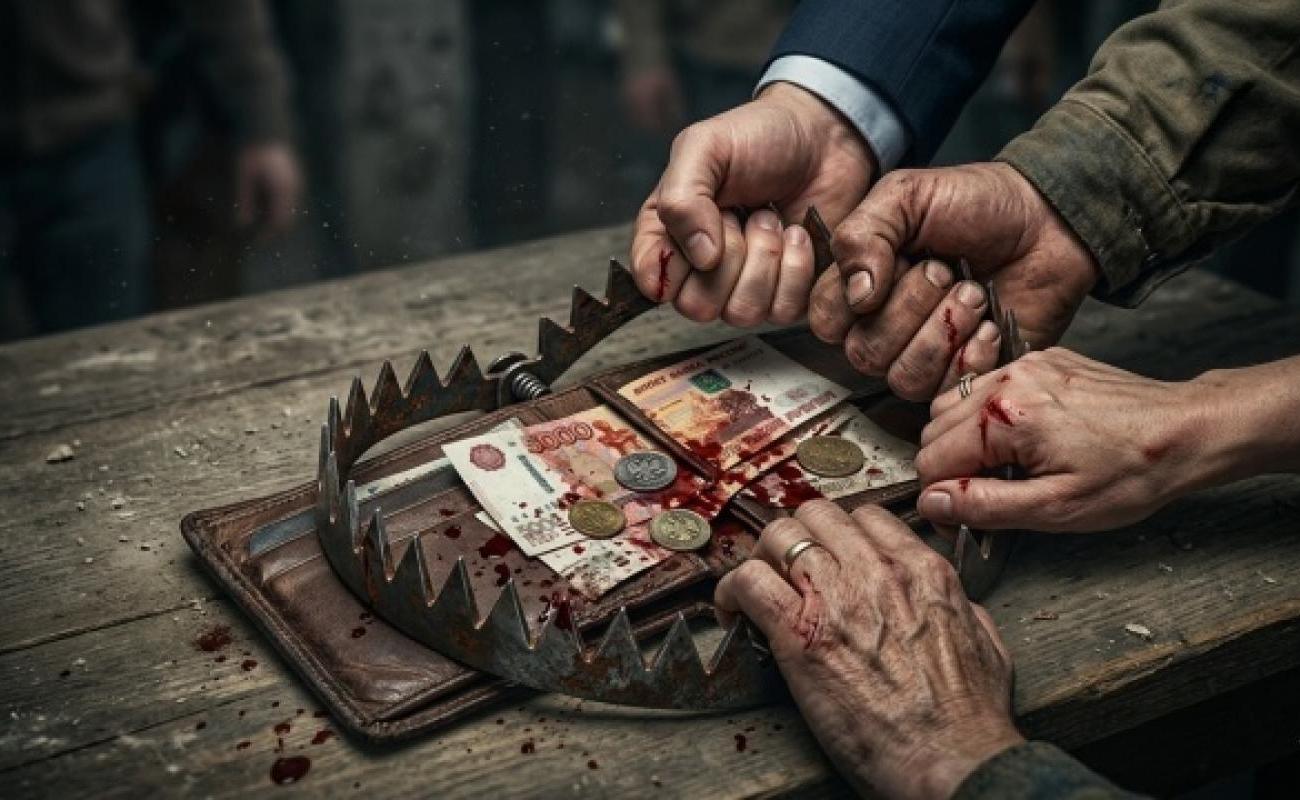
Last week, Russian President Vladimir Putin convened his annual meeting with representatives of major domestic businesses. While such gatherings are typically procedural, this year’s meeting signaled a notable shift: leading business figures were effectively encouraged to make financial contributions to Russia’s war effort in Ukraine.
The Kremlin framed the initiative as voluntary. Presidential spokesperson Dmitry Peskov stated that one participant had independently proposed allocating a substantial sum to the state, describing it as a personal decision subsequently endorsed by Putin. According to Peskov, the justification was that many Russian billionaires accumulated their wealth in the 1990s in close interaction with the state, and therefore now feel a sense of obligation to provide support.
However, reporting by The Bell and the Financial Times points to a more structured dynamic. Both outlets identified businessman Suleiman Kerimov as the individual in question, noting that he reportedly expressed readiness to contribute approximately 100 billion rubles within this “voluntary” framework.
Whether this specific account is entirely accurate is ultimately secondary. More important is the broader trajectory: the deepening integration of large private capital into the state’s wartime financing model. This development reflects a longer-term trend in Russia, where the relationship between the state and major business has evolved from conditional autonomy to increasingly enforced alignment.
The financial capacity for such mobilization remains considerable. According to Forbes, as of March 2026 Russia counts a record 155 dollar billionaires (nine more than the previous year), with combined wealth estimated at $696.5 billion. This concentration of capital constitutes a substantial reservoir for potential extraction, whether formal or informal.
At the same time, the limits of business autonomy are well established by precedent. High-profile cases—including Mikhail Khodorkovsky, whose company Yukos was dismantled and who was imprisoned, and Oleg Tinkov, who exited his banking business after publicly criticizing the war—continue to shape elite behavior. Similarly, the 2014 house arrest of Vladimir Yevtushenkov, owner of AFK Sistema, underscored the risks associated with perceived political non-alignment, despite his subsequent exoneration.
Taken together, these dynamics suggest that the Kremlin is moving beyond expectations of political loyalty toward more direct forms of financial participation from business elites. The emerging model implies not only alignment with state policy, but also tangible contributions to sustaining it.
Over time, the Kremlin has methodically transformed large private capital into a functional extension of state policy, including in the context of the war. Passive loyalty from business elites is no longer sufficient; what is increasingly required is demonstrable participation, including financial contributions to the so-called “special military operation.”
For many individuals on Russia’s Forbes list, this threshold has effectively already been crossed. The breadth of Western personal sanctions reflects the extent to which leading business figures are perceived as linked to the state’s actions. In this context, the Kremlin’s current objective appears to be not merely securing compliance, but making such alignment structurally irreversible.
Accordingly, calls for “voluntary” contributions from major businesses should be understood less as requests than as signals within a highly managed system. The sequence is relatively consistent: expectations are articulated at the top level, followed by visible expressions of compliance from prominent figures—such as Suleiman Kerimov—after which additional names circulate in the public domain, reinforcing the perception of broad-based elite support.
This mechanism serves a dual purpose. First, it creates the appearance that the business community has already internalized and endorsed the state’s financial demands. Second, it narrows the scope for future disengagement by tying business actors more directly to the financing of state policy, including the war effort.
The logic of this system resembles a form of enforced collective responsibility. Its dynamics were particularly visible during the Russian Security Council meeting on February 21, 2022, where senior officials—including Foreign Intelligence Service head Sergei Naryshkin—were publicly required to articulate their positions on the recognition of separatist territories, effectively committing themselves to the course of action that preceded the full-scale invasion of Ukraine days later.
In this sense, the current engagement of business elites can be seen as an extension of the same governance model: explicit alignment followed by implicit obligation.
A similar logic of enforced collective alignment is now being extended to large business. Unlike senior state officials—who publicly demonstrated loyalty in highly choreographed settings—business elites operate under more implicit constraints, with limited space for dissent. Privately, however, questions persist regarding the strategic rationale of the war effort, particularly in relation to the long-term economic value of territories such as Donbas, where much of the industrial base has been severely degraded.
There is also an important macroeconomic dimension. The Kremlin appears increasingly skeptical of relying on energy revenues as a stabilizing factor and is signaling to major businesses the need to allocate resources more selectively. This includes, for example, investments in protective infrastructure such as air defense systems around key industrial assets. Such measures are framed within the language of “patriotism” and the preservation of industrial capacity for future generations.
Extending the model to the broader population
At the same time, the state’s approach is not limited to large capital. Since early 2023, authorities have experimented with mechanisms aimed at mobilizing financial resources from the general population. One such initiative was the proposal to issue “patriotic” bonds to support the federal budget amid rising wartime expenditures. While presented as a tool to strengthen “financial sovereignty,” uptake among the population remained limited, reflecting low levels of trust shaped by historical experience.
By 2026, the emphasis has shifted toward more direct and administratively driven methods. Reports from multiple regions indicate that public-sector employees—including healthcare workers and local government staff—are being encouraged, and in some cases pressured, to contribute a portion of their salaries to support the war effort. Although formally described as voluntary, these practices often operate within hierarchical workplace structures that constrain genuine choice.
Regional adaptations of this model are also emerging. In Buryatia, for instance, earlier one-off fundraising campaigns—such as requests for one-day salary contributions—have been replaced with regularized monthly deductions set at a fixed share of the minimum wage. Local authorities have justified this shift as a means of making contributions more “systematic and predictable,” effectively institutionalizing the process.
At the beginning of last month, social media reports pointed to coordinated fundraising practices across multiple regions—from medical personnel in St. Petersburg to employees of defense enterprises in the Chelyabinsk and Tyumen regions, as well as public-sector workers in the Kurgan region. By March, similar signals were emerging simultaneously from several parts of the country, with public employees reportedly asked to sign forms authorizing the “voluntary” transfer of a day’s wages.
Taken together, these developments suggest increasing fiscal pressure on the Russian state. The cumulative impact of sanctions, alongside sustained and elevated spending on the defense-industrial base, appears to be placing growing strain on public finances. At the same time, industrial expansion remains concentrated in defense production, particularly munitions, while other sectors show more limited growth.
In this context, the financial burden of sustaining the war effort is being distributed more broadly—extending beyond large business to include segments of the general population, particularly those employed in the public sector.