
Peace on the Kremlin's terms? What lies behind calls for talks with Russia?
Neutrality, the lifting of sanctions, the status of the Russian language—the "peace plan" put forward by Verkhovna Rada MP Honcharenko has divided the Ukrainian opposition and a frustrated public. Why are politicians calling for negotiations with Russia right now, and what do they hope to achieve?
On the morning of October 2, three prominent Ukrainian politicians called for finding a way to end the war through negotiations with Russia.
Ukrainian politicians' "peace plans"—who proposed what
Oleksiy Honcharenko, a Member of Parliament from the "European Solidarity" party, stated on social media: "The reality right now is this: we are losing the war; we are losing a huge number of people; we lack the funds not only to pay for the war but even to keep the country running." Honcharenko proposed talks with Moscow regarding neutrality and a decision not to join NATO, the lifting of certain sanctions, the status of the Russian language and the church in Ukraine, and the status of the Donbas.
"To die along with the entire country for the sake of joining NATO is, in my opinion, absurd," the MP remarked.
Later, in a column for *Ukrayinska Pravda*, he elaborated on the idea of "a thousand small agreements"—separate accords covering maritime security, energy, and infrastructure, alongside a gradual localization of the front to the Donbas region, backed by guarantees from third countries. On the same day, the head of the parliamentary finance committee, Danylo Hetmantsev (Servant of the People), wrote on social media that "intensifying negotiations and peace should be our top priority," and that the final terms of peace, in his view, should be approved via a referendum.
Kharkiv Mayor Ihor Terekhov spoke out against the "war party," though he emphasized that peace must be based on defense capabilities and concrete guarantees from partners.
Russian media quickly reported Honcharenko's statements, presenting them as a sign that Kyiv was allegedly beginning to accede to Moscow's demands.
On October 4, Ukrainian President Volodymyr Zelenskyy reminded everyone that unity is primarily the responsibility of the people's representatives.
"We shouldn't sow panic (...) No matter how difficult things are for us, we cannot bow to Putin and Russia, because Ukraine would be crushed," Zelensky said.
On October 5, the European Solidarity parliamentary faction expelled Honcharenko from its ranks.
"Oleksiy Honcharenko's public stances regarding the end of the war and Ukraine's future security architecture diverged from the position of European Solidarity and its ideological principles," stated the faction in a release published on the European Solidarity party's website.
The statement listed a strong military, the Ukrainian language, an independent church, and membership in the EU and NATO among the values that are non-negotiable—whether domestically or in negotiations with Russia. At the same time, the party acknowledged that compromises could play a role in ending the war.
Another MP from the European Solidarity faction, Volodymyr Viatrovych, responded to Honcharenko's column with a Facebook post titled "The Chamberlain Complex."
"The problem with such texts isn't even the specific unacceptable proposals—of which there are many. The problem lies in promoting a dangerous illusion: that it is possible to reach an agreement with Russia by meeting its demands," Viatrovych wrote.
Viatrovych pointed out that Chamberlain did not save Britain from war, whereas Churchill led it to victory—"a leader who did not promise an easy peace, but spoke directly of 'blood, toil, tears, and sweat'."
A "trial balloon" or preparation for elections? Oleksiy Haran, a political science professor at the Kyiv-Mohyla Academy and research fellow at the Ilko Kucheriv Democratic Initiatives Foundation, points out the differences in the statements made by the three individuals.
"Hetmantsev and Terekhov phrased things more carefully; Terekhov, in particular, was quite cautious. Honcharenko's statement, of course, is the scandalous one," he said in comments to DW.
Haran notes that Honcharenko is a former member of the Party of Regions and a "populist," and that he has expressed similar views in the past, albeit more cautiously.
"Why have such statements surfaced now? We are facing a difficult winter, people are exhausted, and everyone is talking about negotiations—both the Ukrainian authorities and US President Donald Trump," Haran explains.
In his view, politicians have decided to "get a head start" in order to reap a future electoral harvest. He does not rule out the possibility that this is a "trial balloon" launched to gauge society's reaction.
Anton Hrushetskyi, Executive Director of the Kyiv International Institute of Sociology (KIIS), also sees an electoral strategy behind these statements.
"This is more likely an attempt to capitalize on the Ukrainian electoral system, where you need only five percent of the vote to enter parliament," he explains to DW. Elections are not yet on the horizon, but the sociologist notes that the sooner peace arrives, the sooner elections will follow; some politicians fear "missing the moment" and running out of time to build political capital. The patriotic segment of the electorate already has many potential leaders, but people broken by the war—who are ready for peace at any price—lack a party of their own, and several politicians are now vying for this niche, Hrushetskyi believes.
Political scientist and head of the Center for Analysis and Strategies, Ihor Chalenko, suggests looking at the situation from a broader perspective, particularly regarding the U.S. angle. According to him, these statements by Ukrainian politicians emerged against the backdrop of preparations for a trilateral technical meeting in Abu Dhabi concerning sectoral ceasefires and updates to Trump's peace plan. Some of these politicians, Chalenko notes, maintain good contacts with the U.S. president's team, and Trump himself is interested in achieving a quick result ahead of the November 3rd congressional elections. "The entire matter is now primarily focused on organizing such a meeting in order to draw Russia into these negotiations," believes Chalenko.
At the same time, according to Chalenko, these synchronized statements resemble a coordinated campaign intended to test the public's readiness for compromise scenarios—ranging from neutrality to the status of language and the church.
What Ukrainians Really Think About Negotiations with the Russian Federation
The latest KIIS poll, conducted between September 12 and 21—that is, following the start of "Shahed" jet-powered drone attacks—does not support calls for peace at any cost. According to the survey, 75 percent of Ukrainians are open to negotiations with Russia to end the war, while 21 percent are not. However, KIIS emphasizes that the question concerned the mere fact of negotiations, not concessions. Sixty-nine percent are willing to support an immediate ceasefire along the current front line—provided that Ukraine does not legally recognize the occupied territories as Russian and continues to strengthen its military and move toward the EU and NATO. Sixty-two percent are prepared to endure the war for as long as necessary; in Kyiv, that figure is 72 percent. Additionally, 79 percent believe in a Ukrainian victory, although the share of those who *definitely* believe in it has dropped from 60 percent to 47 percent since the end of July.
"Statements by certain politicians do not reflect the public opinion of the majority of Ukrainians," notes Anton Hrushetskyi.
There is a segment of the population willing to accept capitulation: about a year ago, roughly 20 percent of respondents were prepared to approve a Russian peace plan involving troop withdrawals from the Donbas and demilitarization.
"But this is a minority," the sociologist emphasizes.
He describes the majority sentiment as pragmatic—people, he says, are open to difficult compromises, but not to capitulation. According to Hrušetac, politicians "cook in their own bubbles".
Negotiating with those who do not want to negotiate
Experts emphasize that the main flaw in Honcharenko's "peace plan" is Moscow's stance. On October 1, Vladimir Putin rejected the proposal for a mutual halt to attacks on energy infrastructure and civilian vessels, dismissing it as "meaningless." Meanwhile, Kremlin spokesman Dmitry Peskov stressed on October 2 that piecemeal agreements cannot bring peace closer, noting that agreements "can only be comprehensive." In other words, the Kremlin rejects the very logic of "small agreements" upon which Honcharenko bases his plan.
"Russia's lack of willingness is a fundamental fact," emphasizes Ihor Chalenko.
According to him, even Honcharenko admits in his column that Russia is not ready for negotiations. Chalenko considers the division into "war and peace factions" to be artificial. "There is no significant group in Ukrainian society today advocating for perpetual war. Ukraine's position will settle on the contact line and security guarantees—that is already a compromise, and there can be no further compromise," the political scientist believes.
Oleksiy Haran draws attention to the fact that Ukraine's current position already represents a painful concession.
"We are now discussing a 'frozen conflict' scenario. That means we are, in effect, already making a colossal concession," says Haran.
Most Ukrainians are prepared for this, but they are not willing to withdraw troops from the Donbas or recognize the occupied territories as Russian.
He believes that such statements are merely counterproductive. "The problem isn't with negotiations or compromises. The problem is that Putin now wants to drag us through this harsh winter to break us. And what Honcharenko and others are saying now only encourages Putin—it makes him think, 'Let me push a little harder,'" Haran emphasizes.
Betting on fatigue
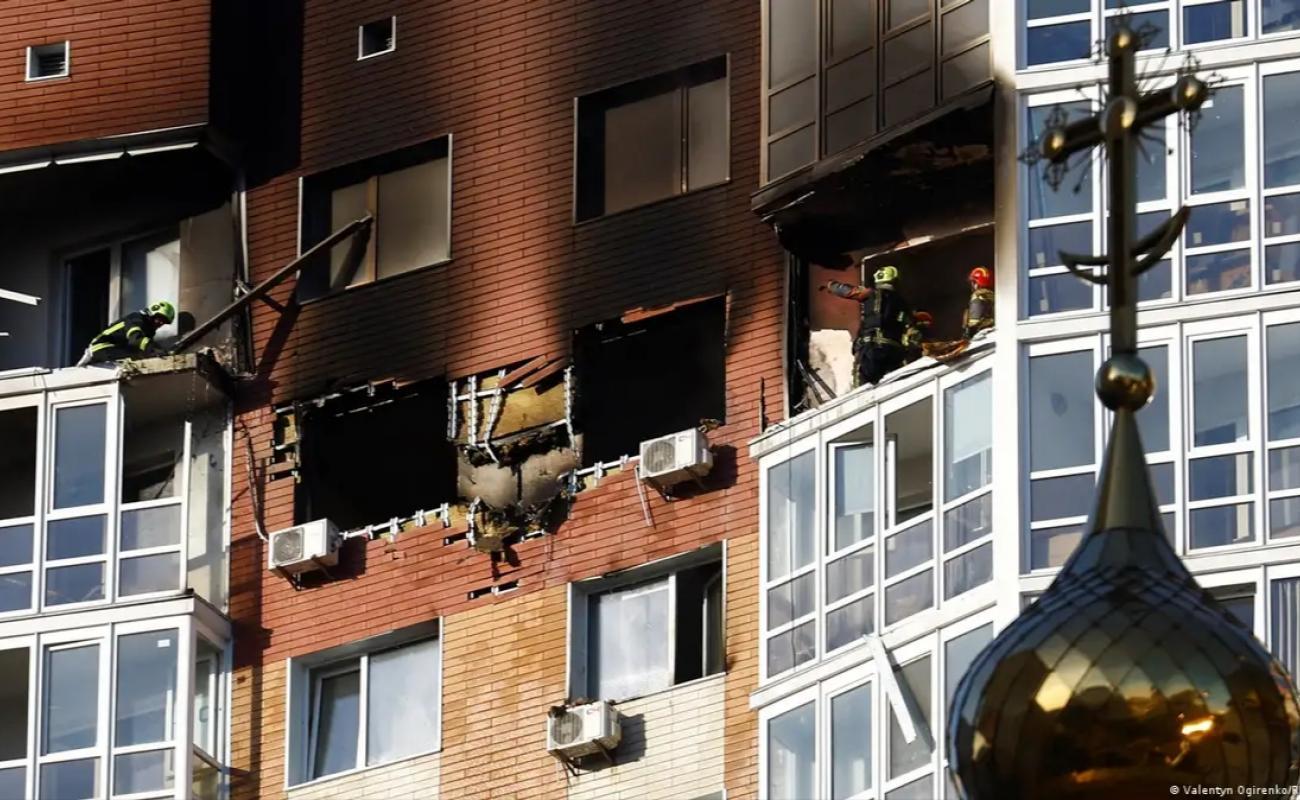
Chalenko explains Moscow's calculations simply: massive strikes on the energy sector, data centers, warehouses, and bridges in the Ukrainian capital, along with the shutdown of the metallurgical industry, are intended to expand the segment of society demanding an end to the war at any cost.
"This is an attempt to increase the number of people in society who will demand an end to the war under any conditions. Consequently, as societal resilience weakens, the aim is to use that situation to demand greater concessions from the Ukrainian authorities," he explains.
According to Chalenko, Russia postponed some attacks originally planned for winter to September and October precisely to achieve this kind of "cognitive effect."
However, according to KIIS data, this calculation is not currently playing out as expected. Anton Hrushetskyi points out that the actual sentiment among people on the street increasingly contrasts with what is seen on social media, which is rife with bots and heated emotions.
"Average citizens are much calmer, even regarding complex issues. The compromises Ukrainians are willing to make must not be one-sided concessions or anything resembling a capitulation by Ukraine. Ukrainians are choosing to continue the fight for a genuine peace," the sociologist emphasizes.