
Paying off the court
At least 8,000 Russian criminal defendants have donated to the army to get their sentences reduced. How did funding the war become a legal strategy?
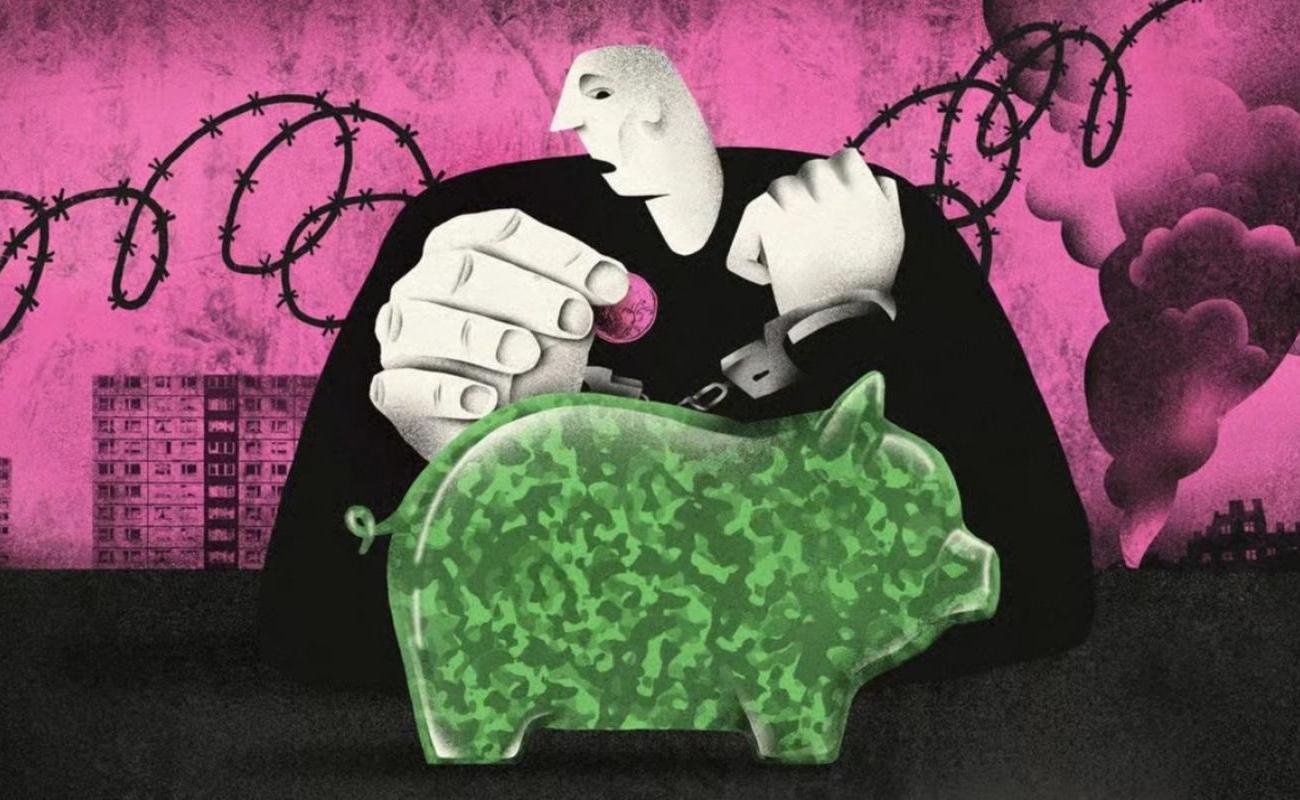
How to secure a ‘mitigating factor’
In the spring of 2019, Kostas Togas, the owner of a textile company called Togas, and his CFO signed two contracts with foreign companies for the supply of clothing and wired more than two million euros abroad as an advance payment. The goods never arrived, the money never came back to Russia, and the contract deadlines expired.
This is a standard “diversion” scheme, described in Russia's Criminal Code as “evasion of currency repatriation by a group of persons acting in prior conspiracy, on an especially large scale”. The offence carries a prison term of up to five years.
But the business partners managed to get off with a relatively modest court fine. In 2023, Moscow’s Nikulinsky District Court ruled that they had “made amends for the harm caused by the crime” after donating more than 140 million rubles (€1.5 million) to the front: 6.1 million rubles (€65,000) for body armour for the Akhmat special forces, 8.5 million rubles (€90,000) for prosthetics for the wounded, 7.7 million rubles (€81,000) for five SUVs for the 2nd Army Corps of the 8th Combined Arms Army, 99.4 million rubles (€1.1 million) for staging an award ceremony, and 20 million rubles (€212,000) to the Defenders of the Fatherland Foundation, created to support veterans of the invasion of Ukraine.
Since it first took off in 2023, the practice of donating to help the “special military operation”, as the Kremlin refers to the war, in order to secure a lighter sentence — or avoid punishment altogether — has become genuinely widespread. Novaya Gazeta Europe identified nearly 8,000 defendants who supported the front in one way or another for this purpose. Most were tried under common non-violent charges such as drunk driving, drug and weapons offences, theft, document forgery. In the first 10 months of 2025, there were already as many such cases as in all of 2024.
Judges are not obligated to treat support for the war — or charitable giving in general — as a mitigating factor, but in practice, that is exactly what happens.
“Given that acquittals are practically impossible, the defence focuses heavily on circumstances the court might recognise as mitigating. Among them is humanitarian aid, including for initiatives that help the army,” explains attorney Yevgeny Smirnov.
The practice originated from investigators and judges, and lawyers picked it up and made it commonplace.
“Sometimes an investigator says outright that if you want the mitigating factor written into the indictment, you need to transfer a certain minimum amount to a specific fund. But more often it’s hinted at, something like: ‘Haven’t you made any donations to funds for the fighters of the special military operation?’ And you can hear that not only from investigators, but from the court as well,” says Smirnov. “As a result, lawyers, studying the precedents, began offering donations to the front’s needs as one of the simplest ways to secure a mitigating circumstance.”
How defendants support the war
The simplest route to leniency from a judge is a one-time bank transfer to a fund supporting the front. Relatively few of those in Novaya Europe’s sample had already been supporting the war before facing prosecution, such as by delivering humanitarian aid, volunteering in hospitals, sewing uniforms, or weaving camouflage nets.
In 2022, a garrison court in Volgograd found a way to spare Ivan Aleksandrin, who was accused of forging a driving licence, a criminal record. The judge treated his aid to wounded servicemen as making amends for harm done to state interests. Aleksandrin ended up with a court fine instead of an actual sentence. And in 2025, a court in Pskov closed the case entirely against a defendant charged under Article 228, Alexey Mikhailov. The judge counted his trips with a humanitarian convoy to the combat zone as active repentance.
Support for the army in the media can also count as a mitigating factor. That's what a court in Kopeysk decided in the case against Timur Fatkhutdinov. At the start of the war, he published three pieces about the “special military operation” for the news agency Ural-Press-Inform. Among them was an interview headlined “I'm ready to leave for Donbas at any moment” with a regional legislative assembly deputy who also headed the local “United Russia” committee, as well as a news item about a humanitarian shipment that quoted the same deputy.
But sometimes simply expressing an intention to help the front is enough; courts counted this as a mitigating factor in 70 verdicts. Most defendants — at least 1,800 people — simply transfer money to military support funds on the advice of a lawyer or investigator. The median donation is 15,000 rubles (€160).
The effect of donations
Whether support for the invasion affects a judge's final decision depends on the specific crime and the nature of the charitable act. Since the defendant's goal is to make amends, lawyers advise clients facing drug charges to donate to anti-drug-addiction funds, and those responsible for traffic accidents to donate to funds helping crash victims. But when there's no obvious match, lawyers say orphanages and the army are the safest bets.
Since 2016, Russian law has allowed defendants to be released from criminal liability entirely — in exchange for a court-imposed fine — if they make a charitable donation. Based on an analysis of rulings issuing such fines before 2022, the main donation recipients in these cases were orphans, sick children, and kindergartens.
“There's no clear understanding of how effective charity actually is. But when a client decides to make a donation, I usually recommend spreading it across several different funds: children, restoration of cultural monuments, aid to affected residents, and so on,” says Yevgeny Smirnov. “Since there's no official list of approved funds, we usually go with whatever the client prefers. Though sometimes an investigator will hint which fund — often a local one — the donation should go to.”
There isn't enough data to assess exactly how much donations affect sentence severity. According to Smirnov, this approach can shorten a prison term by six months to a year and a half, or result in a punishment that doesn't involve incarceration at all.
Direct participation in the war, as Novaya Gazeta Europe has previously reported, also works in defendants' favour — and signing a military contract at the right moment can release someone from criminal liability altogether. In Smirnov's view, this discredits Russia's justice system: it doesn't even formally attempt to uphold the values it claims to represent.