
Le Monde: Serbia is the main center of Russian actions to destabilize Europe
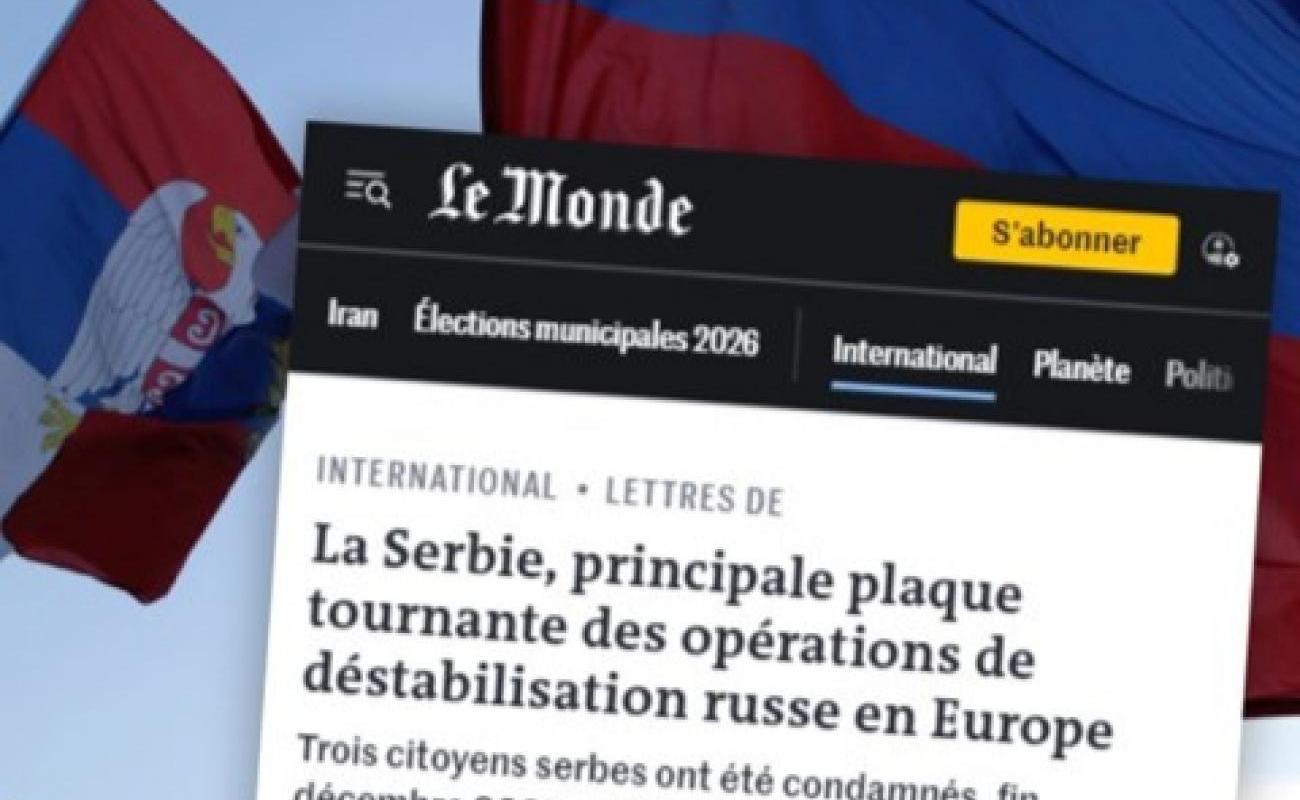
The French daily Le Monde has published an article on its website entitled "Serbia, the main hub of Russian destabilization operations in Europe". The article is written by the newspaper's Vienna correspondent Jean-Baptiste Chastand.
The first example they use to support this claim is the case of three Serbian citizens who were convicted in Serbia of espionage and racial discrimination for placing pig heads in front of nine mosques in the Paris region in September 2025.
The verdict, handed down in secret at the end of December as part of a plea bargain, was revealed on March 6 and was first reported by Radio Free Europe, while Le Monde also had access to it. Index reported on the case a week ago.
Details of the verdict and perpetrators
The Higher Court in Smederevo convicted three men of throwing green paint at the Holocaust Memorial and three Paris synagogues in May 2025. Both actions had a strong impact and caused a wave of indignation in France, and French services later attributed them to Russia.
The verdict confirms that the group "received orders and financial resources from the intelligence structures of the Russian Federation".
They were recruited and sent to France for several thousand euros by a man referred to in the verdict as "Hunter", whom Mediapart revealed to be Serbian Aleksandar Savić. While Savić's fate remains unknown, his recruits were sentenced to six to eighteen months of house arrest with electronic monitoring. Eight other people are under investigation.
Other destabilizing actions
According to the court, the group also organized other actions that went largely unnoticed. In April 2025, they put up "600 to 700 stickers" calling for the commemoration of the Armenian genocide near the Arc de Triomphe and in the 18th arrondissement of Paris.
In July of the same year, they placed plastic skeletons in front of the Brandenburg Gate in Berlin.
The messages in German, which mentioned Chancellor Friedrich Merz, read: "I'm still waiting for my retirement. Thank you, Merz". The Serbian judiciary concluded that "the group's goal was to carry out actions of political destabilization and incite religious and ethnic hatred in France and Germany".
Serbia as a training ground for Russian operations
Le Monde states that the use of susceptible and often untrained individuals for destabilization operations in Europe has been well documented since the beginning of the war in Ukraine, and that Serbia has become the main center of such Russian actions during 2025.
In September, Moldovan police arrested more than 70 Moldovans and Romanians on suspicion of training on Serbian territory to prepare for riots ahead of parliamentary elections, which ended up being peacefully won by pro-European parties.
According to the Serbian police, that group numbered more than 150 people who had been training for weeks in a camp near a restaurant along the river that forms the border between Serbia and Bosnia and Herzegovina. In that case, two Serbian citizens were also arrested, but the fate of the alleged organizer of the camp, a Russian citizen, remains unknown.
Why Moscow chose Serbia
The choice of Serbia for these operations is not accidental. Russian President Vladimir Putin's services prefer citizens of countries with low living standards and strong pro-Russian sentiment. For example, in the case of the "red hands" at the Holocaust Memorial in 2024, the Kremlin used Bulgarians, who were not finally convicted by a Paris court in October 2025, according to the French media.
Serbia, which is a candidate for membership in the European Union but refuses to impose sanctions on Russia, also offers practical advantages. Russian citizens do not need visas to enter Serbia, nor do its citizens need visas to travel to the EU.
"Serbia offers the best conditions for hybrid operations because the population is mostly pro-Russian, and the Russian and Serbian regimes do each other favors," says Predrag Petrović, a researcher at the Belgrade Center for Security Policy, pointing to the good relations between President Aleksandar Vučić and Vladimir Putin.
Serbia's reaction and ties with France
Le Monde also writes that the investigative portal BIRN has discovered that two Serbian citizens arrested in the Moldovan training camp case are former associates and former members of the party of Nenad Popović, a Serbian minister decorated by Putin in 2010. While US- and EU-funded media outlets such as RFE/RL and BIRN have reported extensively on these Russian operations, they have been almost completely ignored in numerous Serbian government-controlled media outlets, which are otherwise filled with pro-Russian messages.
Petrović believes that the Serbian judiciary acted quickly in the pig heads case "solely because they were faced with irrefutable evidence" from the French police and because "France is very important to Mr. Vučić."
Namely, French President Emmanuel Macron has been sparing the Serbian government criticism since he sold twelve Rafale fighter jets to the Serbian army in 2024.
"However, Serbia is essentially doing nothing to really stop these influence operations, as shown by the fact that not a single Russian has been arrested," Petrović concludes.
His research center, known for its critical stance towards Russia, was itself the victim of a major hacker attack in the fall of 2025, which Microsoft attributed to hacking groups linked to Russian intelligence services.