
How the Russian Federation is "taking away" apartments from Ukrainians in the occupied territories
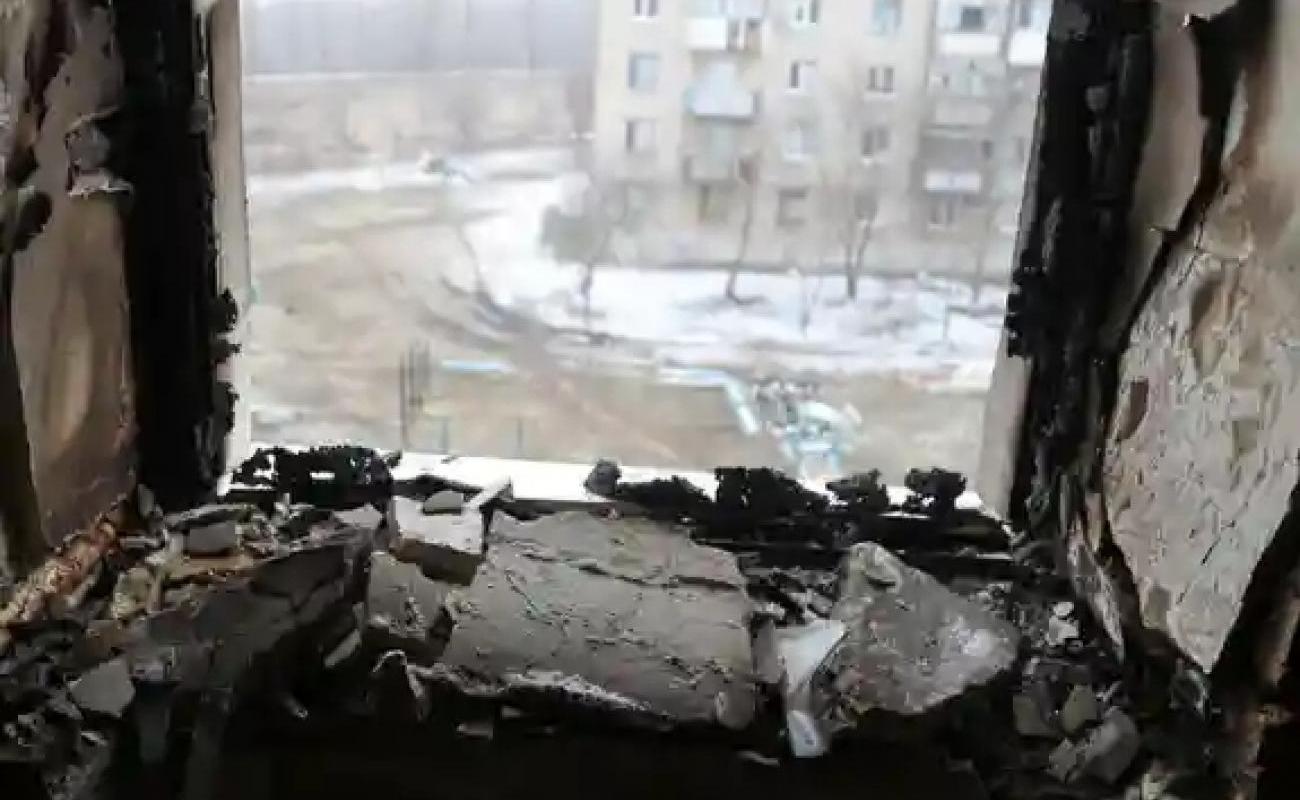
By July, the Russian occupation authorities are demanding that owners of housing units in the temporarily occupied territories of Ukraine re-register under the laws of the Russian Federation. How can Ukrainians protect their rights?
Russia is demanding that real estate in the temporarily occupied territories of Ukraine, registered under Ukrainian law, be re-registered under the Russian system by July 1, 2026. At the same time, "re-registration" can only be carried out in person at the location of the residential facility and with a Russian passport. A significant part of Ukrainians are actually unable to fulfill these requirements. Is there a way to protect their rights - DW found out.
The way home through "filtration"
"My soul hurts. I have been building all my life. My work, which was bombed, remained there. The land, and the houses, the things I love. Everything remained. There was hope that no one would touch the apartment. And now a new blow", - Ljudmila (name changed), resident of Zaporizhzhya Oblast, who moved to Kyiv in 2022 due to the occupation of the city, sadly states in an interview with DW.
Until the beginning of this year, the woman paid utility bills for her occupied apartment.
"The neighbor took care of the apartment, and then so did my ex-husband. Since the new year, I have decided not to pay the utility bills. I am waiting for my town to be de-occupied. I don't know if I did the right thing by paying the utility bills," Ljudmila thinks.
The woman does not plan to go home to "re-register" her apartment.
“First, I don’t want to see the occupiers, because I lived there and I know what those people are like. I don’t want to steal years of my life and be nervous. Second, I don’t know if they’ll let me in at all,” says Lyudmila. She recalled the case of her friend who wanted to go to Horlivka in the Donetsk region to re-register her apartment, but was not let in at Sheremetyevo Airport, without any explanation. “Maybe they found something pro-Ukrainian on her phone, because she’s been living in Kiev for a long time, her children are here,” Lyudmila believes.
However, not everyone is turned away, according to Mariupol resident Igor (name changed), who left for one of the European countries in 2022 due to the occupation of his hometown. “My friend, who went to re-register his apartment, was released. He took a month off from work and plans to return to Germany. But it’s a lottery. There is also filtering at Sheremetyevo Airport - they check your phone, social networks, everything. If you have never liked Ukrainians, they might let you go. I liked a lot, so I don’t even want to try to go, because they will put you somewhere,” says Igor.
Igor bought an apartment in Mariupol just before the large-scale war, but he never managed to live in it.
Russian Federation legalizes seizure of property from Ukrainians
Russian occupiers began seizing apartments from Ukrainians in the occupied territories of Ukraine after 2014, but this phenomenon began to become systematic a little later. In particular, in 2021, the occupation administration of the so-called “DNR” introduced the concept of “ownerless” property, which, according to the occupiers, can be sold or confiscated through a “court”.
There were no clearly defined criteria for “ownerlessness”, but only generalizations from Russian civil law and the legal interpretation of “removal from maintenance of property”. Therefore, until now, in order not to give grounds for recognizing housing as “ownerless”, many Ukrainians who left the occupied territories paid for utilities and asked acquaintances to periodically visit the apartment.
In 2024, the occupation administrations in the territories occupied by the Russian army in the Luhansk, Donetsk, Zaporizhia and Kherson regions clarified the criteria for "ownerless" property: non-payment of utility bills for more than a year, lack of ownership data in the Russian real estate registry, and non-use of residential premises, which "creates a threat to their security." In late 2025, Russia legalized this at the federal level, providing for the possibility of transferring such "ownerless" residential premises to Russian citizens.
It is currently difficult to calculate the exact amount of residential premises that the Russian occupation authorities can appropriate. In August 2025, the head of Rosregistr, Oleg Skufinsky, stated that there are about 550,000 "ownerless objects" in the occupied Ukrainian territories. Currently, in Mariupol alone, almost 13,000 residential premises are on the "ownerless" lists, which the occupation authorities publish on their websites.
Removal of residential premises from these lists is possible only by re-registration in the Russian real estate registry - Rosregister. It is worth noting that Russian legislation does not formally require Russian citizenship for this. However, according to a DW source with contacts in the Donetsk occupation administration, in practice re-registration is impossible without a Russian passport. At the same time, the Russian Federation has limited the time for recognizing Ukrainian documents for real estate - they are accepted only until July 1, 2026. At the same time, the procedure for issuing a power of attorney has become more complicated: while it was previously possible to issue a power of attorney for another person through Russian consulates abroad, now this is allowed only at the location of the property. In fact, this means the need to personally arrive in the occupied territory.
The risks of traveling to the occupied territories
Human rights activists spoke to DW to warn about traveling to the occupied territories.
"There are big risks. You can only enter with a Ukrainian passport through the border crossing at Sheremetyevo Airport, where Russian representatives carry out the so-called filtering. They may not like something - in the answers or on the phone. It is impossible to predict. At best, there will be a ban on entry, and at worst - detention with unknown consequences," warns Onisia Senyuk, head of the analytical department of the ZMINA Human Rights Center.
Those who are allowed to pass, the human rights activist adds, will have to get a Russian passport in order to re-register their accommodation.
"This also carries risks. For example, the obligation to serve in the Russian army," Senyuk notes.
At the same time, from the point of view of Ukrainian legislation, obtaining a Russian passport in order to preserve life, property, for one's own safety and the safety of one's relatives will not be considered collaboration, emphasizes Anatoly Kolesnikov, senior lawyer of the Vostok SOS charity fund.
"If the person's actions do not contain signs of crimes stipulated by the articles on treason and collaborationist activities. Also, according to the Constitution of Ukraine, a citizen of Ukraine cannot be deprived of citizenship or expelled from Ukraine. This is the norm of direct action," says Kolesnikov.
By requiring re-registration of property, Kolesnikov is convinced, the Russian Federation is trying to force a larger number of Ukrainian citizens to take out passports, identify those who are not loyal to the Russian regime and confiscate their property. Such actions, he emphasizes, contradict Ukrainian and international law.
"For example, the Hague Convention on the Laws and Customs of War on Land from 1907 prohibits the confiscation of private property and guarantees its inviolability. The Geneva Convention relative to the Protection of Civilian Persons in Time of War also prohibits the mass seizure of property not related to military necessity," the lawyer explains.
Ways to protect rights
Since it is currently physically impossible to restore housing rights due to occupation, DW's interlocutors say that only the legal plane remains. According to Kolesnikov, it is necessary to ensure that all documents confirming the right of ownership of real estate are available at that very moment.
"Specifically, real estate in the occupied territory must be entered into the State Register of Property Rights of Ukraine," says Kolesnikov.
At the same time, the lawyer emphasizes, it is necessary to record all actions related to your property. He advises to monitor messages on social networks, on the websites of the occupation administrations, or ask neighbors who still live in the temporarily occupied territories of Ukraine. If it turns out that the housing is recognized as "ownerless", then, according to Kolesnikov, it is worth writing a statement to the Ukrainian law enforcement agencies under Article 438 of the Criminal Code of Ukraine, which provides for liability for violation of the rules and customs of warfare.
Currently, Ukrainian courts, the lawyer adds, are making decisions on compensation for the damage caused by Russia to citizens and legal entities of Ukraine, but there are difficulties in implementing these decisions.
"There are no more Russian assets in Ukraine. And in order to enforce the decisions of our courts, the court of the country on whose territory the execution is planned will check compliance with procedural norms, especially in connection with prior notification of the defendant about the consideration of the case. But the Russian Federation refuses to receive court notifications," says Kolesnikov.
There is also a small chance of protecting rights in Russian courts, notes Senjuk.
"If there is a state policy, then the judicial system will not contradict it. Especially if a person has only Ukrainian citizenship," emphasizes Senjuk.
Given this situation, experts interviewed by DW advise owners of residential buildings on TOT to submit claims to the International Register of Losses for Ukraine.
"Moreover, this can be done now, since the Register provides a category of compensation for temporary loss of access to property. While Ukrainian courts can be turned to if the property has already been declared "without ownership", notes Senjuk.
However, it is not yet known when and what amount of compensation will be paid from the Register of Losses.
"There are no more Russian assets in Ukraine. And in order to enforce the decisions of our courts, the court of the country on whose territory the execution is planned will check compliance with procedural norms, especially in connection with prior notification of the defendant about the consideration of the case. But the Russian Federation refuses to receive court notifications," says Kolesnikov.
There is also a small chance of protecting rights in Russian courts, notes Senjuk.
"If there is a state policy, then the judicial system will not contradict it. Especially if a person has only Ukrainian citizenship," emphasizes Senjuk.
Given this situation, experts interviewed by DW advise owners of residential buildings on TOT to submit claims to the International Register of Losses for Ukraine.
"Moreover, this can be done now, since the Register provides a category of compensation for temporary loss of access to property. While Ukrainian courts can be turned to if the property has already been declared "without ownership", notes Senjuk.
However, it is not yet known when and what amount of compensation will be paid from the Register of Losses.