
China in BiH: Major deals, multi-million loans, and too little transparency
In recent years, Chinese companies have become an integral part of major infrastructure and energy projects in Bosnia and Herzegovina. They are building highways and tunnels, participating in the construction of power plants, and entering the renewable energy sector; now, they are also appearing in plans for investment in the healthcare sector.
Some of these projects are already generating electricity or transforming transport infrastructure. Others have stalled, some have been cancelled after multi-million investments, while the fate and completion timelines of others remain uncertain.
What they all have in common is that the substantial sums, loans, concessions, and contracts often mask complex financial structures that are difficult for citizens to track.
Hidden Contracts
Journalist Dino Cviko, who has spent years investigating Chinese influence in Bosnia and Herzegovina, believes that Chinese influence in the country is primarily built through the economy, major infrastructure and energy projects, loans, and the growing presence of Chinese companies.
This is particularly evident in Republika Srpska, he notes—although Chinese companies also operate in the Federation of BiH—with a large portion of these projects characterized by a lack of transparency and limited public access to the contracts and the terms under which they are implemented.
It is worth recalling that SNSD leader Milorad Dodik has repeatedly highlighted good relations with China; indeed, after Germany halted funding for certain projects in Republika Srpska in 2023, he openly discussed the possibility of Chinese companies taking over some of the work.
Chinese Companies Also Operating in the Federation
One reason the Chinese model has become attractive to local authorities is that Chinese companies do not always arrive merely as contractors; in some projects, they are backed by Chinese state-owned banks that provide loan financing.
In Sarajevo, Chinese companies secured the contract to reconstruct the tram line along one of the city's most important transport routes.
The contract was awarded to a consortium comprising the China Shandong International Economic and Technical Cooperation Group and the China Railway No. 10 Engineering Group. However, when Transparency International BiH requested the contract, its annexes, and the Chinese consortium's bid, the Sarajevo Canton Ministry of Transport rejected the request.
TI BiH subsequently initiated legal proceedings, and the Sarajevo Cantonal Court recently ruled that the right of access to information had been violated.
Back in 2022, Detektor published an investigation revealing that the Ministry of Transport had classified as confidential a contract worth over 40 million marks for the reconstruction of tram tracks in Sarajevo—a contract awarded to a Chinese company linked to a series of accidents in previous projects that resulted in worker injuries or fatalities.
This is not the only such case. In Republika Srpska, similar questions have followed the Banja highway project for years
Luka-Prijedor. The concession agreement with the Chinese company Shandong Hi-Speed International was signed back in 2018, and the details of the financial statement are unavailable to the public.
The value of the project was initially 297 million euros, but during 2025 the price was increased by 91 million euros.
When talking about the Chinese business model in Bosnia and Herzegovina, one of the key points is the lack of transparency. In energy, the differences between successful and unsuccessful Chinese projects are perhaps the most visible.
The Stanari thermal power plant is one example of a project that has been completed. China's Dongfang Electric was the contractor, while the financial structure included a loan from the China Development Bank. The power plant began commercial operation in 2016.
In Tuzla, however, the story ended completely differently. Block 7 of the Tuzla Thermal Power Plant has been presented for years as one of the key projects for the future of the power system of the Federation
Bosnia and Herzegovina. The contract was signed with a Chinese consortium, and the financing was to be provided by a loan from the Chinese Exim Bank with a guarantee from the Federation.
The problems were related to the state guarantee, European energy rules and financial structure. An additional problem was the withdrawal of General Electric from the project. In the end, the contract was terminated, and Block 7 was cancelled.
One of the largest Chinese energy projects in Bosnia and Herzegovina—the Dabar Hydropower Plant—is currently under construction in Herzegovina. The project is valued at over 220 million euros. The main contractor is the Chinese firm China Gezhouba Group Corporation, while 85 percent of the project is funded by a loan from the Export-Import Bank of China (Exim Bank), guaranteed by the Government of Republika Srpska. The remainder of the funding is provided by the domestic power sector. However, this project has not been without its challenges.
In May 2026, *Istina.media* reported that funding for the Dabar Hydropower Plant had been temporarily halted due to an assessment by China Exim Bank regarding Republika Srpska's ability to repay the loan. Yet, the Dabar project is far more than just a construction endeavor.
It is part of the "Upper Horizons" (*Gornji horizonti*) system, the implementation of which has long drawn warnings from environmental organizations due to potential consequences for the watercourses and sensitive ecosystems of Herzegovina, including the Hutovo Blato wetlands and the Neretva River area.
Istina.media has previously reported on the connection between the Chinese loan, the Chinese contractor, and the potential consequences of this energy megaproject.
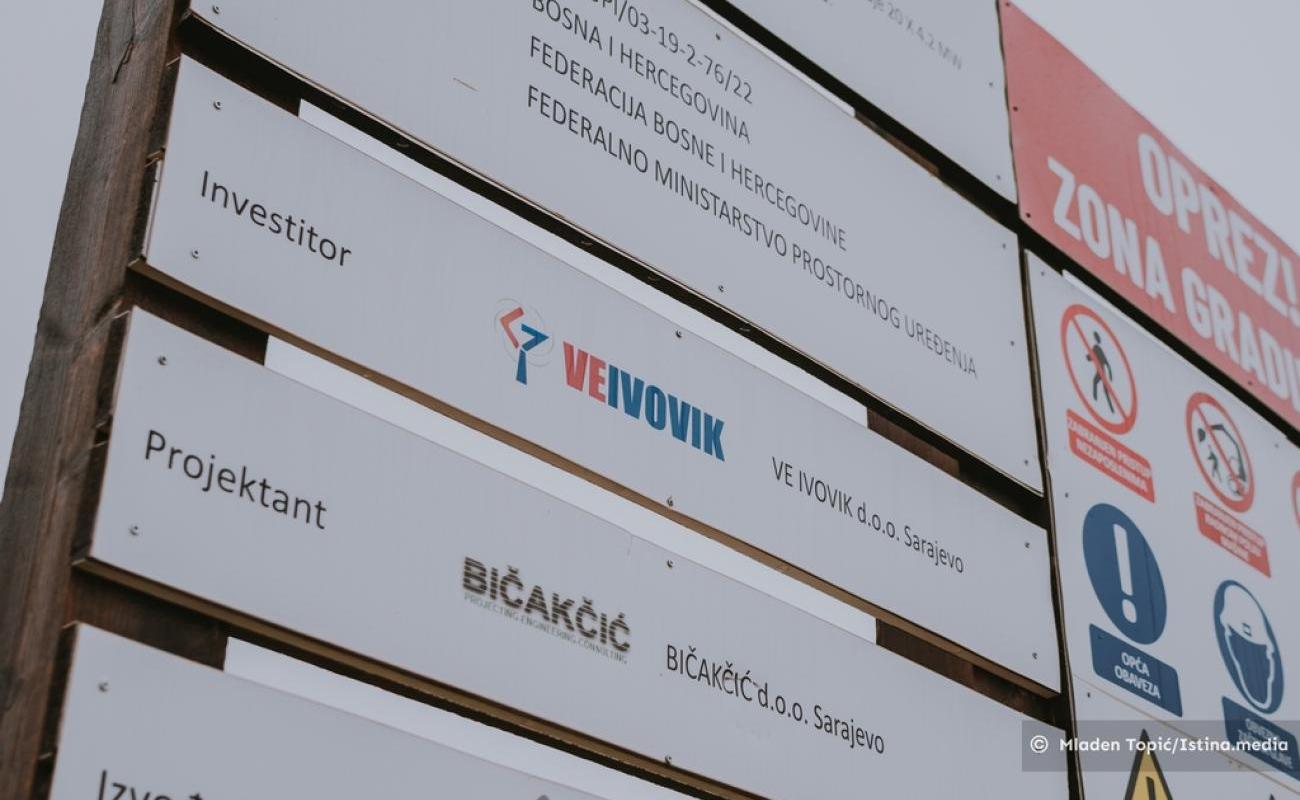
We have also previously raised concerns regarding the awarding of the concession for the construction of the Ivovik wind farm near Livno. Transparency International had previously warned that, although this project represents an important step toward utilizing renewable energy sources, it conceals a complex story involving legal uncertainty, conflicts of interest, preferential treatment of investors, and institutional abuses.
Istina.media has also previously highlighted a recurring pattern in which a domestic company initially secures the concession, only for the project to eventually end up in the hands of a foreign investor following changes in ownership.
Cooperation with Sinopharm
China’s presence in BiH extends beyond just roads and power plants. In April of this year, the Government of the Federation of BiH announced a partnership with the Chinese company China Sinopharm International Corporation, valued at approximately 100 million euros. The announcement included healthcare projects in Livno and Sarajevo.
Although it was initially announced that a memorandum of understanding would be signed on April 10, a statement issued following a meeting that day between representatives of the FBiH Government, Sinopharm, and the Chinese Embassy indicated that the signing was scheduled for a later date. To date, there has been no official announcement from the FBiH Government confirming that the memorandum has actually been signed.
There is also uncertainty regarding whether this constitutes an investment or yet another loan-based arrangement. Dino Cviko believes that, for this reason, China’s presence in BiH cannot be viewed solely through the lens of infrastructure construction and contract values.
"However, Chinese influence is not merely economic; in recent years, a political rapprochement has also become evident, particularly with the authorities of Republika Srpska. This is reflected in China's stances on certain key issues for BiH—such as the role of the High Representative or the Srebrenica resolution—where Beijing’s positions have often aligned with those of the authorities in Republika Srpska and Serbia," points out Cviko. He warns that China is simultaneously developing
so-called soft power through education, cultural cooperation, student exchanges, institutional ties, and donations.
"Therefore, Chinese influence in BiH should be viewed as a combination of economic, political, and social presence that is being built over the long term and could impact the country's foreign policy positioning," our interviewee concludes.
- Đeliliović/Istina.media