
ANALYSIS: Why Russia Violated Every Ceasefire for 12 Years, Even Those They Proposed
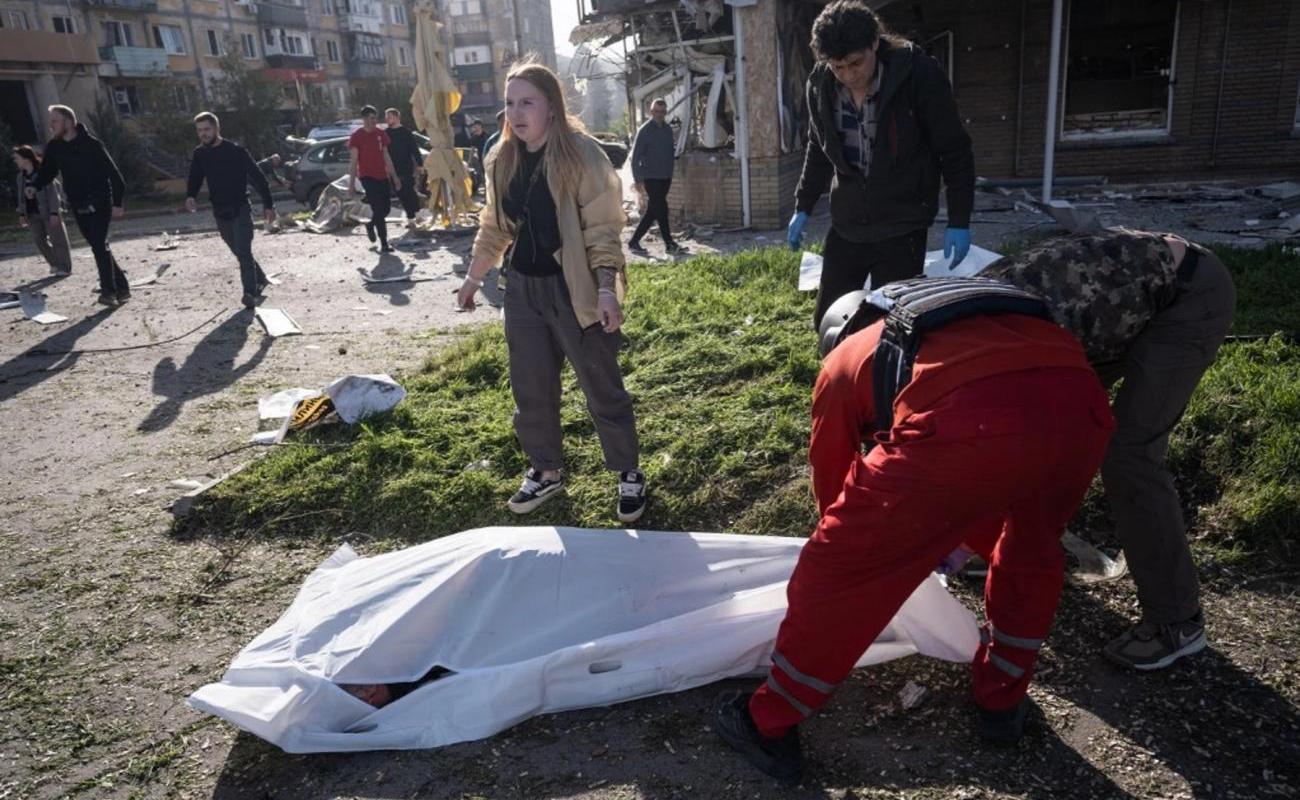
President Volodymyr Zelensky said Russia “has fought itself into a situation where now Ukraine decides whether the parade there will take place or not.”
The feverish preparations in Moscow for the May 9 “parade” – the redeployment of air defense systems from across the country to the capital, calls to US President Donald Trump asking him to pressure Ukraine not to strike Moscow on the day of the parade – demonstrate Moscow’s weakness.
“Every day Russia can make the choice and stop its war. And not for a few hours in order to receive our permission to hold a parade in Moscow, but in order to save people’s lives,” Zelensky remarked.
Russia itself, on the night of May 8, declared a “ceasefire regime” from May 8 to May 10, which it immediately violated. It would be more accurate to say that it never began – throughout the night Russia attacked Ukraine with guided aerial bombs, missiles, and drones that had been launched before the start of the ceasefire, meaning it is logical to assume that the ceasefire was never even planned and existed merely for the sake of announcing it.
Ukraine, throughout the night, carried out retaliatory strikes – 270 drones flew to targets on Russian territory, and an oil refinery in Yaroslavl was hit.
All of this occurred within the concept that Ukraine has adhered to since the summer of 2014 – carrying out strikes exclusively in response.
Thus, on May 5, Zelensky, in response to Russia’s proposal for a ceasefire from May 8–10 so that Putin could calmly hold a parade in Moscow (even in a reduced format), made a counter-proposal – Ukraine would cease hostilities starting on the night from May 5 to May 6. In the event of violations by Russia, Ukraine would respond symmetrically.
How this ceasefire ended was predictable – Russia attacked within the very first minutes after midnight. Several hours earlier, Russian forces had struck the center of the city of Kramatorsk in Donbas with aerial bombs, attacked Zaporizhzhia and Dnipro with missiles, and targeted the city of Merefa in the Kharkiv region with drones. In total, more than 20 Ukrainian civilians were killed that day.
This does not look much like a desire for peace. And this is not the first time.
Since 2014, when the Russian-Ukrainian war began with Russia’s attack on Crimea, there have been more than 20 ceasefires between Ukraine and Russia. ALL of them without exception were violated by Russia, and all ended in nothing.
History of Russo-Ukrainian ceasefires and how they started
The war between Ukraine and Russia has been ongoing since the end of February 2014. It was then that Russian troops invaded the territory of Ukrainian Crimea. The first shots were fired on March 18, 2014 – their victim was Ukrainian Armed Forces Warrant Officer Serhii Kokurin.
He died on March 18, 2014 during the assault on the Ukrainian Armed Forces (AFU) Main Directorate of Operational Support’s 13th Photogrammetric Center in Simferopol.
After that came the hybrid invasion of Donbas by Russian armed special-purpose units, which, after seizing warehouses and police departments in Ukrainian cities (Sloviansk, Kramatorsk, Luhansk), began distributing weapons to local criminal and pro-Russian elements.
On April 12, with the support of Russian military personnel and under the direction of Russian handlers, the so-called “Donetsk People’s Republic” was proclaimed on Ukrainian territory.
In response, Ukraine declared the Anti-Terrorist Operation regime on April 14.
The first shots on Donbas against the Russian occupiers had sounded a day earlier. The first battle was fought by the SBU Alpha special forces group, and the first shot at the Russian occupiers (including Igor Girkin’s detachment) was fired by Col. Vadym Sukharevskyi, who gave the order to open fire to kill, saving the group.
Very quickly Russia began sending unmarked, ghost soldier military personnel to Donbas under the guise of “local militias,” of which there is now extensive evidence. Heavy weaponry also arrived – tanks, GRAD systems, even Buk anti-aircraft missile systems, which a Russian crew used to shoot down Malaysian Airlines Flight MH17.
On August 24, 2014, an open “badged-up” invasion by the Russian Armed Forces directly onto Ukrainian territory began, no longer disguised as “locals” – the Pskov-Ryazan airborne division of the Russian Armed Forces invaded Donetsk region, helping the unmarked Russian units avoid encirclement in Donetsk. This prolonged the war for another 12 years.
Beginning as early as the summer of 2014, international partners pressured Ukraine and Russia to introduce ceasefires. However, the pressure was, of course, unequal, because it is always more difficult to pressure the aggressor than the victim.
Ukraine was forced to agree to ceasefire conditions, and Russia violated nearly all of them with virtually complete impunity vis-à-vis the international community.
Many analysts believe that Russia’s absolution in 2014 and the pressure on Ukraine demanding ceasefires were analogous to the “appeasement policy” toward Hitler in the 1930s and led Russia to dare launch a full-scale war in Europe in 2022.
Meaningless ceasefires – how many?
There were 17 in total, not counting situational local arrangements on specific sections of the front established by fighting units for exchanging bodies directly on the front line.
- June 20-30, 2014 – Introduced by Ukraine at the insistence of international, primarily Western, partners. It had no effect on the course of hostilities except that Russian forces brought up reserves and improved the operational position of their units, so fighting resumed with renewed intensity on June 30. Meanwhile, the ceasefire itself was not complete – small-arms fighting continued along the entire front line in Donbas.
- Sept. 5, 2014 – late September 2014 – the first “Minsk” ceasefire. Concluded after the first Minsk agreements. Violated by Russia, which sought to seize additional territories in Donbas.
- Dec. 9, 2014 – “Day of Silence.” Violated by Russia.
- Feb. 15, 2015 – the second “Minsk” ceasefire. Concluded after signing the full Minsk agreements package. Violated by Russia just days later, after Russia used several days of the ceasefire to reinforce troops and begin the assault on the city of Debaltseve, attempting to encircle Ukrainian forces. The AFU and volunteer battalions inflicted heavy losses on the Russians but were forced to withdraw from Debaltseve.
- Sept. 1, 2015 – “School” ceasefire. Violated by Russia the same day.
- Dec. 23-25, 2015 – “Christmas” ceasefire. Small-arms fighting continued on separate sections of the front, while Russian forces used the ceasefire to conduct logistical operations.
- Dec. 31, 2015 – New Year ceasefire. Not fully followed by Russia; firefights occurred in several areas. Lasted one day.
- April 30, 2016 – “Easter” ceasefire. Violated by Russia in several sectors.
- June 24, 2017 – August 2017 – “Harvest ceasefire” during the harvest season for agricultural companies – repeatedly violated by Russia despite a decrease in the intensity of fighting during the first days of the ceasefire.
- Aug. 25, 2017 – Sept. 1, 2017 – “School” ceasefire. Generally followed by Russia despite several firefights initiated from the Russian side, but used for transporting ammunition and regrouping troops.
- March 30, 2018 – “Easter” ceasefire. Generally followed by Russia.
- July 1, 2018 – August 2018 – “Harvest” ceasefire – despite a decrease in fighting intensity, it was violated by Russia. After its end, hostilities resumed with greater activity – Russia used the ceasefire to strengthen and regroup forces.
- Aug. 29 – Sept. 1, 2018 – “School” ceasefire. Violated by Russia in several sectors.
- Dec. 29, 2018 – “Christmas” ceasefire. Not fully followed.
- March 8, 2019 – “Spring” ceasefire. Lasted less than a full day; generally followed.
- July 21, 2019 – September 2019 – “Summer” ceasefire. Not fully followed by Russia and later broken by Russia.
- Aug. 21, 2020 – March 26, 2021 – the longest ceasefire, the “Silence Regime,” which Russia began violating within 30 minutes of its start. Shelling of Ukrainian positions occurred, though extremely rarely. From January 2021 onward, the ceasefire began to be violated regularly until it was finally broken on March 26, 2021, when Russia killed four Ukrainian servicemembers near the town of Shumy in Donbas.
After Feb. 24, 2022, all ceasefire ideas were sabotaged by Russia. Individual days that were considered “ceasefires” were in fact merely days of reduced intensity in hostilities, but overall combat operations did not stop.
As we can see, all ceasefires began with Russian troops remaining on occupied Ukrainian territory (before 2022 there was no discussion of military operations on internationally recognized Russian territory).
And all ceasefires were violated by Russia
Most international partners were satisfied even with such formats of “ceasefires,” in which Ukraine ceased fire (except for retaliatory strikes), while Russia merely reduced the intensity of hostilities.