
"An alarming situation." In Crimea, elections for the Russian State Duma are being overseen by the military and the FSB.
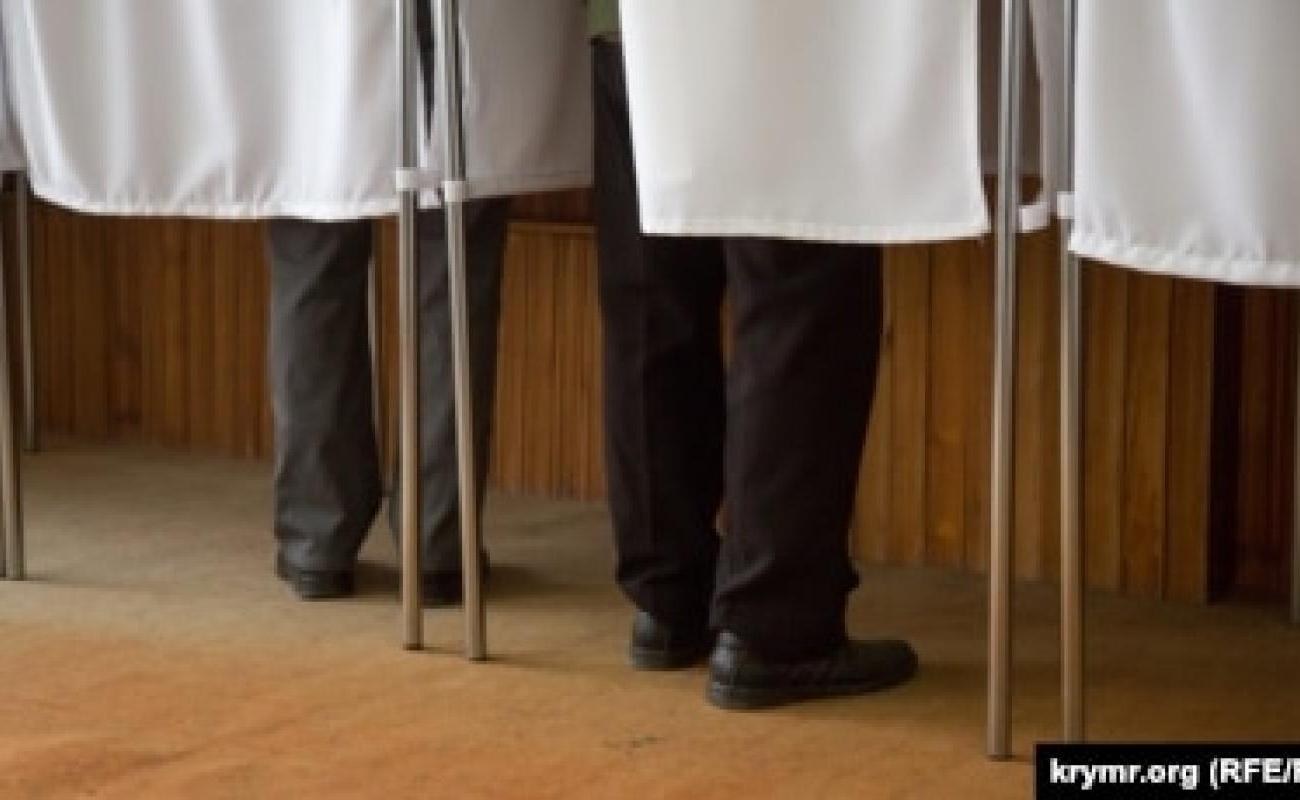
Russian authorities are preparing to hold voting in annexed Crimea for deputies to the State Duma of the Russian Federation—an election not recognized by Ukraine or the international community. This electoral process is being organized despite military threats and a fuel and energy crisis that has intensified in recent months, affecting the Crimean Peninsula due to strikes by Ukrainian defense forces. Residents of Crimea are being urged to go to the polls despite daily air raids. In this article, *Krym.Realii* discusses what the voting days will look like and why Ukrainian human rights activists recommend avoiding them.
Russia is holding State Duma elections in Crimea in defiance of the position held by Ukraine and its international partners. They do not recognize the legitimacy of voting on the Crimean Peninsula while it is under the control of the Russian Federation, viewing it as a violation of international law.
However, while previous Russian elections in Crimea primarily raised questions regarding legitimacy, the focus has now shifted to include security concerns amidst the escalating hostilities between the Russian Federation and Ukraine. This year, warnings for Crimean residents are coming from both the Ukrainian and Russian sides. Russian authorities, in particular, fear "provocations by the Kyiv regime."
Ukraine's Foreign Intelligence Service, for its part, states that Russian special services "may resort to provocations and violent scenarios during the elections, subsequently attempting to blame Ukraine for them." According to the department, polling stations, administrative buildings, and other public gathering places could pose a particular risk.
"Extreme" voting
The unified voting day for the election of deputies to the State Duma of the Russian Federation is scheduled for September 20. However, voting will be possible over a three-day period, starting on September 18. Russian elections have been announced in Crimea, despite regular strikes by Ukrainian defense forces on military and energy facilities, as well as Russian logistics, in the region.
Russian authorities reported that nearly three million ballots have been printed for Crimea for the Russian State Duma elections. They have already been handed over for distribution to the districts.
The Russian voter rolls included 1.46 million Crimean residents and 343,000 residents of Sevastopol. Electronic voting will not be available in the latter city due to internet and connectivity issues amidst the energy crisis.
Election commissions in Crimea have secured generators to ensure autonomous operation.
"Since the elections will be held under extreme circumstances," stated Ella Pamfilova, head of the Russian Central Election Commission. According to her, the commission—like other bodies and structures—is aware of the need to ensure "optimal security measures" while preparing for the elections.
The electoral process in annexed Crimea is also associated with potential threats. Speaking for the Russian Election Commission of Crimea, Inna Guzeeva specifically noted that the voting would take place with "full consideration of all alarming situations and the conditions in which we live."
"All 28 territorial election commissions in Crimea will be equipped with generators to support local government operations, as there is a risk of power supply issues. We have designated backup polling stations for use in the event of unforeseen external incidents; this ensures we can either establish and continue the electoral process or relocate voting to a backup site to guarantee safety," Guzeeva stated at a press conference in Simferopol.
Special units and security advisories
A special task force will be in place to monitor the situation in Crimea during the Russian elections, said Mikhail Malyshev, head of the Moscow-controlled Crimean Election Commission.
Public order in the region during the voting period will be maintained not only by the police but also by representatives of the Russian National Guard, the FSB, and the Ministry of Emergency Situations, according to the Crimean headquarters of the Russian Interior Ministry. Security forces will take control of Crimean polling stations in advance to provide round-the-clock security and have pledged to screen every voter.
"Security checkpoints staffed by police officers, private security personnel, and Russian National Guard units will be set up a short distance from the polling station entrances. Tables will be placed in front of these checkpoints where citizens can leave personal items—such as bags, packages, or other belongings—under supervision. Our preference is for people to arrive at the polling station with a minimal set of items: a passport, a pen, and glasses," Olha Jakubova, a representative of the Crimean branch of the Russian Interior Ministry, told local media.
According to her, security forces have been preparing for the elections since the summer, conducting joint inspections of all polling stations.
Crimea's Russian election committee claims to have developed a "protocol for emergencies—covering not only drone attacks but also other issues that could disrupt the electoral process."
"Not democracy, but a provocation"
Ukrainian human rights activists have called on residents of occupied territories, including annexed Crimea, to refrain from participating in the "elections" for the Russian State Duma. This call was issued in a joint appeal by a coalition of human rights organizations on September 8.
They urge residents not to serve on election commissions, not to agree to act as campaign canvassers or observers for any organization, and to avoid attending public events organized by local Russian authorities.
Representatives of the Regional Council of Ukrainians of Crimea have also called for a boycott of the State Duma election process in Crimea, describing the proceedings as "yet another farce with no connection to the will of the people, democracy, or the rule of law."
Crimean residents are advised to steer clear of polling stations and large gatherings on voting days, as these events could be "exploited for provocations, forced conscription, or the collection of personal data."
The Ukrainian partisan movement "Atesh" believes that Russian special services are "orchestrating provocations during the State Duma elections—planning to pin the blame on the Ukrainian side while disregarding potential civilian casualties." This is necessary in order to "shape public opinion for a subsequent mobilization" into the Russian army—a possibility that has been discussed for several months.
Russian authorities also do not rule out the possibility of provocations on election days, but are convinced that Ukraine is preparing them.